
Wheel Stop Installation
In Charleston, SC
Concrete and Rubber Parking Stops
1-800-STRIPER provides professional wheel stop installation in Charleston, SC — anchoring concrete, recycled-rubber, and plastic-composite wheel stops at stall heads, including the four-inch curb stops Charleston County’s Zoning and Land Development Regulations require in unpaved lots in unincorporated areas.
1-800-STRIPER® of Charleston PROVIDes Wheel Stops Services NEAR YOU
Need to protect vehicles or walls from accidental damage?
Wheel stops (also called parking blocks) protect your property, enhance safety, and improve parking lot organization.
Benefits:
Wheel stops prevent vehicles from parking too far into a space or overextending into other spots, pedestrian walkways, and other areas, while also helping with vehicle alignment. They can prevent damage to buildings, curbs, or landscaping. Wheel stops also serve as clear visual cues for proper parking and are sometimes used on slopes to prevent cars from rolling.
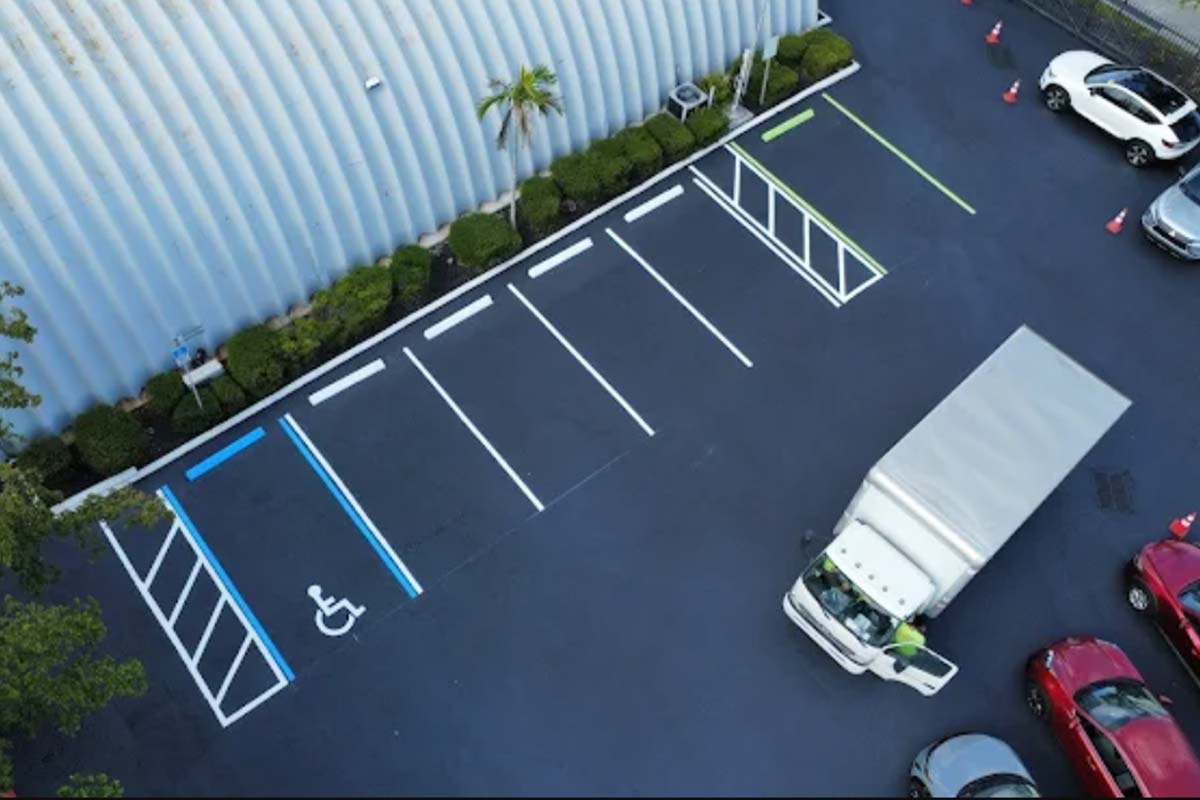
Wheel Stop Installation in Charleston, SC
On most lots a wheel stop is a choice. On some Charleston-area lots it’s a code requirement — and almost nobody in this market mentions that.
We install wheel stops across Charleston, Dorchester, and Berkeley counties: concrete, recycled-rubber, and plastic-composite units, anchored at stall heads on retail, office, medical, industrial, and multi-family properties. New installs, replacements for units that have broken up, and re-anchoring where stops have shifted.
Where Curb Stops Are Required by Code
In unincorporated Charleston County, wheel stops on unpaved parking areas are mandatory. ZLDR §9.3.7.D.4 covers unpaved parking areas, and subsection (a) states:
“All parking spaces must have a minimum four-inch Curb stop to delineate the location of each space and to prevent Encroachment onto adjoining properties, Rights-of-Way, or landscaped or pervious areas.”
Three things about that sentence, and the details matter because they’re widely misquoted:
It says “minimum four-inch” — it does not say height. The code gives a four-inch minimum dimension without stating which dimension it governs. We’re not going to tell you it means height, because the text doesn’t say that, and a specification you make up is worse than one you look up. If the exact dimension matters for your approval, that’s a question for the county’s Zoning and Planning department.
It’s a delineation rule, not a bumper rule. The stated purposes are “to delineate the location of each space” and “to prevent Encroachment onto adjoining properties, Rights-of-Way, or landscaped or pervious areas.” The curb stop is doing the job a painted line does on asphalt — it is the marking. That’s why it’s mandatory there and not elsewhere.
It applies to unpaved parking areas in unincorporated Charleston County. Both halves of that qualifier are load-bearing. The ZLDR binds “development… within the unincorporated areas of Charleston County” (§1.4.1), and §9.3.7.D.4 is headed Unpaved Parking Areas. Inside the City of Charleston, North Charleston, Mount Pleasant, Summerville, or Goose Creek, this rule does not reach you — and the City of Charleston’s zoning code contains no wheel stop requirement at all (we read Article 3 end to end; the phrases wheel stop and curb stop appear zero times).
Why do so many county lots end up unpaved in the first place? Because the same code pushes them that way. ZLDR §9.3.7.D.2.a–b caps impervious cover at “no more than 70 percent of all developable land within Parcels” and requires “30 percent of parking spaces” to have a pervious surface. A lot designed to hit that pervious quota is a lot with spaces that can’t be painted — and §9.3.7.D.4.a then requires a curb stop on each of them. The pervious rule and the curb stop rule are two halves of the same design.
Concrete vs Recycled-Rubber vs Plastic-Composite
There’s no universally correct material. There’s a correct material for your lot.
Concrete. The traditional choice and still the heaviest. It stays where it’s put largely by mass, handles vehicle contact without deforming, and looks like what people expect. Its failure mode is cracking — concrete stops chip at the ends and eventually break up, especially where they take repeated contact, and a broken concrete stop is a trip hazard and a liability rather than a worn item. They’re also heavy to handle, which matters if you’re doing a whole lot.
Recycled rubber. Much lighter, and it doesn’t crack — it flexes on contact and returns. That makes it a strong choice where stops take regular knocks, and it removes the “shattered stop” failure entirely. Because it’s light, anchoring does all the work of holding it; a poorly anchored rubber stop moves. It also has an environmental story worth having if that matters to your organization.
Plastic composite. Light like rubber, doesn’t rot, doesn’t rust, doesn’t crack, and takes color well — which is genuinely useful when a stop needs to be seen rather than just felt. Like rubber, it lives or dies on the anchoring.
The Charleston-specific factor is the environment. This is a coastal market: 52.51 inches of rain a year at Charleston International Airport, salt air near the water, and 64.3 days a year above 90 °F. Steel rebar pins in concrete stops near the coast are exactly the kind of detail that looks fine at installation and less fine a few years on. We’ll talk through the anchoring hardware as well as the stop itself, because on a Lowcountry lot the hardware is often what fails first.
Anchoring and Placement
A wheel stop that moves is worse than no wheel stop — it’s a hazard that also isn’t doing its job.
Anchoring depends on the surface. On asphalt, pins driven through the stop into the substrate. On concrete, anchors set into drilled holes. On unpaved surfaces — the county’s mandatory case — anchoring is the whole problem, because there’s no rigid substrate to hold a pin. Longer pins and correct depth do the work, and this is precisely where a rushed install shows up within a season.
Placement is geometry. Set the stop by the overhang you’re protecting against, not by the end of the stall, and remember what a stop is actually for: it prevents the vehicle going somewhere, but the bumper still overhangs it. That distinction decides everything downstream — how much walkway you keep, whether a landscape bed survives, and whether an accessible route stays legal.
Common placement errors we’re called out to fix: stops set so far forward that bumpers overhang a walkway; stops set at the wrong offset so cars park short and lose the aisle; and stops installed individually by eye rather than to a line, which looks exactly as bad as it sounds across a whole lot.
Wheel Stops and the ADA Accessible Route
This is the one place where a wheel stop stops being an amenity and starts being a compliance tool.
ADA §502.7 requires that “parking spaces and access aisles shall be designed so that cars and vans, when parked, cannot obstruct the required clear width of adjacent accessible routes.” And an accessible route needs 36 inches of clear width minimum (§403.5.1).
Now picture the failure. An accessible space sits at the head of a walkway. The car parks correctly. Its bumper overhangs the curb by eighteen inches. The walkway was 48 inches wide, so it’s now 30 inches — and your accessible route is non-compliant every time a car parks in the space that’s meant to serve it.
The 2010 Standards address this directly in the advisory to §502.7:
“Wheel stops are an effective way to prevent vehicle overhangs from reducing the clear width of accessible routes.”
Read that precisely, because we’re not going to overstate it: that’s an advisory, which means wheel stops are not mandated by the ADA. What is mandated is the outcome in §502.7 — parked vehicles must not obstruct the route’s clear width. A wheel stop is the standard’s own suggested way of achieving it, and usually the cheapest. But you could equally achieve it with a deeper walkway or different geometry. Anyone telling you “the ADA requires wheel stops” is overreading an advisory.
Where this bites in practice is on retrofits. A lot laid out before anyone thought about overhang often has accessible spaces butting straight onto a walkway of exactly the width someone measured on paper. The fix is usually a correctly-placed stop, and it’s a small job that resolves a real exposure.
For a full list of our pavement marking services, visit our parking lot striping in Charleston page.
Businesses We Serve




How it Works

GET A FREE ESTIMATE
Contact us today and we’ll have a quote to you in 24 hours

SCHEDULE AN INSTALLATION
We’ll have your installation scheduled restriped in less than 7 days, without affecting your business hours

GET A PARKING LOT THAT POPS
For a budget-friendly price, you’ll get a parking lot that looks like new
We proudly work with:


We proudly work with:


Frequently Asked Questions About Wheel Stop Installation in Charleston, SC
Are wheel stops required in Charleston?
Sometimes — it depends on the surface and the jurisdiction. In unincorporated Charleston County, ZLDR §9.3.7.D.4.a requires that on unpaved parking areas “all parking spaces must have a minimum four-inch Curb stop to delineate the location of each space and to prevent Encroachment onto adjoining properties, Rights-of-Way, or landscaped or pervious areas.” That’s a mandate, not a suggestion. Inside the City of Charleston, there’s no wheel stop requirement in the zoning code at all. And on paved county lots the requirement doesn’t apply either — §9.3.7.D.4 governs unpaved parking areas.
Does the four-inch rule mean four inches high?
The code doesn’t say. ZLDR §9.3.7.D.4.a says “a minimum four-inch Curb stop” without stating which dimension the four inches governs — and we’re not going to guess on your behalf. If the precise dimension matters for an approval, ask Charleston County’s Zoning and Planning department. What the section does make clear is the purpose: delineating each space and preventing encroachment onto adjoining property, rights-of-way, or landscaped and pervious areas.
Does the ADA require wheel stops?
No — and this is commonly overstated. ADA §502.7 requires that parked cars and vans “cannot obstruct the required clear width of adjacent accessible routes” (an accessible route needs 36 inches clear minimum under §403.5.1). The standard’s advisory to §502.7 notes that “wheel stops are an effective way to prevent vehicle overhangs from reducing the clear width of accessible routes” — that’s guidance, not a requirement. The outcome is mandatory; the wheel stop is one good way to get there.
Concrete or rubber — which should I use?
It depends on your lot. Concrete is heavy and holds by mass, but chips and eventually breaks up, especially where stops take repeated contact. Recycled rubber and plastic composite are light and won’t crack, but rely entirely on anchoring to stay put. In a coastal market like Charleston, the anchoring hardware often outweighs the stop material as a decision — salt air is hard on steel pins, and that’s usually what fails first.
Is wheel stop installation possible on a gravel lot?
Yes, and in unincorporated Charleston County that’s exactly where the code requires them. It’s also the hardest anchoring case, because there’s no rigid substrate for a pin to grip. It comes down to pin length and correct depth. This is the install where cutting corners shows up within a season, so it’s worth doing properly first time.
Can you replace broken wheel stops without redoing the whole lot?
Yes — replacing individual failed units is routine work. Broken concrete stops are worth treating as urgent rather than cosmetic: a cracked stop with exposed rebar is a trip hazard in a place where people walk between parked cars. If a lot of your stops are going at once, it’s usually a sign the original anchoring or material choice was wrong for the lot, and worth reviewing before replacing like for like.