ADA Parking Lot Striping
In Charleston, SC
ADA-Compliant Accessible Parking
1-800-STRIPER provides professional ADA parking lot striping in Charleston, SC — installing accessible spaces, van-accessible stalls, access aisles, and ISA symbols per the 2010 ADA Standards for Accessible Design and the ANSI A117.1 accessibility standards South Carolina adopts under Code Section 10-5-250.
1-800-STRIPER® of Charleston PROVIDes ADA Compliance Services NEAR YOU
Need to make your property more accessible?
Upgrade your facility to become fully ADA compliant by partnering with us to create clear, accessible parking for all your visitors.
Our ADA Compliant line striping services include:
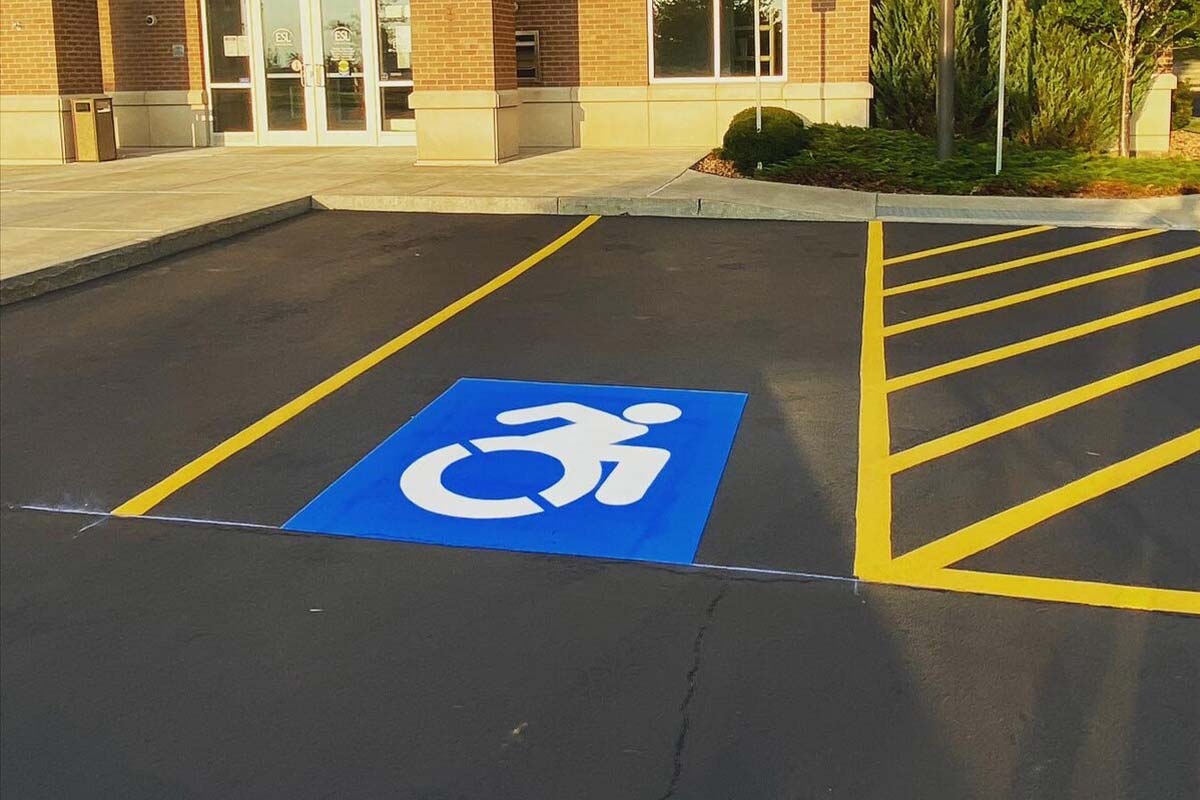
ADA Parking Lot Striping in Charleston, SC
Accessible parking is the most prescriptive part of any commercial lot, and — usefully — the least ambiguous. Every jurisdiction in this market points at the same federal standard, so for once you don’t have to work out whose rule wins.
We install and restore accessible parking across Charleston, Dorchester, and Berkeley counties: accessible and van-accessible stalls, access aisles, ISA symbols, signage, and the accessible routes that connect spaces to entrances.
Here’s the part worth knowing before anyone quotes you: all three layers of local law defer to the federal ADA.
- City of Charleston, Zoning §54-318.a.2: “Handicapped Parking Space Size and quantity shall be determined by Building Code and Federal regulations.” The same sentence repeats at §54-318.b.4 for parking garages.
- Charleston County (unincorporated areas), ZLDR §9.3.6.B: accessible spaces “shall comply with the regulations under the… (ADA).” Its §9.3.7.D.1 adds that “ADA reserved parking signs and ADA parking markings shall be in compliance with the Americans with Disabilities Act.”
- South Carolina adds a statewide accessibility layer — see below — but the counts and dimensions still come from the federal standard.
So the answer to “whose accessible parking rules apply to my Charleston lot?” is: the federal 2010 ADA Standards for Accessible Design, everywhere, in every jurisdiction here. The local codes say so themselves.
How Many Accessible Spaces the Standard Sets
The count comes from ADA Table 208.2, which is keyed to the total number of spaces in the parking facility:
| Total spaces in the facility | Minimum accessible spaces |
|---|---|
| 1 to 25 | 1 |
| 26 to 50 | 2 |
| 51 to 75 | 3 |
| 76 to 100 | 4 |
| 101 to 150 | 5 |
Table 208.2 continues past this point for larger facilities — 151 to 200 needs 6, and it keeps climbing to a percentage basis above 500 spaces. The rows above cover the lots we see most in this market.
Then the van rule applies on top. ADA §208.2.4: “For every six or fraction of six parking spaces required by 208.2 to comply with 502, at least one shall be a van parking space.”
Work that through for a small lot. A 20-space lot needs 1 accessible space under Table 208.2. One is a “fraction of six.” So that single space must be van-accessible. A modest strip-mall lot with twenty stalls doesn’t get to install a standard accessible space — its only accessible space has to be the van one.
One more rule catches multi-lot sites: §208.2 states that “where more than one parking facility is provided on a site, the number of accessible spaces provided on the site shall be calculated according to the number of spaces required for each parking facility.” You count per facility, not by totalling the site. A campus with three separate lots does the math three times.
Compact spaces can’t help you here either. In unincorporated Charleston County, ZLDR §9.3.7.C.5 is explicit: “Compact spaces cannot be used as required ADA parking spaces.”
Access Aisles, ISA Symbols, and Signage
Section 502 of the 2010 Standards covers what actually gets marked:
- Space width (§502.2) — car spaces “96 inches wide minimum”, van spaces “132 inches wide minimum”, and both “shall be marked to define the width.” There’s an exception: a van space may be 96 inches wide “where the access aisle is 96 inches wide minimum.” That’s the trade-off between a wide space and a wide aisle, and it’s a real design choice on a tight lot.
- Access aisle width (§502.3.1) — “60 inches wide minimum”, for car and van spaces alike.
- Access aisle length (§502.3.2) — “shall extend the full length of the parking spaces they serve.” Not most of the length.
- Access aisle marking (§502.3.3) — “shall be marked so as to discourage parking in them.” Note what the standard then says in its own advisory: “The method and color of marking are not specified by these requirements but may be addressed by State or local laws or regulations.” Hatching is convention, not a federal dimension — and in South Carolina, no state or local rule fills that gap for private lots. What the standard does insist on is the outcome: the aisle must read as somewhere you don’t park.
- Shared aisles (§502.3) — “Two parking spaces shall be permitted to share a common access aisle.” Angled spaces are the exception, and DOJ spells it out: two spaces may share an aisle “except for angled parking spaces”, and “access aisles may be located on either side of the parking space except for angled van parking spaces which must have access aisles located on the passenger side.”
- Signage (§502.6) — signs “shall include the International Symbol of Accessibility”; van space signs “shall contain the designation ‘van accessible'”; and signs “shall be 60 inches minimum above the finish floor or ground surface measured to the bottom of the sign.” That 60-inch dimension is measured to the bottom of the sign, and it’s the detail we most often find wrong on existing lots.
- Surface (§502.4) — spaces and aisles must be at the same level, “changes in level are not permitted,” with slopes no steeper than 1:48 permitted.
- Route protection (§502.7) — spaces and aisles “shall be designed so that cars and vans, when parked, cannot obstruct the required clear width of adjacent accessible routes.” An accessible route needs 36 inches of clear width minimum (§403.5.1). Where an overhanging bumper would eat into that, the standard’s own advisory notes that “wheel stops are an effective way to prevent vehicle overhangs from reducing the clear width of accessible routes.”
One local rule does add something the ADA doesn’t. Inside the City of Charleston, §54-318.d requires that “all handicapped parking spaces, and the paths connecting spaces to buildings, shall be hard-surfaced regardless of the land use” — even on lots the city otherwise permits to be gravel or grasscrete.
South Carolina’s Own Layer: ANSI A117.1 via Section 10-5-250
South Carolina adds its own accessibility layer, and — unlike the county’s ZLDR — it works inside city limits.
South Carolina Code Section 10-5-250(A):
“The requirements for accessibility for people with disabilities contained within the building code and ANSI A117.1, with such modifications as the board considers appropriate, are adopted as minimum standards for compliance with this chapter.”
The natural objection is that Title 10 is called “Public Buildings and Property” — so surely this is a government-buildings rule? It isn’t, and the chapter says so. Section 10-5-220(2) defines “public buildings” to mean facilities used by the public that are “constructed, purchased, leased, or rented by the use of private funds”, excluding only “a private residence.” Section 10-5-260 then applies the chapter to construction or alteration “of any occupancy classification, with exception of detached one and two family dwellings.” A privately-owned commercial property in South Carolina is squarely inside it.
And then Section 10-5-260 does something the ADA doesn’t do as plainly:
“It is the responsibility of the owner or the occupant of property which contains structural or building elements or components required to be in compliance with this article, to continuously maintain these elements and components in a condition that is safe and usable by persons with disabilities at all times.”
That is a continuous maintenance duty, in state statute, on the owner or occupant — and it doesn’t stop at the city line the way the county’s ZLDR does.
The same section’s closing paragraph carves out an entire class of property, and it belongs right here next to the duty:
“Nothing in this chapter affects in any way government buildings, public buildings, or facilities exempted by any federal law, including the Americans with Disabilities Act of 1990, as amended.”
Read the qualifier, though, because it does real work: the duty runs to elements “required to be in compliance with this article.” The chapter attaches that requirement when a building is constructed, altered, or changed in occupancy (§10-5-260’s own first three sentences). So this is not a freestanding rule that every faded symbol in the state must be repainted — it’s a maintenance duty on accessibility elements that were required to comply in the first place. For a commercial lot built or altered under the chapter, a faded ISA symbol or a worn access aisle is more than an aesthetic problem. But the duty comes with that predicate attached, and we’d rather you hear it from us than from your attorney.
We’ll be precise about the limits, because precision is the point of this section: Chapter 5 never uses the word “parking.” Not once. It reaches your lot through its definition of “facilities” — “all building elements defined or specified by ANSI A117.1” (§10-5-220(3)). So the space counts and the dimensions still come from the federal 2010 ADA Standards, as your city and county codes both say. What South Carolina adds is the adopted ANSI standard as a minimum and the duty to keep it maintained.
For a full list of our pavement marking services, visit our parking lot striping in Charleston page.
Businesses We Serve




How it Works

GET A FREE ESTIMATE
Contact us today and we’ll have a quote to you in 24 hours

SCHEDULE AN INSTALLATION
We’ll have your installation scheduled in less than 7 days, without affecting your business hours

GET A PARKING LOT THAT POPS
For a budget-friendly price, you’ll get a parking lot that looks like new!
We proudly work with:


We proudly work with:


Frequently Asked Questions About ADA Parking Lot Striping in Charleston, SC
How many accessible spaces does ADA parking lot striping require on my Charleston lot?
It’s set by federal ADA Table 208.2, based on the total spaces in the parking facility: 1–25 spaces needs 1 accessible space; 26–50 needs 2; 51–75 needs 3; 76–100 needs 4; 101–150 needs 5. Both your local codes point at the same federal standard — City of Charleston §54-318.a.2 says accessible space “size and quantity shall be determined by Building Code and Federal regulations,” and Charleston County’s ZLDR §9.3.6.B defers to the ADA. If your site has more than one parking facility, count each one separately.
Does a small lot really need a van-accessible space?
Yes. ADA §208.2.4 requires that “for every six or fraction of six parking spaces required by 208.2… at least one shall be a van parking space.” A 20-space lot needs one accessible space, one is a fraction of six, so that space must be van-accessible. Your only accessible space is the van space. This is a federal rule, not a Charleston quirk.
How wide does an access aisle have to be?
60 inches minimum, for both car and van spaces (ADA §502.3.1). It must extend the full length of the spaces it serves (§502.3.2) and be marked so as to discourage parking in it (§502.3.3). Two spaces may share one aisle. If you’d rather run a 96-inch van space than a 132-inch one, §502.2 permits it — but only where the access aisle is 96 inches wide minimum.
What color do access aisle markings have to be?
The federal standard doesn’t say — one of the few places the ADA leaves the method open. The advisory to §502.3.3 states that “the method and color of marking are not specified by these requirements but may be addressed by State or local laws or regulations” — and in South Carolina no state or local rule fills that gap for a private lot. What §502.3.3 requires is the result: the aisle must be “marked so as to discourage parking.” Diagonal hatching is convention because it reads unambiguously, not because a regulation specifies it.
How high does the accessible parking sign have to be?
60 inches minimum from the ground to the bottom of the sign (ADA §502.6). It must include the International Symbol of Accessibility, and if it marks a van space it must carry the “van accessible” designation. The measurement being to the bottom of the sign rather than to its center or top is the detail we most often find wrong on existing lots.
Do South Carolina’s own rules add anything to the federal ADA?
Yes, and it reaches places the county code can’t. S.C. Code §10-5-250(A) adopts “the building code and ANSI A117.1… as minimum standards” for accessibility, and §10-5-260 applies that to construction or alteration of buildings “of any occupancy classification” except detached one- and two-family dwellings — private commercial property included, per the chapter’s own definition at §10-5-220(2). §10-5-260 also imposes a duty to “continuously maintain” those elements “in a condition that is safe and usable by persons with disabilities at all times.” Read that duty with its own qualifier: it runs to elements “required to be in compliance with this article” — meaning accessibility elements that the chapter reached when the property was built, altered, or changed in occupancy, rather than every marking on every lot in the state. Where it does apply, it applies inside city limits, which is the part Charleston County’s ZLDR can’t do.
Can I count compact spaces toward my ADA requirement?
No. In unincorporated Charleston County, ZLDR §9.3.7.C.5 states directly that “compact spaces cannot be used as required ADA parking spaces” (and §9.3.7.C.6 says the same for required electric charging stations). Your accessible spaces have to meet ADA §502’s dimensions regardless of how the rest of the lot is laid out.