Parking Lot Restriping
In Charleston, SC
Restripe Existing Lines and Markings
1-800-STRIPER provides professional parking lot restriping in Charleston, SC — restoring faded stalls, ADA spaces, fire lanes, and directional arrows to the four-inch minimum marking width Charleston County’s Zoning and Land Development Regulations require to stay visible at all times in unincorporated areas.
1-800-STRIPER of Charleston PROVIDes Restriping Services NEAR YOU
Need to brighten up your faded parking lot?
Keep your parking lot safe and attractive by restriping annually to freshen up lines and symbols that have faded from the sun, weather, and traffic. Nothing beats a fresh coat of paint!
Benefits:
Parking Lot Restriping in Charleston, SC
Restriping is maintenance with a compliance deadline attached. Faded markings aren’t just untidy — on a commercial lot in this market, two separate rules turn worn paint into a condition you’re obliged to fix.
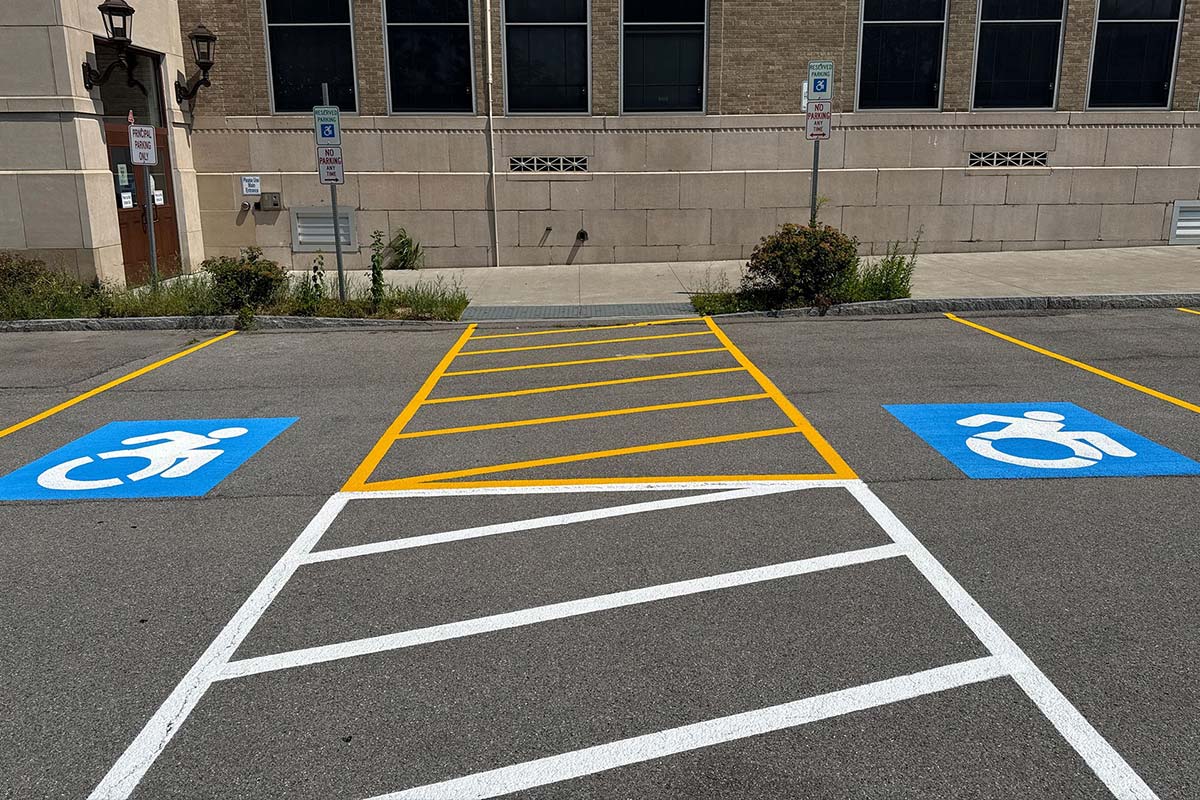
We restripe commercial lots across Charleston, Dorchester, and Berkeley counties: retail centers, office parks, medical and industrial properties, apartment communities, and churches. The work covers stalls, accessible spaces and access aisles, fire lane markings, directional arrows, crosswalks, stop bars, and curb painting — usually in one visit, scheduled around your business hours.
When Faded Markings Become a Code Problem
Two written rules cover a Charleston-area lot, and which one bites depends on where you sit.
Statewide — and this one reaches inside the city. South Carolina Code Section 10-5-260 puts a standing duty on the property owner or occupant:
“It is the responsibility of the owner or the occupant of property which contains structural or building elements or components required to be in compliance with this article, to continuously maintain these elements and components in a condition that is safe and usable by persons with disabilities at all times.”
Read the section’s next paragraph too, because it carves out an entire class of property:
“Nothing in this chapter affects in any way government buildings, public buildings, or facilities exempted by any federal law, including the Americans with Disabilities Act of 1990, as amended.”
That’s a maintenance obligation in statute, not a design rule that ends at handover. South Carolina Code Section 10-5-250(A) adopts “the building code and ANSI A117.1… as minimum standards” for accessibility, and the chapter’s own definitions put privately-funded commercial property inside its reach — Section 10-5-220(2) defines “public buildings” to include facilities used by the public that are built “by the use of private funds.”
Read the statute’s own qualifier before you take that as universal, because it’s doing work: the duty runs to elements “required to be in compliance with this article.” The chapter attaches that requirement when a property is constructed, altered, or changed in occupancy — those are §10-5-260’s own first three sentences. So this isn’t a rule that every faded symbol in South Carolina must be repainted on pain of statute. It’s a continuing duty on accessibility elements the chapter reached in the first place. For commercial lots built or altered under it, a worn access aisle or a faded ISA symbol is more than cosmetic. That’s the accurate version, and it’s the one we’d rather you heard from us.
In unincorporated Charleston County, the ZLDR adds a second, blunter line. Section 9.3.7.D.2:
“Each parking space must be identified by surface markings at least four inches in width, which must be visible at all times.”
Read the clause at the end. “Visible at all times” is the restriping mandate, written into the code. A stall whose paint has gone is not a stall that’s merely looking tired — it has stopped meeting the requirement. Note the qualifier, though: that sentence binds development in the unincorporated areas of Charleston County (ZLDR §1.4.1). Inside the City of Charleston, the city’s zoning code sets no stripe width at all — but the Section 10-5-260 duty still reaches your accessible spaces, on the terms set out above.
The Four-Inch Minimum — and Where It Applies
The four-inch figure comes from ZLDR §9.3.7.D.2 and it is a minimum, not a target: “at least four inches in width.” The same section requires markings to be “arranged to provide for orderly and safe loading, unloading, parking, maneuvering, queuing, and storage of vehicles” — so layout and legibility count, not just line width.
Where does it apply? Unincorporated Charleston County only. This matters more here than in most markets, because the county’s population is concentrated in municipalities — Charleston, North Charleston, Mount Pleasant, Summerville, Goose Creek — where the ZLDR does not reach. Anyone telling you flatly that “four-inch stripes are required in Charleston” is overstating it. We work out which jurisdiction your lot sits in and stripe to the rule that actually governs it.
Federal ADA rules don’t care about the jurisdiction question at all. Under the 2010 ADA Standards, car spaces are 96 inches wide minimum and van spaces 132 inches minimum, and both “shall be marked to define the width” (§502.2). Access aisles are 60 inches wide minimum (§502.3.1), must “extend the full length of the parking spaces they serve” (§502.3.2), and “shall be marked so as to discourage parking in them” (§502.3.3). Those dimensions don’t vary by jurisdiction anywhere in the Lowcountry — the federal standard is the federal standard in the county and inside every city here.
Whether those federal specifications attach to your particular lot — and what you owe if they do — turns on your property’s history and on the scope of the work, and it’s a question for your attorney rather than your striping contractor. What we can tell you is what the standard says, and we’ll walk your lot and quote it with you.
Why the MUTCD Doesn’t Govern Your Parking Lot
Here’s the thing almost every striping company in this market gets wrong, and it’s worth knowing before you buy.
The Manual on Uniform Traffic Control Devices is the standard everyone name-drops. It is a real federal standard — and by its own applicability rule, it does not cover your parking lot. The regulation that sets the MUTCD’s scope is 23 CFR 655.603(a). It says the MUTCD applies to devices on any road “open to public travel,” then defines that term, and the definition ends like this:
“For the purpose of MUTCD applicability, open to public travel includes toll roads and roads within shopping centers, airports, sports arenas, and other similar business and/or recreation facilities that are privately owned but where the public is allowed to travel without access restrictions… Parking areas, driving aisles within parking areas, and private highway-rail grade crossings are also not included in this definition.”
Read it twice, because it’s counter-intuitive. The road through a shopping center is covered. The parking area and the driving aisles inside it are expressly carved out. So when a contractor tells you your stalls must be striped “to MUTCD,” they’re citing a standard that federal regulation has excluded from the exact surface they’re standing on.
This isn’t pedantry — it changes who is actually in charge. On a private commercial lot, the binding rules are the federal ADA standards, the statewide accessibility duty in Section 10-5-260, your local zoning code, and the fire code official for fire lanes. The MUTCD is a useful reference for the shape of a marking — an arrow that looks like an arrow — but it is not the authority for your lot, and no one is going to cite you under it.
For a full list of our pavement marking services, visit our parking lot striping in Charleston page.
Businesses We Serve




How it Works

GET A FREE ESTIMATE
Contact us today and we’ll have a quote to you in 24 hours

SCHEDULE AN INSTALLATION
We’ll have your installation scheduled in less than 7 days, without affecting your business hours

GET A PARKING LOT THAT POPS
For a budget-friendly price, you’ll get a parking lot that looks like new
We proudly work with:


We proudly work with:


Frequently Asked Questions About Parking Lot Restriping in Charleston, SC
How often should I schedule parking lot restriping?
There’s no fixed interval in any code, and any contractor quoting you one is guessing. What the rules actually say is condition-based. In unincorporated Charleston County, ZLDR §9.3.7.D.2 requires stall markings to be “visible at all times.” Statewide, S.C. Code §10-5-260 requires owners to “continuously maintain” accessibility elements “in a condition that is safe and usable by persons with disabilities at all times” — a duty that runs to elements “required to be in compliance with this article,” which the chapter attaches when a property is built, altered, or changed in occupancy, so it covers most operating commercial lots rather than literally every marking in the state. So the test isn’t the calendar — it’s whether your markings still do their job. Traffic volume, sun exposure, and surface condition decide how fast you get there.
How wide do parking stall stripes have to be in Charleston?
It depends which side of the city line you’re on. In unincorporated Charleston County, ZLDR §9.3.7.D.2 requires surface markings “at least four inches in width.” Inside the City of Charleston, the city’s zoning code contains no stripe-width rule at all — we read Article 3 end to end. Federal ADA rules apply everywhere and are stricter about the spaces they govern: accessible car spaces 96 inches wide minimum, van spaces 132 inches minimum, both marked to define the width (§502.2).
Does the MUTCD apply to my parking lot?
No. 23 CFR 655.603(a) sets the MUTCD’s applicability and expressly states that “parking areas, driving aisles within parking areas… are also not included in this definition” of roads open to public travel. Roads running through a shopping center are covered; the parking area itself is not. What does govern your lot is the ADA, the statewide maintenance duty, your local zoning code, and the fire code official for fire lanes.
Do you need to close the whole lot?
Almost never. We normally work the lot in sections so you keep trading, and we schedule around your hours — nights, early mornings, or weekends for most retail and office properties. What we do need is a clear, dry surface for the sections we’re marking, and traffic kept off the fresh paint until it cures.
Can you restripe a lot that’s been resealed?
Yes, and that’s the usual sequence — seal first, then stripe. If the lot has just been sealed or resurfaced, the surface needs to be cured and dry before we mark it. If we’re layering thermoplastic onto new asphalt rather than paint, the wait is longer and specified: SCDOT’s own specification requires new asphalt to be “in place a minimum of 7 days” before thermoplastic goes down. We’ll tell you what your surface needs when we walk it.