Parking Lot Sign Installation
In Charleston, SC
ADA, Fire Lane, and Directional Signage
1-800-STRIPER provides professional parking lot sign installation in Charleston, SC — installing ADA accessible-space signs, fire lane no-parking signs, directional signage, and private-property tow-away notices per the 2010 ADA Standards for Accessible Design and South Carolina Code Section 16-11-760.
1-800-STRIPER® of Charleston PROVIDes Signage Installations Services NEAR YOU
Are you communicating clearly?
We install new signs in adherence with local regulatory standards and can repair or replace damaged signs so you can clearly communicate your parking requirements.
Parking Lot Sign Installation in Charleston, SC
Parking signs are where a lot’s rules become enforceable. Paint tells drivers where to put the car; signs are what let you do something about it when they don’t.
We install parking lot signage across Charleston, Dorchester, and Berkeley counties: accessible-space signs, fire lane no-parking signs, directional and one-way signage, reserved and visitor signs, speed and stop signs, and private-property tow-away notices. New installs and replacements for signs that have faded, bent, or gone missing.
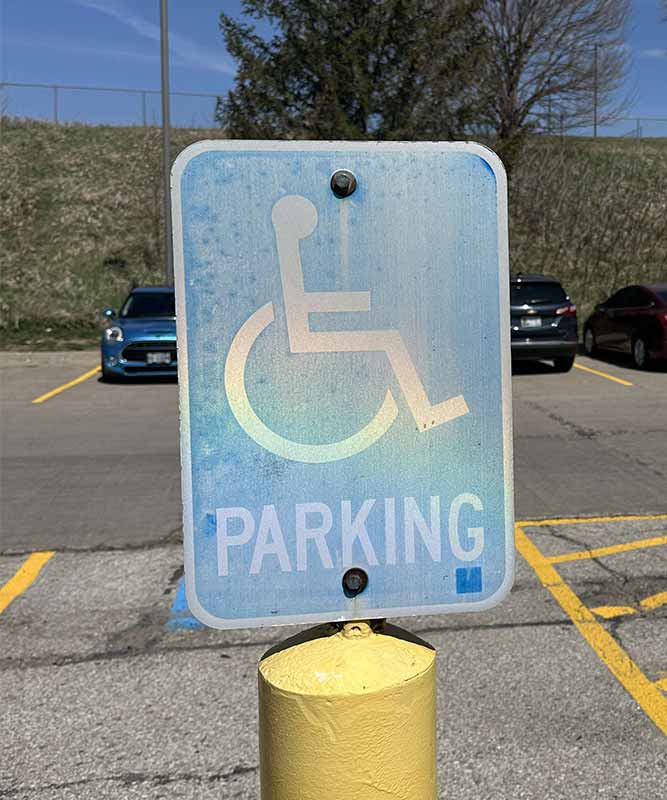
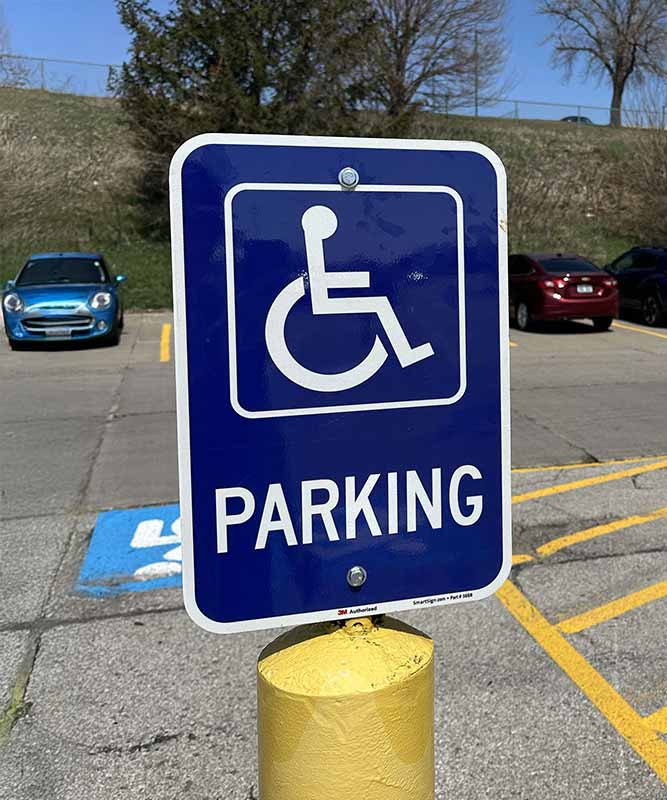
ADA Accessible-Space Signage
Accessible space signs are the most specified signage on your lot, and the requirements are federal.
ADA §502.6 covers it:
“Parking space identification signs shall include the International Symbol of Accessibility complying with 703.7.2.1. Signs identifying van parking spaces shall contain the designation ‘van accessible.’ Signs shall be 60 inches (1525 mm) minimum above the finish floor or ground surface measured to the bottom of the sign.”
Three requirements, and the third is the one we most often find wrong:
- The International Symbol of Accessibility must be on the sign.
- Van spaces must say “van accessible.” This is a designation on top of the ISA, not instead of it. And note the exception that runs the smallest sites’ way — §216.5 EXCEPTION 1: “Where a total of four or fewer parking spaces, including accessible parking spaces, are provided on a site, identification of accessible parking spaces shall not be required.” The Justice Department states the same thing twice in its own parking brief: “where four or fewer parking spaces are provided on a site, a sign identifying the accessible space, which must be van-accessible, is not required.” The space still has to meet the spec. The sign is what the exception excuses.
- 60 inches minimum, measured to the bottom of the sign. Not to the center, not to the top. It’s a mounting-height spec that a surprising number of existing lots miss, and it’s the cheapest thing in the world to get right at install and expensive to revisit.
Charleston County’s ZLDR reinforces the same point for unincorporated areas rather than adding to it: §9.3.7.D.1 requires that “ADA reserved parking signs and ADA parking markings shall be in compliance with the Americans with Disabilities Act,” and §9.3.6 opens by requiring compliance with the ADA “including… the requirements for ADA reserved parking signs and ADA parking markings.” The City of Charleston defers the same way at §54-318.a.2. Federal standard, three times over.
Tow-Away Notice: What South Carolina Actually Requires
Here’s the one most Charleston property owners don’t know, and it’s the difference between being able to tow and not.
South Carolina Code Section 16-11-760(A):
“It is unlawful for a person to park a vehicle… on the private property of another without the owner’s consent. If the property is for commercial use, the owner must post a notice in a conspicuous place on the borders of the property near each entrance prohibiting parking. Proof of the posting is considered notice conclusive against the person making entry.”
Take that apart, because every clause does work:
“If the property is for commercial use, the owner must post a notice.” Unauthorized parking on private property is unlawful — but for commercial property, the statute conditions it on posting. No notice, no foundation.
“Near each entrance.” Not one sign at the office door. Each entrance. On a site with three ways in, that’s three notices — and this is the requirement we most often find half-met.
“In a conspicuous place on the borders of the property.” On the borders, and conspicuous. A notice nobody can see isn’t doing the statutory job.
“Proof of the posting is considered notice conclusive against the person making entry.” This is the sentence that matters commercially. Post it properly and a driver cannot argue they didn’t know. That’s what the sign buys you: it forecloses the argument.
Section 16-11-760 goes on to cover towing, storage, liens, and sale of unclaimed vehicles by reference to other sections of the code. We’re not going to walk you through the towing procedure — that’s a conversation for your attorney and your towing operator, not a striping company. What we can tell you is that the posting is the part that lives on your lot, and it’s the part that’s usually wrong.
Fire Lane and Directional Signage
Fire lane signage is the fire code official’s call. IFC §503.3 requires, “where required by the fire code official, approved signs or other approved notices or markings that include the words ‘NO PARKING—FIRE LANE.'” The legend is specified; the dimensions aren’t, and no fire-lane sign or stripe dimension is specified at any level that reaches Charleston. In the City of Charleston, Fire Marshal guidance requires that “contractors shall receive approval from the Charleston Fire Marshal Office for striping and signage prior to initiating work” — signage explicitly included. We handle that approval as part of the job. Our fire lane striping page goes into the detail.
The same §503.3 sentence that mandates the legend also imposes the upkeep: fire lane designations “shall be maintained in a clean and legible condition at all times and be replaced or repaired when necessary to provide adequate visibility.” A faded or bent fire lane sign is a code condition, not a to-do item.
Directional signage is sometimes a straight code requirement rather than a convenience. In unincorporated Charleston County, ZLDR §9.3.7.D.3 requires that “one-way and two-way ingress and egress driveways shall be marked by directional arrows” — and §9.3.7.D.4.c then covers the case where you can’t paint one:
“For surfaces that cannot be marked with directional arrows, directional signage is required to mark one-way ingress and egress driveways.”
That’s the county telling you directly: on a gravel or pervious lot where arrows won’t hold, signage is not optional — it’s the required substitute. Given that the same code requires 30 percent of spaces to be pervious (§9.3.7.D.2.b), that situation is common on unincorporated county lots rather than exotic.
Inside the City of Charleston, §54-318.a.5 pairs signs with paint for compact spaces: publicly-monitored lots may designate up to 20 percent of spaces for compact cars “with signs and pavement markings” — both, not either.
For a full list of our pavement marking services, visit our parking lot striping in Charleston page.
Businesses We Serve




How it Works

GET A FREE ESTIMATE
Contact us today and we’ll have a quote to you in 24 hours

SCHEDULE AN INSTALLATION
We’ll have your installation scheduled in less than 7 days, without affecting your business hours

GET A PARKING LOT THAT POPS
For a budget-friendly price, you’ll get a parking lot that looks like new
We proudly work with:


We proudly work with:


Frequently Asked Questions About Parking Lot Sign Installation in Charleston, SC
How high does parking lot sign installation have to place an accessible space sign?
60 inches minimum from the ground to the bottom of the sign (ADA §502.6). Measuring to the center or the top of the sign is the usual mistake. The sign must also carry the International Symbol of Accessibility, and if it marks a van space, the “van accessible” designation.
Do I need a sign to tow someone off my commercial lot?
For commercial property, South Carolina Code §16-11-760(A) requires the owner to “post a notice in a conspicuous place on the borders of the property near each entrance prohibiting parking.” Note “near each entrance” — one sign at the front door doesn’t cover a site with three ways in. The statute adds that “proof of the posting is considered notice conclusive against the person making entry”, which is the practical value: posted properly, a driver can’t claim they didn’t know. Anything beyond the posting — the towing and storage process itself — is a question for your attorney and towing operator.
What does a fire lane sign have to say?
IFC §503.3 requires approved signs or markings “that include the words ‘NO PARKING—FIRE LANE'” where the fire code official requires them. The wording is specified in the code; the size, color, and letter height are not — at any level that reaches Charleston. Your fire code official approves the sign, which is why we take that approval before installing rather than after.
Do I need Fire Marshal approval before installing signs?
In the City of Charleston, yes. Fire Marshal guidance states that “contractors shall receive approval from the Charleston Fire Marshal Office for striping and signage prior to initiating work” — signage is named explicitly, not just striping. We handle that approval as part of the job. It matters because the approval effectively is the specification: since no fire-lane sign dimension is published at any level that reaches Charleston, what the Fire Marshal accepts is the standard. Installing first and asking after is how properties end up paying twice.
Do I need directional signs if my lot is gravel?
In unincorporated Charleston County, yes. ZLDR §9.3.7.D.3 requires one-way and two-way ingress and egress driveways to be marked with directional arrows, and §9.3.7.D.4.c states that “for surfaces that cannot be marked with directional arrows, directional signage is required.” On a gravel or pervious lot where paint won’t hold, signage is the code’s required substitute — not an upgrade.