Fire Lane Striping
In Charleston, SC
Code-Compliant Fire Lane Markings
1-800-STRIPER provides professional fire lane striping in Charleston, SC — marking fire lanes, curbs, and no-parking zones per the International Fire Code as adopted by the South Carolina Building Codes Council and enforced by the Charleston Fire Marshal Division.
1-800-STRIPER® of Charleston PROVIDes Fire Lane Striping Services NEAR YOU
Is your parking lot ready for first responders?
Our team is well-versed in local fire regulations and will parter with you to design a fire lane striping plan that creates unobstructed emergency access to protect your customers and property.
Core Services:
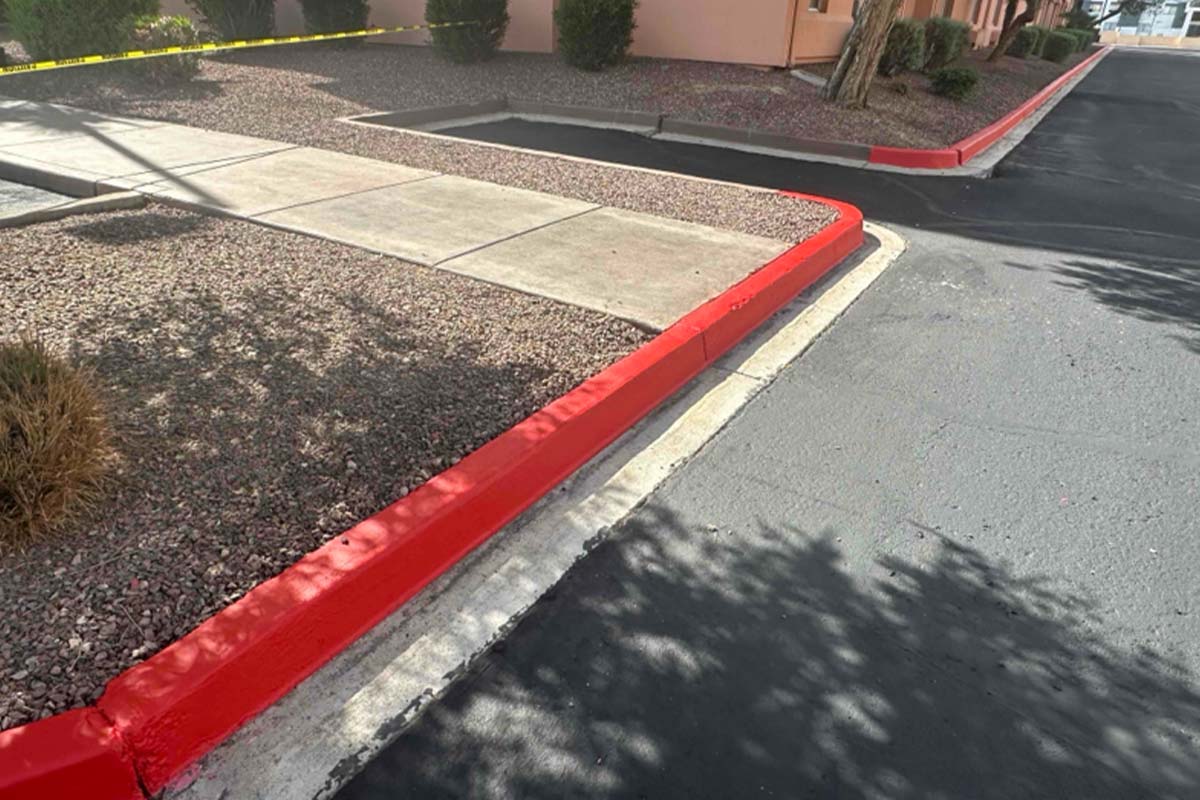
Fire Lane Striping in Charleston, SC
Fire lane marking is the one area of parking lot striping where a person — not a table — has the final say. That’s not a gap in the code. It’s how the code is built, and once you see it, the whole subject gets simpler.
We mark fire lanes on commercial properties across Charleston, Dorchester, and Berkeley counties: retail centers, apartment and condominium communities, medical campuses, schools, hotels, and industrial sites. Curb painting, pavement legends, no-parking markings, and the signage that goes with them.
Who Sets the Rules
South Carolina adopts the International Fire Code statewide through the South Carolina Building Codes Council, and the edition in force lives in regulation rather than in the statute. Locally, the Charleston Fire Marshal Division enforces it — and under the IFC, the fire code official is the authority having jurisdiction for fire apparatus access.
Two clarifications worth having, because both circulate wrongly in this market:
South Carolina Code Section 6-9-50 does not name the International Fire Code, and does not name an edition. The phrase “International Fire Code” appears nowhere in Title 6, Chapter 9. Section 6-9-50 delegates to the ICC family of codes and is deliberately edition-agnostic; the specific edition is set by regulation. So a page telling you “South Carolina Code 6-9-50 adopts the 2021 IFC” is citing a sentence that isn’t there.
We deliberately don’t name an edition on this page. A 2024 IFC adoption has been finalized at state level but its implementation date isn’t something we’ve been able to verify, and the requirement that matters here — Section 503.3 — is word-for-word identical across editions. So the honest phrasing is the International Fire Code as adopted by South Carolina, and the substance doesn’t move when the edition flips.
The practical consequence of all this: your fire code official is the decision-maker. Not a table in a manual, not us, and not a competitor’s website.
What IFC Section 503.3 Actually Requires
Section 503.3 is short, and it’s the whole of the marking requirement:
“Where required by the fire code official, approved signs or other approved notices or markings that include the words ‘NO PARKING—FIRE LANE’ shall be provided for fire apparatus access roads to identify such roads or prohibit the obstruction thereof. The means by which fire lanes are designated shall be maintained in a clean and legible condition at all times and be replaced or repaired when necessary to provide adequate visibility.”
Three things are in there, and it’s worth separating them.
The legend is real. If marking is required, it must include the words “NO PARKING—FIRE LANE.” That’s specified, in the code, verbatim. (We’ll be honest: we assumed at first that §503.3 required only “approved signs” and left the wording open. It doesn’t. The legend is mandated; the dimensions aren’t.)
“Where required by the fire code official” governs the whole sentence. Whether your property needs fire lane marking at all, and where the lanes run, is the fire code official’s determination. Not automatic, not universal.
“Approved” means approved by that official. The word appears twice and it’s doing real work — signs and markings are approved ones, which is to say the ones your AHJ accepts.
There is a related dimension people sometimes mistake for a stripe spec. IFC §503.2.1 requires fire apparatus access roads to have “an unobstructed width of not less than 20 feet” and “an unobstructed vertical clearance of not less than 13 feet 6 inches.” That’s the road — how much clear space the truck needs. It is not a specification for the paint.
There Is No Fire-Lane Stripe Spec — and We Went Looking For It
This is the part no competitor in this SERP will tell you, and it’s the most useful thing on the page: no fire-lane stripe width, color, or letter height is specified in the codes that govern a Charleston lot. Not federal, not state, not the county, not the City of Charleston.
We didn’t assume this. We went looking for the spec, expecting to find it, and it isn’t there:
- South Carolina Fire Code, Chapter 5 (fire service features — the chapter that contains §503): the words stripe and striping appear zero times. The word red, as a standalone word, appears zero times.
- The complete Charleston city code — 1,799 section nodes, about 1.98 million characters — searched end to end: no fire lane stripe specification.
- All 54 Charleston Fire Marshal bulletins and PDFs: no stripe width, no color, no letter height.
- The City of Charleston zoning code, Article 3 (site regulations, read in full): the phrase fire lane appears zero times.
The absence is deliberate, not a gap in our searching — and here’s the evidence for that. The very same Charleston Fire Marshal bulletin series does write dimensional specs when it means to. Elsewhere in those bulletins, it specifies “6″ red letters reading ‘FDC'” on a white background for fire department connections. The city writes precise specs where it wants them. For fire lane striping, it wrote none.
One honest limit on that, because we’d rather bound the claim than oversell it. The list above is what we read: the state fire code, the City of Charleston’s code, and the Charleston Fire Marshal’s bulletins. We did not read the municipal codes of North Charleston, Mount Pleasant, Summerville, or Goose Creek line by line, and South Carolina leaves room for them to have something of their own — S.C. Code §6-9-100 says this chapter’s provisions are “cumulative to other local ordinances and do not limit the authority of counties or municipalities,” and §6-9-105 gives a municipality a route to local variations. Fire code adoption itself sits with the state Building Codes Council under §6-9-50, so a local stripe spec would have to be a deliberate local addition rather than the norm — but if your lot sits in one of those municipalities, treat this as “we found none in the codes that govern Charleston,” not as a guarantee about your address. Ask your fire marshal, or ask us and we’ll ask them.
So what does that mean for your property? It means the question “what’s the fire lane spec in Charleston?” has no documentary answer — and the right move is to ask the fire code official rather than to trust a number off a website. That’s exactly what §503.3 tells you to do: the marking is the approved marking, and the official is who approves it.
Charleston makes this concrete. Fire Marshal guidance requires that contractors obtain approval from the Charleston Fire Marshal Office for striping and signage before starting work:
“Contractors shall receive approval from the Charleston Fire Marshal Office for striping and signage prior to initiating work.”
Which is the whole point. There’s no table to look up, because the approval is the specification. We handle that conversation as part of the job.
And the duty to keep it legible. The second sentence of §503.3 is a maintenance obligation, and it’s easy to skim past:
“The means by which fire lanes are designated shall be maintained in a clean and legible condition at all times and be replaced or repaired when necessary to provide adequate visibility.”
“At all times.” “Replaced or repaired when necessary.” A faded fire lane isn’t a deferred maintenance item you get to schedule at leisure — the code requires legibility continuously, and the trigger for re-marking is condition, not calendar. It’s the fire-lane twin of the ZLDR’s “visible at all times” rule for stalls in unincorporated county land, and it applies wherever your fire lanes were required in the first place.
For a full list of our pavement marking services, visit our parking lot striping in Charleston page.
Businesses We Serve




How it Works

GET A FREE ESTIMATE
Contact us today and we’ll have a quote to you in 24 hours

SCHEDULE AN INSTALLATION
We’ll have your installation scheduled in less than 7 days, without affecting your business hours

GET A PARKING LOT THAT POPS
For a budget-friendly price, you’ll get a parking lot that looks like new
We proudly work with:


We proudly work with:


Frequently Asked Questions About Fire Lane Striping in Charleston, SC
What color do fire lanes have to be painted in Charleston?
There isn’t one in the codes that govern a Charleston lot. We searched the South Carolina Fire Code’s Chapter 5 (zero hits for stripe, striping, or red as a standalone word), the complete Charleston city code, and all 54 Fire Marshal bulletins. No color, width, or letter height is specified in any of them. We didn’t read every surrounding municipality’s code line by line, so if you’re in North Charleston, Mount Pleasant, Summerville, or Goose Creek, ask your fire marshal before treating that as settled for your address. IFC §503.3 requires approved signs or markings including the words “NO PARKING—FIRE LANE” — approved by the fire code official. Red is the near-universal convention and what most AHJs here expect, but the authority is that approval, not a published spec.
Do I need fire lane striping at all?
That’s the fire code official’s call, not ours and not a table’s. IFC §503.3 requires marking “where required by the fire code official” — it isn’t automatic for every property. Whether your site needs marked fire lanes, and where they run, is determined by your authority having jurisdiction. In Charleston that’s the Charleston Fire Marshal Division. If you’ve been told flatly that every commercial lot needs fire lanes, that’s a sales position rather than what the code says.
Do I need approval before the work starts?
In the City of Charleston, yes. Fire Marshal guidance states that “contractors shall receive approval from the Charleston Fire Marshal Office for striping and signage prior to initiating work.” We handle that as part of the job — it’s not an optional courtesy step, and doing the work first and asking after is how properties end up re-marking.
What does the fire lane marking have to say?
The legend is specified even though the dimensions aren’t. IFC §503.3 requires “approved signs or other approved notices or markings that include the words ‘NO PARKING—FIRE LANE.'” Those exact words are in the code. The size, color, and letter height are not — not in the state fire code, the Charleston city code, or the Fire Marshal’s bulletins — and are left to the approving official. So the wording is fixed and the rest is a conversation with your fire code official.
How wide does a fire lane need to be?
The road width is specified, though it’s not a paint question. IFC §503.2.1 requires fire apparatus access roads to have “an unobstructed width of not less than 20 feet” and vertical clearance of “not less than 13 feet 6 inches.” That’s how much clear space the apparatus needs — it says nothing about how wide the stripe should be.
How often do fire lane markings need repainting?
Whenever they stop being legible. IFC §503.3 requires that fire lane designations “be maintained in a clean and legible condition at all times and be replaced or repaired when necessary to provide adequate visibility.” There’s no interval in the code — the standard is condition, continuously. If your markings are worn to the point that a driver won’t read them, they’ve already stopped meeting the requirement.