Sports Court Striping
In Charleston, SC
Multi-Sport Court Line Marking
1-800-STRIPER provides professional sports court striping in Charleston, SC — marking pickleball courts to USA Pickleball specifications, basketball courts, tennis courts, and playground game markings using durable acrylic court paint for schools, apartment communities, and commercial properties.
1-800-STRIPER® of Charleston PROVIDes Sport Court and Playground Markings Services NEAR YOU
Want to get people to come out to play?
Brighten up your faded sport courts or turn your playground into a safe, colorful, and engaging space that entices people to come out and play.
Sport Court Specialties:
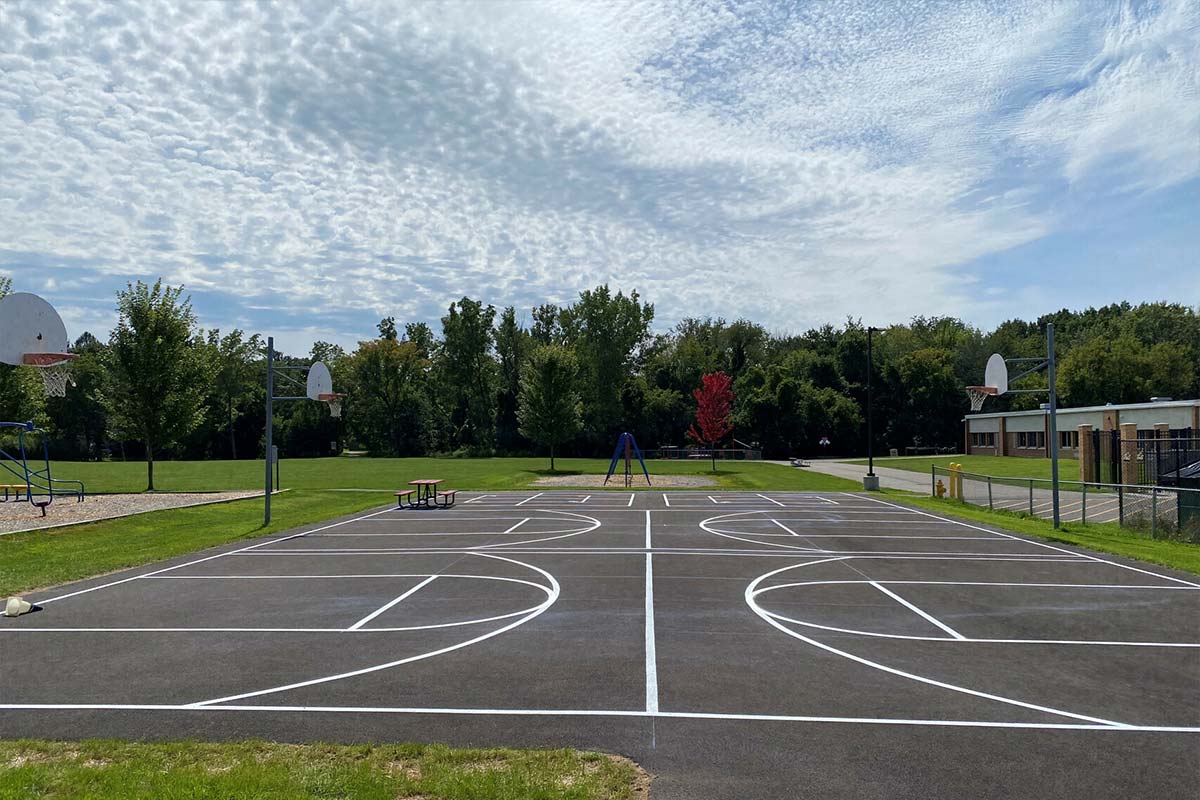
Sports Court Striping in Charleston, SC
Court markings are dimensional work — the lines are the court. Get a line an inch wide of true and you’ve built a court that plays wrong and, for anything sanctioned, won’t pass.
We stripe sports courts across Charleston, Dorchester, and Berkeley counties: pickleball, basketball, tennis, and playground game markings for schools, apartment and HOA communities, churches, parks, and commercial properties. New layouts, re-marks of faded courts, and overlays that put more than one game on a single slab.
Pickleball Court Dimensions
Pickleball has driven most of the court work in this market, and the specification is published — the USA Pickleball Official Rulebook, Section 3.A:
- Court size (3.A.1) — “The court must be a rectangle measuring 20 feet (6.10 m) wide and 44 feet (13.41 m) long for both singles and doubles matches.” Same court for both formats.
- How to measure (3.A.2) — “Court measurements must be made to the outside edge of the perimeter and non-volley zone lines.” This one matters more than it looks. Measure to the inside edge and every dimension on the court is wrong by two line-widths.
- Playing surface (3.A.3) — “The minimum playing surface area is 30 feet (9.14 m) wide and 60 feet (18.29 m) long.” For new construction the rulebook recommends 34 feet by 64 feet. The court is 20 × 44; the surface you need around it is considerably bigger, and that’s the constraint that decides whether a given slab can take a court at all.
- Non-volley zone (3.A.4.c) — “the 7-foot by 20-foot… area of the court adjacent to each end of the net,” with its lines running “parallel to the net, 7 feet… from the net on each end between the two sidelines.” The rule adds a detail that decides where you actually lay the paint: “all lines that bound the non-volley zone are part of the zone.”
- Centerline (3.A.4.d) — “the line down the center of the court on each end… extending from the non-volley zone line to the baseline,” separating the right and left service courts.
- Line size and color (3.A.4.e) — “All lines should be 2 inches (5.08 cm) wide and the same color, clearly contrasting with the color of the playing surface and court.”
Worth reading the verbs. The court dimensions “must” be as stated; the line width “should” be 2 inches. That’s a recommendation rather than an absolute — but 2-inch lines are what players and referees expect, and it’s the width we mark unless you tell us otherwise.
Basketball, Tennis, and Multi-Use Overlays
Most of the courts we’re asked about aren’t single-game courts. An apartment community with one slab wants pickleball and basketball; a school wants game markings that survive a decade of use.
The design problem in an overlay is legibility, not geometry. Two full sets of lines on one slab is visually busy, and busy courts play badly because players read the wrong line under pressure. Color separation is what fixes it — each game’s lines in their own clearly distinct color, which is exactly what the pickleball rulebook asks for when it requires lines “clearly contrasting with the color of the playing surface and court.”
Slab size decides what’s actually possible. A pickleball court needs a 30 × 60 foot minimum playing surface around a 20 × 44 court; a full basketball court needs far more. We measure the slab before proposing an overlay, because the honest answer is sometimes that your slab fits one game properly or two games badly.
Coastal Climate and Court Coatings
Charleston’s climate shapes court work in ways that catch out-of-town contractors, and the numbers are worth being specific about. These come from the NOAA station at Charleston International Airport (GHCND: USW00013880) — 1991–2020 climate normals:
- 52.51 inches of precipitation a year.
- 64.3 days a year above 90 °F.
- 22.4 nights a year at or below 32 °F.
- Annual average temperature 66.5 °F.
Two things follow for court coatings.
Summer is wet, and concentrated. June through September each average over six inches of rain (6.21, 6.60, 6.97, and 6.01 inches respectively) — nearly half the year’s total in four months. Acrylic court coatings need a dry surface going down and a dry window to cure. In a Lowcountry summer the constraint isn’t the temperature, it’s finding consecutive dry hours. That’s a scheduling problem, and it’s why we plan court work around the forecast rather than the calendar.
Winter is mild but not exempt. January’s normal daily average is 49.5 °F — the only month below 50 — and the area sees an average of 22.4 nights at or below freezing. Court coatings have surface-temperature minimums, so the deciding factor on a winter install is the slab temperature on the day, not the month on the calendar.
The heat cuts the other way too: with 64.3 days a year above 90 °F, a dark court surface in a Charleston July gets very hot, and coatings set faster than the label’s timings suggest. Early starts exist for a reason.
For a full list of our pavement marking services, visit our parking lot striping in Charleston page.
Businesses We Serve




How it Works

GET A FREE ESTIMATE
Contact us today and we’ll have a quote to you in 24 hours

SCHEDULE AN INSTALLATION
We’ll have your play space restriped in less than 7 days, without affecting your playtime

GET A PARKING LOT THAT POPS
For a budget-friendly price, you’ll get a parking lot that looks like new
We proudly work with:


We proudly work with:


Frequently Asked Questions About Sports Court Striping in Charleston, SC
What size is a pickleball court?
20 feet wide by 44 feet long — the same for singles and doubles (USA Pickleball Official Rulebook 3.A.1). The non-volley zone extends 7 feet from the net at each end. Crucially, the rulebook requires that “court measurements must be made to the outside edge of the perimeter and non-volley zone lines” — so measure to the outside of the lines, or every dimension comes out wrong.
How much space do I actually need for a pickleball court?
More than the court. The rulebook sets a minimum playing surface of 30 feet by 60 feet around the 20 × 44 court, and recommends 34 by 64 feet for new construction. That surrounding space, not the court itself, is usually what decides whether your slab can take a court. We measure before we quote.
How wide should court lines be?
The USA Pickleball rulebook says all lines “should be 2 inches wide and the same color, clearly contrasting with the color of the playing surface and court” (3.A.4.e). Note should — it’s a recommendation rather than a hard requirement, unlike the court dimensions, which “must” be as specified. We mark 2-inch lines by default because that’s what players and referees expect.
Can I fit pickleball and basketball on the same slab?
Often, yes — with color separation so players read the right lines at speed. The limit is slab size, not paint. Pickleball needs a 30 × 60 foot minimum playing surface; a full basketball court needs a great deal more. We’ll measure and tell you honestly whether your slab supports both games properly or only one — a cramped overlay plays badly and nobody thanks you for it.
When’s the best time of year for sports court striping in Charleston?
It’s driven by dry windows more than by season. Charleston International Airport’s 1991–2020 normals show 52.51 inches of rain a year, with June to September each averaging over six inches — so summer’s problem isn’t warmth, it’s finding consecutive dry hours for the coating to cure. Winter is mild (January’s normal average is 49.5 °F) but the area still averages 22.4 nights at or below freezing, and coatings have surface-temperature minimums. We work off the slab temperature and the forecast on the day rather than a rule of thumb about months.