
Thermoplastic Striping
In Charleston, SC
Long-Lasting Pavement Markings
1-800-STRIPER provides professional thermoplastic striping in Charleston, SC — heat-applied stop bars, crosswalks, directional arrows, and fire lane markings in a thick retroreflective material that bonds into the pavement instead of drying on top of it.
1-800-STRIPER® of Charleston PROVIDes Thermoplastics Services NEAR YOU
Want to reduce the maintenance requirements for your parking lot?
Thermoplastic pavement markings are a durable, weather and vehicle-resistant striping option for your parking lot or facility.
You can utilize them for stop bars, ADA stalls, no-parking zones, directional arrows, crosswalks, or your entire parking lot.
Benefits:
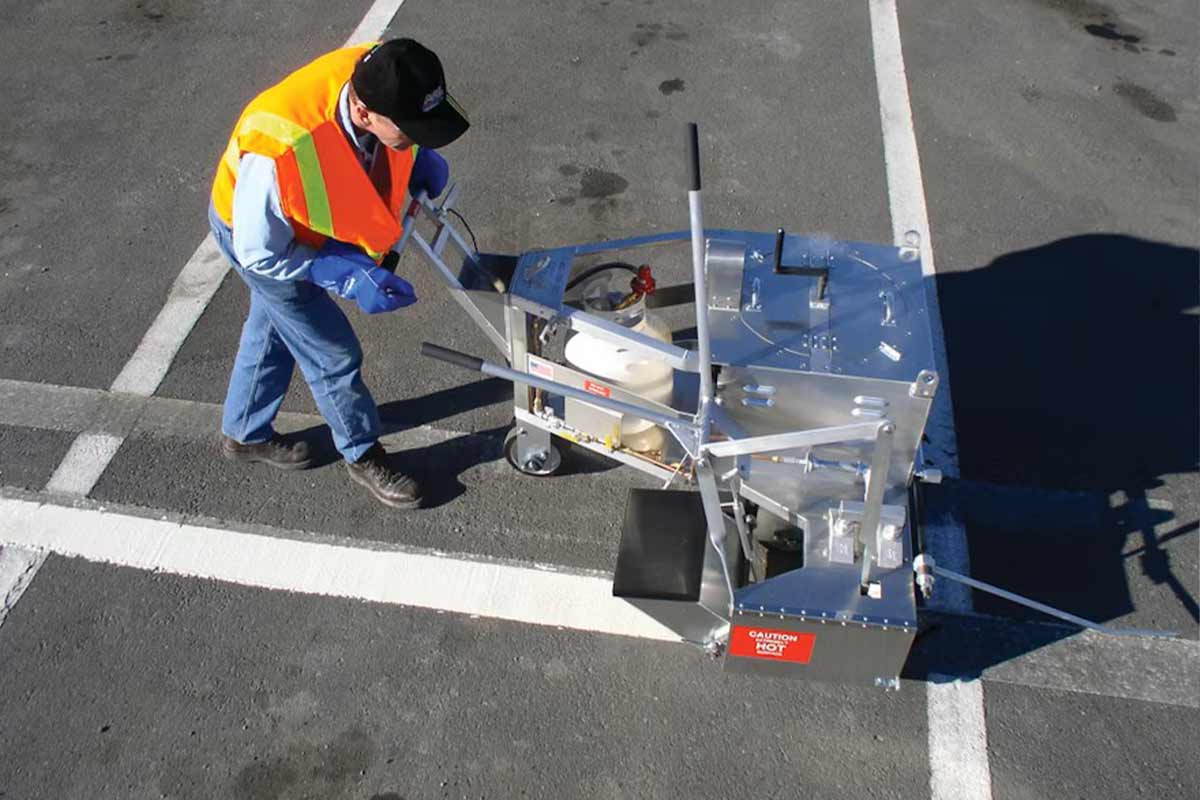
Thermoplastic Striping in Charleston, SC
Thermoplastic is a different product from paint, not a premium version of it. It goes down hot, it fuses into the pavement rather than drying on top, and it’s built to survive traffic that would erase paint in a season.
We apply thermoplastic markings across Charleston, Dorchester, and Berkeley counties: stop bars, crosswalks, directional arrows, lane lines, fire lane markings, and legends on commercial properties, industrial sites, apartment communities, and campuses — anywhere a marking has to hold up under real traffic.
How Thermoplastic Differs From Paint
The difference is physical, not a matter of quality grades.
Paint is a liquid coating. It’s applied cold, and it dries — the solvent or water leaves and a thin film is left bonded to the surface. It’s fast, inexpensive, and works well for stalls.
Thermoplastic is a solid at room temperature. It’s heated until it flows, applied molten, and then it cools and fuses into the pavement surface. The result isn’t a film on top — it’s a thick, hardened marking that has bonded into the asphalt. SCDOT’s specification describes the material as “a reflectorized mixture of a thermoplastic binder and spherical glass beads upon which additional glass beads are applied by dropping immediately following application” (§627.2.1).
Three consequences follow, and they’re the whole case for the product:
- Thickness. Thermoplastic is laid measurably thick rather than as a film. There’s simply more material there to wear away.
- Retroreflectivity. Glass beads are both mixed into the binder and dropped onto the surface as it goes down, so as the marking wears, fresh beads keep being exposed. A paint line loses its beads and goes dull; a thermoplastic line keeps returning light for far longer.
- Bond. Fusing into the surface rather than sitting on it is why thermoplastic survives turning, braking, and plow contact where paint shears off.
The trade-offs are real and worth stating plainly. Thermoplastic costs more to install, needs specialized heated equipment, is less forgiving to remove or change, and is fussier about the surface and conditions it goes down on. It is the right answer for markings that take a beating and the wrong answer for markings that might move.
Where It Pays Off: High-Traffic Lanes, Stop Bars, Crosswalks
Thermoplastic earns its cost where traffic concentrates, not across a whole lot.
- Stop bars. Every vehicle brakes on them. It’s the single highest-wear marking on most commercial sites and the most common thermoplastic upgrade.
- Crosswalks. High wear plus a genuine safety function, and the place where retained retroreflectivity matters most — a crosswalk that reads at night is doing its job.
- Directional arrows. Concentrated turning traffic scrubs paint off arrows fast, and in unincorporated Charleston County arrows aren’t decorative: ZLDR §9.3.7.D.3 requires that “one-way and two-way ingress and egress driveways shall be marked by directional arrows.”
- Fire lane markings. IFC §503.3 requires fire lane designations to be “maintained in a clean and legible condition at all times.” A marking that stays legible longer means less re-marking to satisfy a duty that never lapses.
- Drive-through and loading lanes. Constant slow, heavy, turning traffic — the worst case for paint.
- Entrances and exits. Every vehicle on the site crosses them.
Where thermoplastic usually isn’t worth it: general parking stalls. Cars park on them; they don’t scrub them. Paint does that job perfectly well and costs less, and a stall layout is exactly the thing you might want to change later — which thermoplastic makes harder. Most properties end up with a sensible mix: thermoplastic where traffic concentrates, paint everywhere else.
Retroreflectivity and Glass Beads
Retroreflectivity is what makes a marking visible in headlights at night, and it’s where thermoplastic’s construction really tells.
The mechanism is glass beads. Light from headlights enters a bead, reflects off its back surface, and returns toward the source rather than scattering. Without beads, a white line at night is just a slightly lighter patch of pavement.
Thermoplastic uses beads two ways at once, which paint cannot do:
- Intermixed beads are distributed throughout the binder, so as the surface wears, new beads are continually exposed.
- Drop-on beads are applied to the molten surface at installation. SCDOT’s specification requires that additional glass beads be “applied by dropping immediately following application” (§627.2.1) — immediately, while the material is still molten, so the beads embed rather than sit loose.
That two-layer system is why thermoplastic holds night visibility over years while paint fades: paint’s beads are surface-applied only, so when they go, the retroreflectivity goes with them.
South Carolina’s own specification is exacting about the beads themselves — bearing in mind, as the next section sets out, that it binds state highway contractors rather than your lot. On that work, SCDOT §627 requires the thermoplastic binder compound to comply with AASHTO M 249 (§627.2.2.1), requires glass beads to comply with AASHTO M 247 subject to modifications, and sets minimum retroreflectivity values the finished marking must meet.
The replacement rule runs to two sentences, and both are worth having:
“Immediately replace any markings failing to meet the initial minimum retroreflectivity requirements by more than 50 mcd/lux/m² at no additional cost to the Department. Any markings failing to meet the initial requirements by less than 50 mcd/lux/m² may be reevaluated at the time of the 180-day evaluation unless the defect causing the lower readings is obvious to the RCE.”
Read that 50 carefully. It isn’t a threshold a reading has to clear — it’s a margin of shortfall. The initial minimums under §627.3.7 are the real bar: 375 mcd/lux/m² white and 250 yellow for a single drop, 450 and 350 for a double drop. Miss one of those by more than 50 and the marking is replaced immediately. Miss by less than 50 and you’re in the second sentence — where the remedy may be deferred to the 180-day evaluation, at the discretion of the RCE (the Resident Construction Engineer, in SCDOT’s own glossary), and not even that if the cause is obvious to them. A marking that misses by less than 50 still fails the requirement; it isn’t inside a tolerance. Discretion, not permission.
And read who the remedy is priced against: the Department. That’s the tell for what this document actually is — a contract term between SCDOT and its paving contractors, not a performance standard hanging over private property.
(One note in the interest of not overstating things: we cite AASHTO M 249 by its designation only. That’s the exact string SCDOT itself uses. We haven’t been able to verify the standard’s full published title from a source that passes a basic reliability check, so we don’t print one.)
What the State’s Own Spec Says — and Who It Binds
South Carolina publishes a detailed thermoplastic specification, and it’s genuinely useful as a reference. It’s also widely misrepresented, so let’s be exact about both the content and the reach.
SCDOT Standard Specifications, Section 627 — Thermoplastic Pavement Markings requires:
- Application temperature — “Apply the thermoplastic pavement marking material at a temperature between 390 ºF and 420 ºF that provides the best adhesion to the pavement as recommended by the manufacturer” (§627.3.4 #9).
- Pavement temperature and dryness — “Place pavement markings only when the pavement is dry… and the pavement temperature is 50 ºF or greater. No work is allowed when any moisture is visible on the pavement surface” (§627.3.4 #5). The spec doesn’t leave that to judgment either: it tells the contractor to “provide each work crew with a hand-held infrared, non-contact thermometer… to verify the minimum surface temperature” and to “measure pavement temperature away from heat generating equipment.” Measured, not estimated.
- New asphalt cure — “Ensure that new asphalt concrete surfaces are in place a minimum of 7 days before application” (§627.3.4 #7).
- Material — binder compound complying with AASHTO M 249 (§627.2.2.1).
- Flash point — “a minimum of 475 ºF (245 ºC) when tested according to ASTM D92″ (§627.2.2.6).
⚠️ A correction worth making, because the whole industry repeats it: thermoplastic is not “applied at 400 °F.” That figure has no source in South Carolina’s specification. We searched §627 in full: the number `400` appears exactly twice, and neither is a temperature — one is a CIE chromaticity coordinate (0.4000) and the other is a retroreflectivity value for double-drop beads. The real, citable number is SCDOT’s range: 390–420 °F. And don’t confuse it with the two other temperatures in the same section — the 475 °F flash point and the 50 °F pavement minimum are different things entirely.
Now the part nobody else will tell you: SCDOT §627 does not govern your parking lot.
Section 627.1 states its own scope: “Furnish and place thermoplastic pavement markings according to the Contract documents and the Manual on Uniform Traffic Control Devices (MUTCD).” That’s a contractual scope — it binds SCDOT highway work, through the contract. There’s no clause in §627 saying it doesn’t apply to private property; there doesn’t need to be, because its scope is affirmative rather than exclusionary. It applies to the work it’s written for.
And the MUTCD it rests on has its own limit. Under 23 CFR 655.603(a), “parking areas, driving aisles within parking areas… are not included“ in the definition of roads open to public travel for MUTCD applicability. So the manual §627 builds on expressly excludes the surface your lot is made of.
So why cite §627 at all? Because it’s the best-documented statement of good practice available in this state, written by the people who install the most thermoplastic in it. A private lot follows it because the owner specifies it or because it’s sound practice — not because SCDOT requires it. Ask us what we hold to on your job and we’ll tell you before the truck arrives; what we won’t do is pretend a highway specification is the law on your property.
For a full list of our pavement marking services, visit our parking lot striping in Charleston page.
Businesses We Serve




How it Works

GET A FREE ESTIMATE
Contact us today and we’ll have a quote to you in 24 hours

SCHEDULE AN INSTALLATION
We’ll have your installation scheduled restriped in less than 7 days, without affecting your business hours

GET A PARKING LOT THAT POPS
For a budget-friendly price, you’ll get a parking lot that looks like new
We proudly work with:


We proudly work with:


Frequently Asked Questions About Thermoplastic Striping in Charleston, SC
What temperature is thermoplastic applied at?
South Carolina’s own specification gives a range, not a single figure: SCDOT §627.3.4 requires thermoplastic to be applied “at a temperature between 390 ºF and 420 ºF that provides the best adhesion to the pavement as recommended by the manufacturer.” You’ll often see “400 °F” quoted — that number doesn’t come from the specification. We checked: `400` appears twice in §627 and neither instance is a temperature. Don’t confuse the application range with the 475 °F flash point (§627.2.2.6) or the 50 °F minimum pavement temperature (§627.3.4).
How long does thermoplastic striping last compared to paint?
Considerably longer under the same traffic, for three structural reasons rather than one: it’s laid much thicker, it fuses into the pavement instead of drying on top of it, and its glass beads are both mixed through the binder and dropped onto the surface, so fresh beads keep getting exposed as it wears. We won’t quote you a number of years — it depends entirely on your traffic, your surface, and where the marking sits. What we’ll say is that stop bars and crosswalks are where the difference shows first.
Can thermoplastic go on a new asphalt lot?
Not immediately. SCDOT’s specification requires that “new asphalt concrete surfaces are in place a minimum of 7 days before application of thermoplastic pavement markings” (§627.3.4). New asphalt needs to cure before it will take the material properly. On new Portland cement concrete, the specification requires removing the curing compound before application. If you’ve just paved, plan the sequence — this is a wait you can’t rush.
Does SCDOT’s specification apply to my parking lot?
No — though it’s often implied otherwise. SCDOT §627.1 sets its own scope: markings furnished “according to the Contract documents and the Manual on Uniform Traffic Control Devices.” It’s a highway-contract spec, binding through the contract. And the MUTCD it builds on expressly excludes parking areas — 23 CFR 655.603(a) says “parking areas, driving aisles within parking areas… are also not included” in the definition of roads open to public travel. A private lot follows §627 if the owner specifies it, or because it’s sound practice.
When can you apply thermoplastic in Charleston?
Whenever the pavement is dry and warm enough — measured, not guessed. SCDOT’s spec requires the pavement temperature to be 50 °F or greater with no visible moisture, verified with an infrared thermometer rather than estimated. Charleston’s climate cooperates most of the year: the 1991–2020 normals at Charleston International Airport show only one month (January, 49.5 °F) averaging below 50 °F. But a monthly average isn’t a pavement temperature, and the area still sees 22.4 nights at or below freezing — so the answer comes from the surface, not the calendar.