Wheel Stop Installation
In Philadelphia Suburbs, PA
Concrete and Rubber Parking Stops
1-800-STRIPER provides professional wheel stop installation in Philadelphia Suburbs, PA — anchoring concrete, recycled-rubber, and plastic-composite wheel stops at stall heads so parked vehicles cannot overhang the accessible route, per the 2010 ADA Standards, for commercial properties across Montgomery, Bucks, Chester, and Delaware counties.
1-800-STRIPER® of Philadelphia Suburbs PROVIDes Wheel Stop Installation Services NEAR YOU
Need to protect vehicles or walls from accidental damage?
Wheel stops (also called parking blocks) protect your property, enhance safety, and improve parking lot organization.
Benefits:
Wheel stops prevent vehicles from parking too far into a space or overextending into other spots, pedestrian walkways, and other areas, while also helping with vehicle alignment. They can prevent damage to buildings, curbs, or landscaping. Wheel stops also serve as clear visual cues for proper parking and are sometimes used on slopes to prevent cars from rolling.
Wheel Stops and the Accessible Route
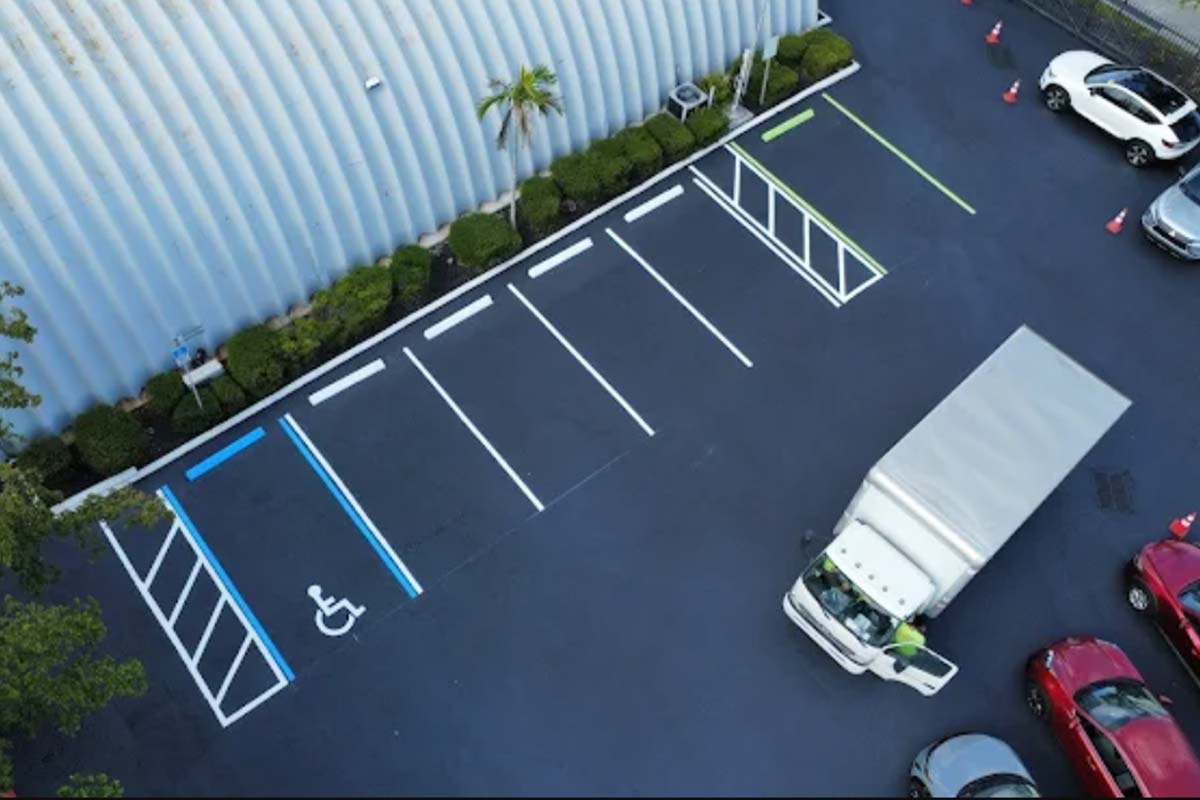
The strongest reason to install wheel stops is written into the accessibility standard, and most owners have never seen it. The 2010 ADA Standards require that parking spaces and access aisles be designed so that cars and vans, when parked, cannot obstruct the required clear width of adjacent accessible routes. The advisory to that section then names the remedy directly: wheel stops are an effective way to prevent vehicle overhangs from reducing the clear width of accessible routes.
That is the situation to look for on your own property. A space head-in to a sidewalk, a compliant route along that sidewalk, and a vehicle overhanging eighteen inches to two feet of it. The route was wide enough when it was measured and is not wide enough when the lot is full. Nothing about the striping is wrong; the geometry is.
Wheel stops solve it by fixing where the vehicle stops rather than by widening the sidewalk. That makes them the cheap answer to a problem whose expensive answer is reconstruction, which is why they are worth considering before a route is rebuilt.
The same logic applies away from accessible routes: storefront glazing, building walls, utility meters, landscape beds, and light poles all take damage from overhang that a stop at the right position prevents.
Concrete, Recycled Rubber, and Composite
Three materials cover almost all commercial installations, and the choice is a trade between mass, longevity, and how easily the thing can be moved or replaced.
Concrete is the traditional option: heavy, immovable, and long-lasting, but brittle under plow contact and awkward to relocate if a layout changes. Recycled rubber is lighter, absorbs impact rather than cracking, tolerates plows better, and is straightforward to reposition, though it moves more easily if under-anchored. Plastic composite sits between the two, resisting weather and salt without the mass of concrete.
In this region the winter argument carries real weight. A concrete stop struck square by a plow blade cracks; a rubber or composite stop is more likely to survive or to be replaced without breaking out a footing. Where a property is plowed every year, that difference compounds.
| Concrete | Recycled rubber | Plastic composite | |
|---|---|---|---|
| Mass | Heaviest | Light | Moderate |
| Plow tolerance | Brittle, can crack | Absorbs impact well | Good |
| Repositioning | Difficult | Straightforward | Straightforward |
| Anchoring demand | Lower, mass helps | Higher | Moderate |
Anchoring, Placement, and Snow Operations
Placement is the decision that determines whether a wheel stop does its job. Set too far forward and the vehicle still overhangs what you were protecting. Set too far back and drivers stop short, losing usable stall depth and encouraging people to nose past it. The right position is derived from the stall depth, the vehicle types the property actually sees, and the clearance the feature behind the stall needs.
Anchoring follows the material and the surface. Asphalt and concrete take different fixings, and a stop that is under-anchored migrates, which is worse than not having one because it becomes a trip hazard in an unpredictable position.
Snow operations deserve a conversation before installation rather than after the first storm. Wheel stops and plow blades are natural enemies, and a property that is plowed every winter benefits from placement that gives the operator a clear run, from materials that survive contact, and sometimes from leaving certain rows without stops entirely. We would rather design around your plowing contractor than replace stops each spring.
For a full list of our pavement marking services, visit our parking lot striping in Philadelphia Suburbs page.
Businesses We Serve



How it Works

GET A FREE ESTIMATE
Contact us today and we’ll have a quote to you in 24 hours

SCHEDULE AN INSTALLATION
We’ll have your installation scheduled restriped in less than 7 days, without affecting your business hours

GET A PARKING LOT THAT POPS
For a budget-friendly price, you’ll get a parking lot that looks like new
We proudly work with:


We proudly work with:

Frequently Asked Questions About Wheel Stop Installation in Philadelphia Suburbs, PA
Where should wheel stops be installed?
Wherever a parked vehicle would otherwise overhang something that matters. The clearest case is written into the 2010 ADA Standards, whose advisory states that wheel stops are an effective way to prevent vehicle overhangs from reducing the clear width of accessible routes, so any space head-in to a sidewalk that forms part of an accessible route is a candidate. Beyond that: storefront glazing, building walls, utility meters, light poles, and landscape beds.
How far from the curb or wall should a wheel stop sit?
It is derived rather than fixed, and the inputs are the stall depth, the vehicles the property actually sees, and how much clearance the feature behind the stall needs. Set too far forward and the vehicle still overhangs what you were protecting; too far back and you lose usable stall depth and drivers nose past it. We measure at the property rather than applying one figure, because a delivery-heavy site and a medical office park differ.
What is a wheel stop actually called?
Several things, all the same object: wheel stop, parking stop, parking block, car stop, curb stop, or bumper block. The variation is regional and by trade rather than meaningful. What does vary meaningfully is the material, concrete, recycled rubber, or plastic composite, and how it is anchored, because those decide whether it survives the plow and whether it stays where you put it.
Which material is best for a lot that gets plowed?
Recycled rubber or plastic composite usually outlast concrete on a plowed property. Concrete is heavy and durable in most respects but brittle under a plow blade struck square, and replacing a cracked concrete stop means dealing with the anchors and the footing. Rubber absorbs impact and tolerates contact better, and composite sits between the two. Just as important is placement: giving the plow operator a clear run prevents most of the damage.
Can wheel stops be added without restriping the lot?
Yes. Installing stops is independent work and does not require the markings to change, so it can be done on its own. That said, if the lot is due for restriping anyway, combining them is efficient, because the stall geometry and the stop position are related decisions and the property only closes sections once. It is also the natural moment to check whether any accessible route is being obstructed by overhang.