Parking Lot Sign Installation
In Philadelphia Suburbs, PA
ADA, Fire Lane, and Directional Signage
1-800-STRIPER provides professional parking lot sign installation in Philadelphia Suburbs, PA — setting accessible-space signs at the 60-inch minimum mounting height the 2010 ADA Standards require, plus fire lane, directional, and tow-away signage, for commercial properties across Montgomery, Bucks, Chester, and Delaware counties.
1-800-STRIPER® of Philadelphia Suburbs PROVIDes Parking Lot Sign Installation Services NEAR YOU
Are you communicating clearly?
We install new signs in adherence with local regulatory standards and can repair or replace damaged signs so you can clearly communicate your parking requirements.
Accessible-Space Signs and the 60-Inch Rule
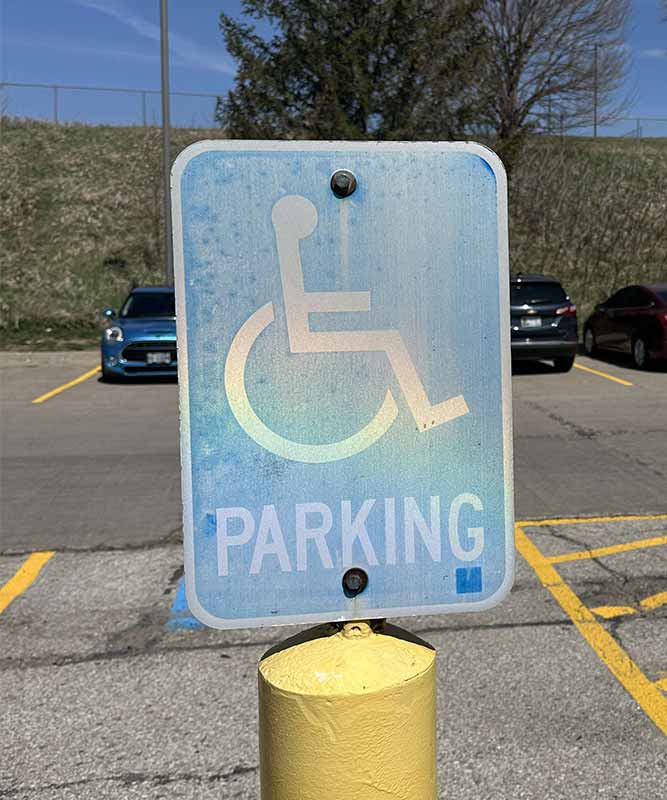
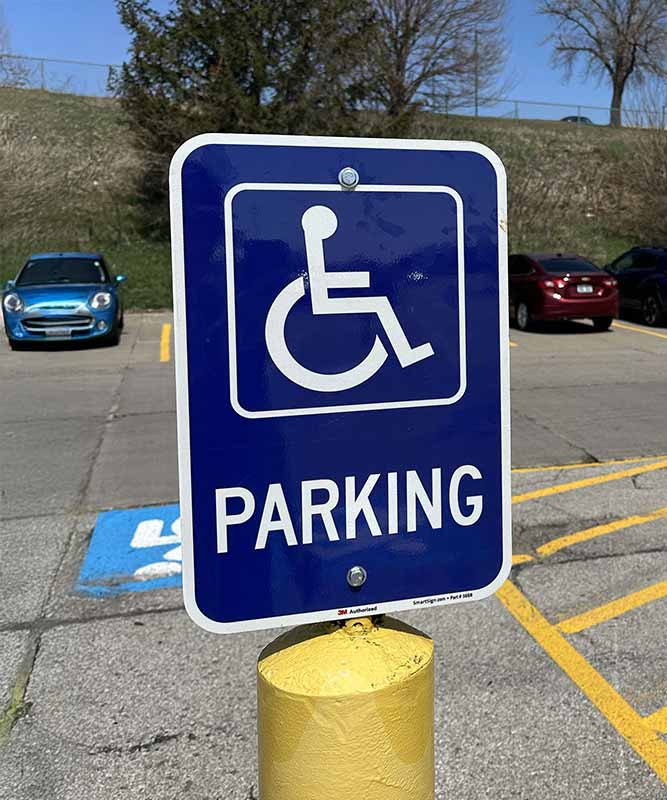
Accessible parking signage is the part of a lot most often installed wrong, and the error is usually height. Under the 2010 ADA Standards, parking space identification signs carry the International Symbol of Accessibility and shall be sixty inches minimum above the finished floor or ground surface measured to the bottom of the sign, not the top. Signs identifying van spaces additionally contain the designation van accessible.
That sixty-inch minimum has a purpose that becomes obvious the first time you look at a lot with low signs: the sign has to stay readable when a vehicle is parked in the space. A sign mounted at bumper height disappears at exactly the moment it is needed.
The standard’s advisory adds a point worth knowing. The van accessible designation is intended to be informative rather than restrictive, and enforcement of motor vehicle laws, including parking privileges, is a local matter. Signage and enforcement are separate questions, and a correctly signed space is the precondition for either.
How a sign installation runs
- Survey the lot and record every existing sign, its position, its condition, and whether it still faces the approach.
- Confirm which municipality has jurisdiction over the address, since fire lane and on-premises sign requirements are set locally.
- Establish mounting heights: accessible-space signs at sixty inches minimum to the bottom of the sign under the 2010 ADA Standards, and fire lane and tow-away signage to the municipality’s stated requirement.
- Set posts for the exposure they will actually face, in concrete where rotation and frost movement are a risk, and out of the plow’s path where placement allows.
- Install faces, including the International Symbol of Accessibility and the van accessible designation where the space calls for it.
- Document what was installed and where, so the property has a record for inspection.
Fire Lane and Tow-Away Signage
Fire lane signage is set by the municipality rather than by a single statewide rule, for the same reason the lane marking is: Pennsylvania does not adopt a free-standing statewide fire code, so each township’s own ordinance governs. Wording, letter height, sign spacing, and mounting height therefore need confirming for the municipality your property sits in.
Tow-away signage sits alongside it and is a legal question as much as a signage one, since a sign that does not carry the information the law expects will not support removing a vehicle. We install to the requirement your municipality states rather than to a generic template, and where a property has received a notice, the notice usually names the defect precisely.
Both categories share a practical failure mode: signs installed once and never revisited. Faded faces, bent posts, and signs turned away from the approach are all common, and all of them quietly stop the sign from working.
Directional and Wayfinding Signs
Beyond compliance signage, most lots need signs that simply make circulation obvious: entrance and exit, one way, stop, do not enter, speed restrictions, reserved and visitor spaces, loading zones, and direction to a specific building or suite.
It is worth being precise about the standards question here, because it is commonly misstated. The Manual on Uniform Traffic Control Devices is the national standard for traffic control devices on streets and highways open to public travel, and under 23 CFR 655.603(a) parking areas and the driving aisles within parking areas are explicitly not included in that definition. Its sign designations, such as R7-8 for accessible parking, are useful as a shared convention, and following them makes a private lot legible to drivers who have learned them on the road. But the Manual does not govern your parking lot, and a contractor telling you otherwise is overstating the case.
Where a sign is a on-premises sign in the zoning sense rather than a traffic control sign, the municipality’s own sign chapter applies, and that is another genuinely local question across our four counties.
Mounting, Footings, and Winter Durability
How a sign is installed decides whether it is still upright and readable in three years. The variables are the post material, how the post is set, and whether the location exposes it to plows and vehicles.
Posts set in concrete resist rotation and frost movement better than driven posts in soft ground. Placement matters: a sign at the head of a stall protected by a curb or wheel stop survives, while one in the plow’s path does not. Where a sign must sit in an exposed position, a breakaway or sleeved installation makes replacement straightforward rather than requiring the footing to be dug out.
In this region, winter is the test. Freeze and thaw movement, plow contact, and road salt are what take signs down, and specifying for that at installation costs much less than replacing posts every spring.
For a full list of our pavement marking services, visit our parking lot striping in Philadelphia Suburbs page.
Businesses We Serve




How it Works

GET A FREE ESTIMATE
Contact us today and we’ll have a quote to you in 24 hours

SCHEDULE AN INSTALLATION
We’ll have your installation scheduled in less than 7 days, without affecting your business hours

GET A PARKING LOT THAT POPS
For a budget-friendly price, you’ll get a parking lot that looks like new
We proudly work with:


We proudly work with:


Frequently Asked Questions About Parking Lot Sign Installation in Philadelphia Suburbs, PA
How high does an accessible parking sign need to be?
At least sixty inches from the finished floor or ground surface to the bottom of the sign, under the 2010 ADA Standards. Measuring to the bottom rather than the top is the detail people get wrong. The reason is practical: the sign has to remain visible when a vehicle is parked in the space, and a sign mounted low disappears behind a van at precisely the moment somebody needs to read it. Van spaces additionally carry a van accessible designation.
Does the MUTCD apply to signs in a private parking lot?
Not as a governing standard. The Manual on Uniform Traffic Control Devices applies to streets and highways open to public travel, and 23 CFR 655.603(a) states explicitly that parking areas and the driving aisles within parking areas are not included in that definition. Its designations remain a useful convention, because drivers already recognize them, and following them makes a lot easier to read. But it does not bind a private lot, and claims that it does overstate the case.
What signs does a fire lane need?
That is set by your municipality rather than by a statewide rule, because Pennsylvania does not adopt a free-standing statewide fire code. Wording, letter height, spacing along the lane, and mounting height all come from the township’s own fire prevention ordinance. We confirm the requirement for your address before installing. If you have received a violation notice, it usually names the specific defect, which is faster and more reliable than working from a generic template.
Do you install the posts as well as the sign faces?
Yes, complete installation including footings. That matters more than it sounds, because most sign failures in this region are post failures rather than face failures: frost movement, plow contact, and salt do the damage. We set posts in concrete where conditions call for it, position signs out of the plow path where the layout allows, and use sleeved installations where a sign has to sit somewhere exposed so replacement is simple later.
Can you replace just the sign faces on existing posts?
Often yes, and it is the sensible option when the posts are sound and correctly positioned. We check the post condition, the mounting height, and whether the position still makes sense before reusing anything, because a faded face on a post that was always too low or facing the wrong way is two problems and replacing the face fixes one. Where the post is bent, loose, or corroded, replacing both is the durable answer.
Do you handle signage for a whole portfolio of properties?
That is common work for us. The complication with a portfolio in this region is jurisdictional rather than logistical: our service area spans four counties and roughly eighty-one municipalities, and fire lane and on-premises sign requirements are set locally. So a specification that satisfies one township is not automatically correct at the next site. We confirm requirements per property and keep the record so subsequent visits are quicker.