Warehouse Line Painting
In Philadelphia Suburbs, PA
OSHA-Compliant Safety Markings
1-800-STRIPER provides professional warehouse line painting in Philadelphia Suburbs, PA — marking permanent aisles, pedestrian walkways, staging bays, and equipment zones per OSHA 29 CFR 1910.176(a) for distribution centers, factories, and industrial facilities across Montgomery, Bucks, Chester, and Delaware counties.
1-800-STRIPER® of Philadelphia Suburbs PROVIDes Warehouse Line Painting Services NEAR YOU
Want your indoor space to operate more efficiently?
Warehouse and interior markings ensure clear traffic lanes, organized storage zones, and designated spaces designed to help your business operate safely and efficiently.
Benefits:
What OSHA Requires, and the Numbers It Deliberately Does Not Give
The federal requirement is one sentence. Under 29 CFR 1910.176(a), permanent aisles and passageways shall be appropriately marked. The same provision requires that sufficient safe clearances be allowed for aisles, at loading docks, through doorways, and wherever turns or passage must be made, and that aisles be kept clear and in good repair with no obstruction that could create a hazard.
What is not in the regulation matters as much. It sets no line width. It sets no line color. It sets no aisle width. The phrase is sufficient safe clearances, which is a performance requirement rather than a dimension. Contractors who quote you a mandatory four-inch yellow line are quoting an industry convention and presenting it as federal law.
Color does appear elsewhere, in 29 CFR 1910.144, which assigns red as the basic color for identifying fire protection equipment and danger, and yellow as the basic color for designating caution and for marking physical hazards such as striking against, stumbling, falling, tripping, and caught in between. That is why aisle marking is conventionally yellow. It is a sound convention grounded in a real standard, and it is not the same thing as a mandated aisle width.
| Question | What the regulation says |
|---|---|
| Must permanent aisles be marked? | Yes: 29 CFR 1910.176(a) |
| Required line width? | Not specified |
| Required line color? | Not specified in 1910.176 |
| Required aisle width? | Not specified: sufficient safe clearances |
| Where does color guidance come from? | 29 CFR 1910.144: red for fire and danger, yellow for caution and physical hazards |
Aisles, Walkways, Staging, and Equipment Zones
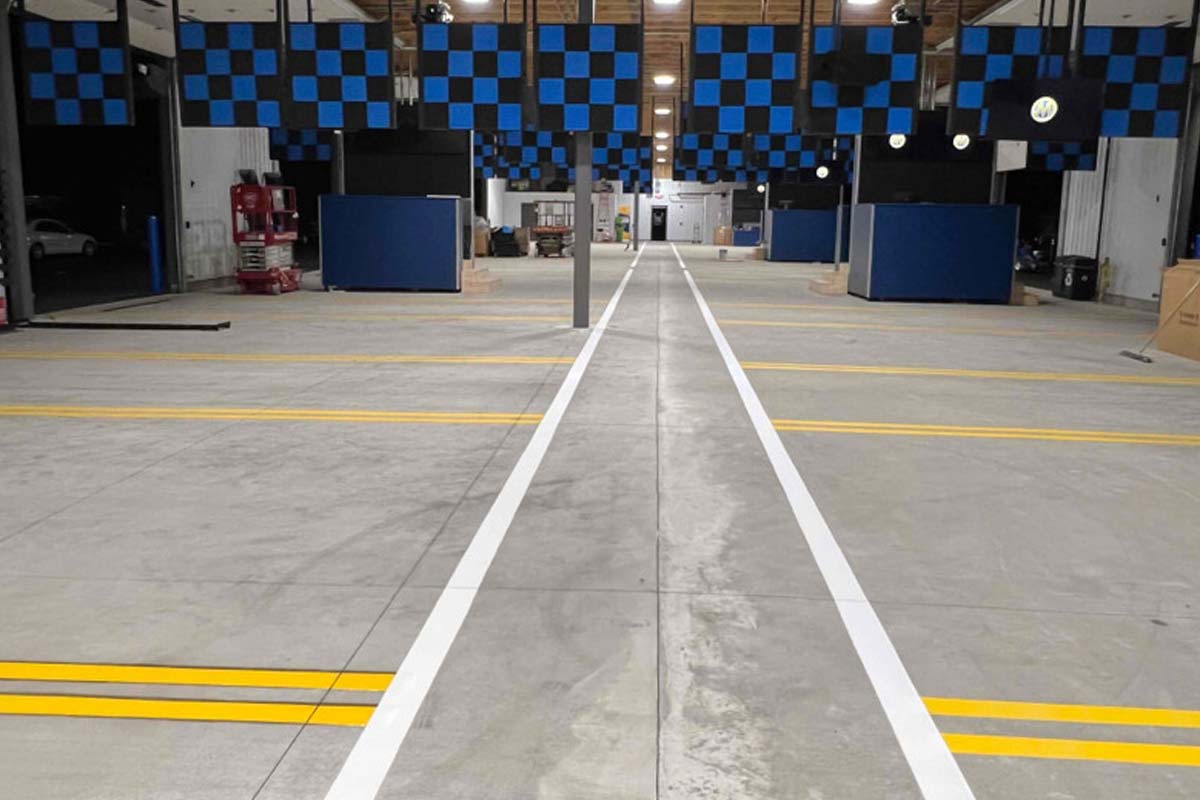
A marking plan for a working facility answers a traffic question before it answers a compliance question. The layout has to separate people from powered equipment, give forklifts predictable paths, and make the places where the two must cross obvious to both.
The elements we mark most often are permanent aisles and passageways, dedicated pedestrian walkways with crossing points at the doors and racking ends people actually use, staging and inbound or outbound zones, equipment parking and charging bays, keep-clear areas at electrical panels, eyewash stations, and fire equipment, and floor lettering for direction, speed, and restricted areas.
The most useful marking in most facilities is the one that is not required at all: a walkway that follows the route people already take. Marking the route somebody wishes staff would use fails quietly, because the marking loses to the shortcut every time.
Coatings, Downtime, and Phased Work in a Live Facility
Interior floor marking is chosen for wear and for cure time, and those two pull against each other. Traffic paint returns the aisle to service fastest and suits areas that see foot traffic and light equipment. Harder coatings last longer under forklift wheels and pallet drag but take the aisle out of service for longer. Tape is instantly usable and appropriate for zones expected to move.
Surface condition sets the ceiling on all of it. A sealed or heavily coated slab, a dusty slab, or one still holding cure compound will reject marking regardless of what is applied, so preparation is scoped honestly rather than assumed.
Live facilities are worked in phases. We take one aisle or one zone at a time, coordinate with your shift pattern, and keep the affected route closed until it is genuinely ready. Distribution operations rarely have a night off, so most of this work happens around production rather than instead of it.
For a full list of our pavement marking services, visit our parking lot striping in Philadelphia Suburbs page.
Businesses We Serve




How it Works

GET A FREE ESTIMATE
Contact us today and we’ll have a quote to you in 24 hours

SCHEDULE A STRIPING
We’ll have your space restriped in less than 7 days, without affecting your business hours

GET A PARKING LOT THAT POPS
For a budget-friendly price, you’ll get a parking lot that looks like new
We proudly work with:


We proudly work with:

Frequently Asked Questions About Warehouse Line Painting in Philadelphia Suburbs, PA
Does OSHA require a specific width or color for warehouse aisle lines?
No. The marking duty is in 29 CFR 1910.176(a), which says permanent aisles and passageways shall be appropriately marked and requires sufficient safe clearances. It gives no line width, no line color, and no aisle width. Separately, 29 CFR 1910.144 assigns yellow as the basic color for caution and physical hazards, which is where the yellow convention comes from. Anyone quoting you a federally mandated four-inch yellow line is describing custom, not regulation.
Which areas of a warehouse actually have to be marked?
Permanent aisles and passageways are the ones the regulation names. Beyond that, marking is driven by how the facility works: pedestrian walkways and the points where they cross equipment routes, staging and dock zones, equipment parking and charging, and keep-clear areas at electrical panels, fire equipment, and eyewash stations. The organizing question is where people and powered equipment share space, because that is where markings do their actual job.
Do you have to shut the warehouse down for line painting?
No. We work aisle by aisle and zone by zone around your shift pattern, closing only the section being marked and reopening it when it is genuinely ready rather than when the schedule says so. Facilities that run continuously usually give us a rotating set of aisles across several visits. What we will not do is release an aisle early, because a forklift through uncured marking means doing that aisle twice.
What is the difference between warehouse line painting and factory floor marking?
In practice, the terms describe the same work. Warehouse line painting, factory floor marking, industrial floor striping, and warehouse floor markings all refer to marking aisles, walkways, zones, and hazard areas on an interior slab. The differences that matter are not in the name but in the floor: sealed versus bare concrete, the type of equipment running on it, and how much downtime the operation can absorb.
Can you mark a sealed or coated concrete floor?
Usually, but the preparation changes and it needs to be scoped honestly up front. Marking bonds to the slab, so a sealer, a cure compound, or an existing coating sits between the marking and the surface it needs to grip. Depending on what is there, that means abrading, profiling, or using a system compatible with the existing coating. We check the floor before quoting rather than discovering it on the day.
Do warehouse markings need to be maintained once they are down?
They do, and the regulation is explicit that aisles must be kept clear and in good repair. Worn marking in a high-traffic aisle stops doing the thing it exists to do, which is telling a pedestrian and a forklift operator where each of them belongs. Pallet drag, wheel scrub, and cleaning equipment are what usually wear it. Most facilities we work with refresh the heaviest aisles on a shorter cycle than the rest of the floor.