Parking Lot Restriping
In Philadelphia Suburbs, PA
Restripe Existing Lines and Markings
1-800-STRIPER provides professional parking lot restriping in Philadelphia Suburbs, PA — refreshing faded stall lines, ADA stalls, fire lanes, and directional arrows so parking areas stay in the proper state of repair the 2024 International Property Maintenance Code requires, for commercial properties across Montgomery, Bucks, Chester, and Delaware counties.
1-800-STRIPER of Philadelphia Suburbs PROVIDes Parking Lot Restriping Services NEAR YOU
Need to brighten up your faded parking lot?
Keep your parking lot safe and attractive by restriping annually to freshen up lines and symbols that have faded from the sun, weather, and traffic. Nothing beats a fresh coat of paint!
Benefits:
When a Lot Is Due: Condition and Code Triggers
There are two separate reasons to restripe, and only one of them is cosmetic. The obvious one is visibility: lines fade, drivers improvise, and the lot loses stalls to bad parking. The one owners tend not to know about is that a worn lot can become a code condition rather than an appearance problem.
The 2024 International Property Maintenance Code, adopted across much of this region including Abington Township, states that sidewalks, walkways, stairs, driveways, parking spaces, and similar areas shall be kept in a proper state of repair and maintained free from hazardous conditions. Parking spaces are named in the text. The same code separately requires that the accessible features of a facility be maintained in good repair and free from impediments to accessibility, which puts a faded accessibility symbol or an unreadable access aisle in a different category from a faded stall line.
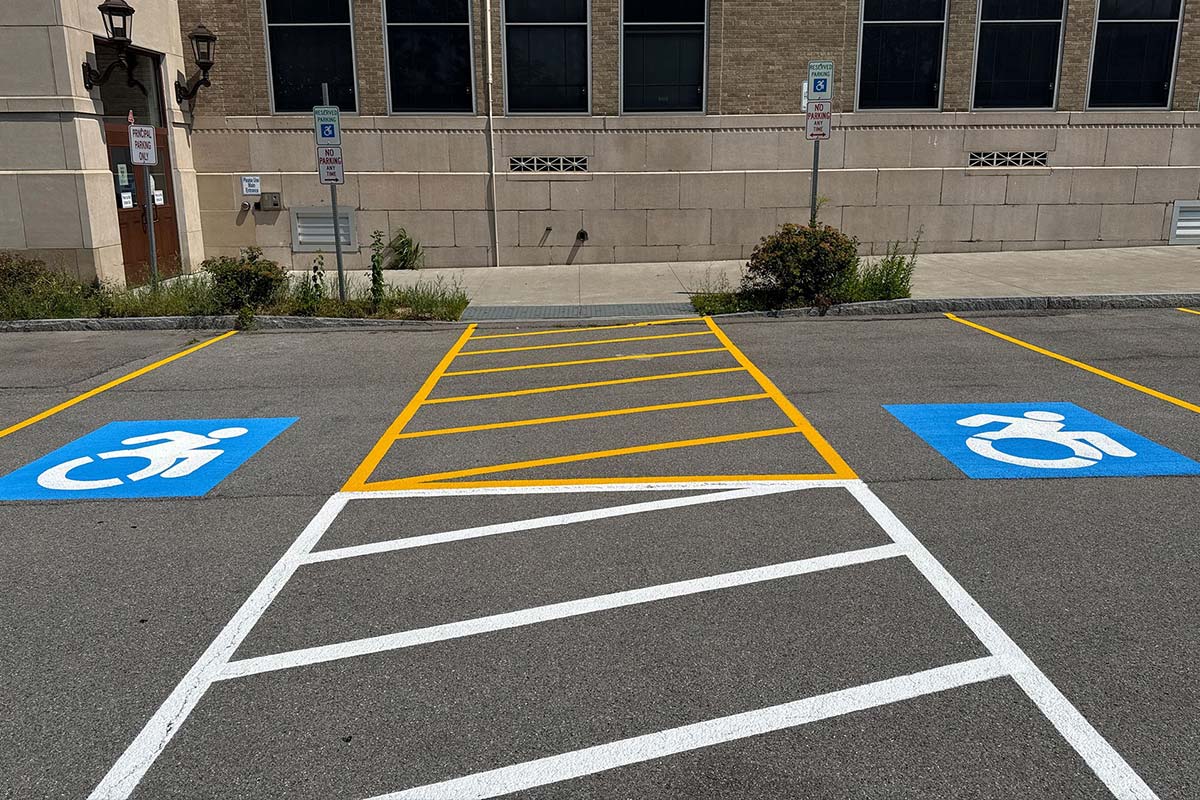
Practically, the triggers we see are these: lines readable only in dry daylight, accessible symbols worn through, fire lane markings that no longer read as continuous, drivers straddling stalls, a sealed or patched surface that buried the old layout, and a change of tenant or use that needs different geometry.
Surface Preparation and Capturing the Existing Layout
Preparation decides how long the work lasts, and it is the step most often skipped. Paint bonds to the pavement, not to what is sitting on it, so the surface has to be clean and dry. That means removing dirt, sand, and salt residue, clearing standing water, and dealing with oil-saturated areas, which will bleed through and reject coating if they are simply painted over.
Capturing the layout comes next. If the existing lines are still legible we lay out from them directly. If a seal coat or resurfacing has erased them, we work from measurements, photographs taken before the surface work, or a survey of the curbs, islands, and entrances that fix the geometry. This is the moment to correct anything that was wrong before, because putting faded lines back exactly where they were also puts back an accessible space that was too narrow.
We also check accessible provision against the standard at this stage rather than after. Restriping is the cheapest opportunity a property ever gets to fix stall count, aisle width, and route obstruction, and once fresh paint is down that opportunity closes for years.
How a restriping job runs
- Survey the lot, count existing stalls, and photograph the current layout.
- Check accessible spaces, aisles, and routes against the 2010 ADA Standards.
- Confirm any township requirements that apply to the geometry.
- Clean the surface and treat oil-saturated areas.
- Lay out from existing lines or from measured control points.
- Apply markings in sections so parts of the lot stay usable.
- Barricade fresh work and confirm when each section can take traffic.
Materials, Cure Time, and Getting the Lot Back
Most commercial restriping in this region uses water-based traffic paint, which is durable, low odor, and returns the lot to service quickly. Where a marking takes heavy wear, such as a main drive lane, a stop bar, or a crosswalk, thermoplastic is worth considering instead, and we cover that on its own page.
Cure time depends on temperature, humidity, and airflow more than on brand. Rather than quote a fixed number, we tell you what the conditions are giving us on the day and mark each section accordingly. The failure mode we design against is a driver crossing a line that looks dry, because tire marks through fresh paint mean redoing that section.
Scheduling is built around your property staying open. We split the lot into zones, take the quietest first, and move as vehicles move. For properties that genuinely cannot give up rows during business hours, overnight work is straightforward.
For a full list of our pavement marking services, visit our parking lot striping in Philadelphia Suburbs page.
Businesses We Serve




How it Works

GET A FREE ESTIMATE
Contact us today and we’ll have a quote to you in 24 hours

SCHEDULE AN INSTALLATION
We’ll have your installation scheduled in less than 7 days, without affecting your business hours

GET A PARKING LOT THAT POPS
For a budget-friendly price, you’ll get a parking lot that looks like new
We proudly work with:


We proudly work with:

Frequently Asked Questions About Parking Lot Restriping in Philadelphia Suburbs, PA
What does restriping a parking lot actually mean?
Repainting the markings on an existing lot: stall lines, accessible spaces and their access aisles, directional arrows, stop bars, crosswalks, fire lane markings, and any lettering such as reserved or no parking. Restriping normally puts the same layout back. If you want a different layout, more spaces, or corrected accessible provision, that is layout design work, and restriping is the natural moment to do it because the lot is already offline.
How often should parking lot striping be redone?
There is no fixed interval anyone can honestly publish, because wear depends on traffic volume, snow plowing, sun exposure, surface age, and what was used last time. The practical test is condition, not calendar: if lines are hard to read in low light or wet weather, if accessible symbols are worn, or if drivers are no longer parking within the stalls, the lot is due. Properties that are plowed each winter typically need attention sooner.
Is faded striping actually a code problem?
It can be. The 2024 International Property Maintenance Code, adopted across much of this region, requires that parking spaces and similar areas be kept in a proper state of repair and free from hazardous conditions, and separately that accessible features be maintained in good repair and free from impediments to accessibility. That reframes worn markings, especially worn accessible markings, as a maintenance obligation rather than a question of how the property looks.
Can I restripe my own lot?
You can paint lines. What is harder to do without equipment and practice is hold a straight line over a long run, keep stall widths consistent, get accessible spaces and aisles to the dimensions the standard requires, and apply at a film thickness that survives a winter of plowing. The parts that carry real consequence are the accessible spaces and the fire lane, because those are the ones inspected and the ones that create liability when they are wrong.
Do you need to seal coat before restriping?
Not necessarily, and the two are separate decisions. Sealing is a pavement treatment; restriping is a marking job. What restriping does require is a clean, dry, sound surface with no oil saturation. If a lot is being sealed by someone else, striping follows it, and this is the case where capturing the existing layout beforehand matters, since sealing erases the lines you would otherwise measure from.
How long before we can drive on it?
It depends on the temperature, humidity, and airflow on the day rather than on a number we can promise in advance. We tell you what the conditions are giving us, barricade fresh sections, and confirm section by section as each one is ready. Working in zones means the lot is never entirely out of service, and it means a section that needs longer can have it without holding up the rest of the property.