Sports Court Striping
In Philadelphia Suburbs, PA
Multi-Sport Court Line Marking
1-800-STRIPER provides professional sports court striping in Philadelphia Suburbs, PA — laying out pickleball courts with the seven-foot non-volley zone the USA Pickleball Official Rulebook specifies, plus basketball and tennis courts, on commercial hard courts and residential driveways across Montgomery, Bucks, Chester, and Delaware counties.
1-800-STRIPER® of Philadelphia Suburbs PROVIDes Sports Court Striping Services NEAR YOU
Want to get people to come out to play?
Brighten up your faded sport courts or turn your playground into a safe, colorful, and engaging space that entices people to come out and play.
Sport Court Specialties:
Commercial Hard Courts
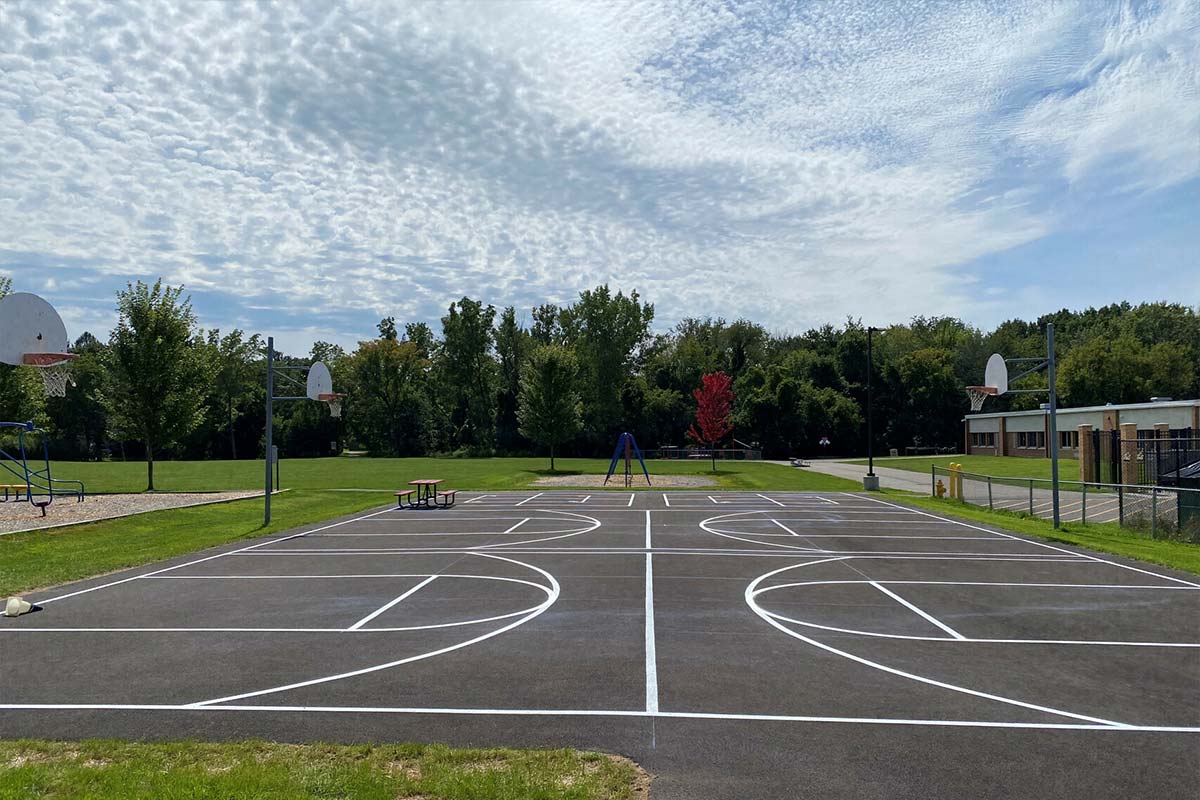
Commercial court work usually means one of three situations: a school, township park, or apartment community with an existing court that has faded; a single surface that needs to carry more than one sport; or a court being converted, most often from tennis toward pickleball.
Multi-use layouts are where the craft is. Two or three sets of lines on one surface is normal, and the difference between a court that plays well and one that confuses everybody is color separation, line priority, and deciding which sport owns the primary color. We lay out the dominant sport first and work the secondary sports around it rather than treating every line as equal.
Surface condition sets what is possible before layout does. Paint bonds to a sound, clean, dry surface; it does not fix cracking, ponding, or a failing coating underneath, and we say so rather than painting over a problem that will reappear.
| Court situation | What decides the layout |
|---|---|
| Existing court that has faded | Whether the surface is sound enough to take paint, and whether the original layout is still the right one |
| One surface carrying more than one sport | Which sport owns the primary color; secondary sports are worked around the dominant layout |
| Tennis court converting toward pickleball | Where the non-volley zone lands, and whether tennis lines stay as a second set or come out |
| Residential driveway or home pad | The space that actually exists; slope, and whether the surface must keep working as a driveway |
*Situations as described above. Full court dimensions come from the USA Pickleball Official Rulebook and are confirmed per court rather than assumed from a diagram.*
Residential Driveway Courts
Driveway and home courts are a real segment that the commercial market ignores, and they are straightforward work: a basketball key and three-point arc on a driveway, a home pickleball court on a flat concrete or asphalt pad, or a shuffleboard or hopscotch layout for a family space.
The constraints differ from commercial work. Space is fixed and rarely regulation, slope matters more, and the surface is often a driveway that also has to keep working as a driveway. We size the layout to the space that exists rather than forcing a full-size court into a pad that cannot take one, and we are honest when the geometry will not fit.
Paint choice leans toward durability under vehicle traffic where the surface is shared, since a driveway court gets driven on as well as played on.
Pickleball Layout and the Non-Volley Zone
Pickleball is the sport driving most court inquiries in this region, and its defining line is the non-volley zone. The USA Pickleball Official Rulebook describes the non-volley zone as the court area within seven feet on both sides of the net, and volleying from inside it is a fault, including where a player’s momentum carries them into the zone or onto its line after the volley.
That line is not decorative. Because the fault includes touching the line itself, the accuracy of where the non-volley zone is painted directly affects play. It is the line players call arguments over, and the one worth getting exactly right.
One useful piece of the rules for anyone planning a court: the same court size and basic rules apply to singles and doubles alike. You are not choosing between two different layouts. Full court dimensions and the complete rules are published in the USA Pickleball Official Rulebook, and we lay out to it rather than to a diagram found online.
Surface Condition, Paint, and Line Color
Court markings live or die on preparation. The surface has to be clean, dry, and structurally sound, with no loose or failing coating, no standing water, and no active cracking through the lines being laid.
Line color does real work on a multi-use court. Contrast against the surface is what makes a line readable at speed, and contrast between line sets is what stops a player reading the wrong sport’s boundary. Where a court carries pickleball alongside tennis or basketball, we pick color and line weight so each sport reads as a set rather than as a field of stripes.
We work in sections so a facility with several courts keeps some playable, and we mark fresh work so nobody walks onto it. Cure time depends on conditions on the day, and we confirm rather than promise a number in advance.
For a full list of our pavement marking services, visit our parking lot striping in Philadelphia Suburbs page.
Businesses We Serve




How it Works

GET A FREE ESTIMATE
Contact us today and we’ll have a quote to you in 24 hours

SCHEDULE AN INSTALLATION
We’ll have your play space restriped in less than 7 days, without affecting your playtime

GET A PARKING LOT THAT POPS
For a budget-friendly price, you’ll get a parking lot that looks like new
We proudly work with:


We proudly work with:


Frequently Asked Questions About Sports Court Striping in Philadelphia Suburbs, PA
How big is the non-volley zone on a pickleball court?
Seven feet from the net on each side. The USA Pickleball Official Rulebook describes the non-volley zone as the court area within seven feet on both sides of the net, and volleying from within it is a fault. That includes stepping on the line, and it includes cases where a player’s momentum carries them into the zone after the volley. Because the line itself is in play, painting it accurately matters more than on most court markings.
Can one court carry lines for more than one sport?
Most of the commercial work we do is exactly that. Two or three sets of lines on a single surface is normal, most commonly pickleball added to an existing tennis or basketball court. What makes it work is deciding which sport owns the primary line color, then giving the secondary sports enough contrast and a consistent weight so each set reads as a group. Done badly it looks like a field of stripes and plays worse.
Do you stripe residential driveway courts?
We do, and it is a segment most commercial contractors skip. Driveway basketball keys and three-point arcs, home pickleball courts on a flat pad, and family games such as shuffleboard or hopscotch are all straightforward. The main difference from commercial work is that the space is fixed and rarely regulation size, so we scale the layout to the pad you have and tell you honestly when a full-size court will not fit rather than cramming one in.
Can you convert a tennis court to pickleball?
That is the most common conversion we see right now. A single tennis court can accommodate pickleball, and the practical decisions are whether the tennis lines stay, how many pickleball courts fit, and what happens with the net. We lay out to the USA Pickleball Official Rulebook rather than to an online diagram. Where the tennis lines remain, color and weight separation keeps both sports readable on the same surface.
Does the court surface need repair before striping?
Occasionally, and we will tell you before rather than after. Markings bond to a clean, dry, structurally sound surface. Active cracking, ponding water, or a failing existing coating will show through new lines and will bring them off early. We assess the surface as part of the estimate. Where the court needs surface work first, that is a different trade, and we would rather say so than paint over a problem that returns in a season.
How long does a freshly striped court need before play?
It depends on temperature, humidity, and airflow on the day rather than a fixed figure. We mark and barricade fresh work and confirm when each court or section is genuinely ready. Facilities with more than one court are usually done in sequence so something stays playable throughout. The one thing we will not do is release a court early, because footfall through uncured line paint means restriping it.