ADA Parking Lot Striping
In Philadelphia Suburbs, PA
ADA-Compliant Accessible Parking
1-800-STRIPER provides ADA parking lot striping in Philadelphia Suburbs, PA — installing accessible spaces, van-accessible stalls, 60-inch access aisles, ISA symbols, and required signage per the 2010 ADA Standards for Accessible Design for commercial properties across Montgomery, Bucks, Chester, and Delaware counties.
1-800-STRIPER® of Philadelphia Suburbs PROVIDes ADA Parking Lot Striping Services NEAR YOU
Need to make your property more accessible?
Upgrade your facility to become fully ADA compliant by partnering with us to create clear, accessible parking for all your visitors.
Our ADA Compliant line striping services include:
How Many Accessible Spaces Your Lot Needs
The count comes from a table, and the table is calculated per parking facility rather than per site. That distinction catches people out: a property with three separate lots works out the requirement for each one on its own, and the advisory to the standard says so explicitly, because the whole point is that an accessible space has to be near where somebody is actually trying to go.
The scoping requirement runs from one accessible space for a facility of one to twenty-five, up through two for twenty-six to fifty, three for fifty-one to seventy-five, four for seventy-six to one hundred, and onward. Between 501 and 1,000 spaces the requirement becomes two percent of the total, and above 1,000 it becomes twenty plus one for each additional hundred or fraction of a hundred.
Hospital outpatient facilities carry a much higher requirement, ten percent of patient and visitor parking, and other use types have their own scoping. Getting the count right is the cheapest part of this work; discovering it is wrong after a complaint is the expensive part.
| Total spaces in the facility | Minimum accessible spaces |
|---|---|
| 1 to 25 | 1 |
| 26 to 50 | 2 |
| 51 to 75 | 3 |
| 76 to 100 | 4 |
| 101 to 150 | 5 |
| 151 to 200 | 6 |
| 201 to 300 | 7 |
| 301 to 400 | 8 |
| 401 to 500 | 9 |
| 501 to 1000 | 2 percent of total |
| 1001 and over | 20, plus 1 for each 100 or fraction over 1000 |
*2010 ADA Standards for Accessible Design, Table 208.2. Calculated separately for each parking facility on a site.*
Stall, Aisle, and Route Dimensions
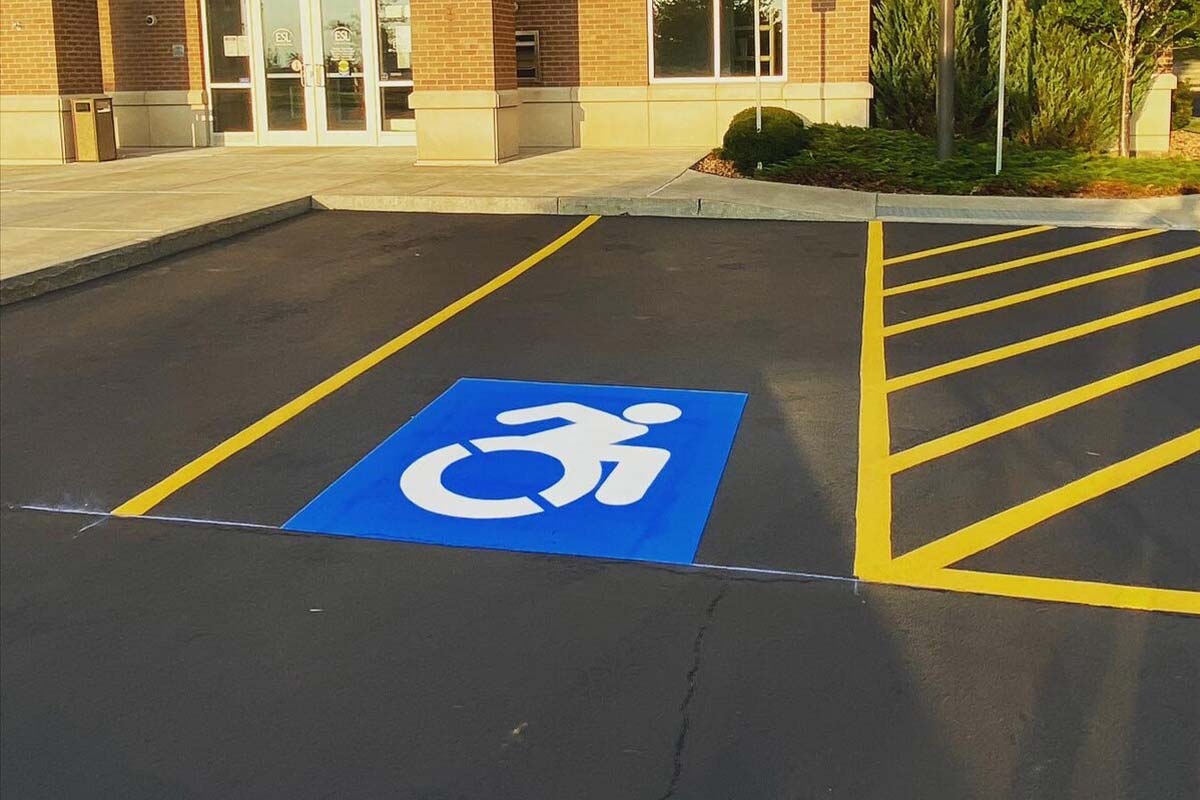
Car parking spaces are ninety-six inches wide at minimum and van parking spaces 132 inches, with an exception permitting a van space at ninety-six inches where its access aisle is itself ninety-six inches wide. Every space is marked to define that width and has an adjacent access aisle.
Access aisles are sixty inches wide at minimum, extend the full length of the spaces they serve, and may not overlap the vehicular way. Where van spaces are angled, the access aisle goes on the passenger side. Signs identifying accessible spaces carry the International Symbol of Accessibility, van spaces additionally carry a van accessible designation, and signs sit at least sixty inches above the finished floor or ground measured to the bottom of the sign.
One detail surprises almost every owner. The standard requires that access aisles be marked so as to discourage parking in them, and its advisory then states outright that the method and color of marking are not specified by these requirements, though they may be addressed by state or local law. Blue diagonal hatching is a convention, not a federal mandate. What is mandated is that the aisle be marked well enough that nobody parks in it.
Pennsylvania’s Accessibility Route: the Advisory Board, Not the Local Board
Pennsylvania handles accessibility differently from the rest of its construction code, and property owners rarely know this until they need it. Under 34 Pa. Code Section 403.122(j), a local board of appeals may not rule on requests for extensions of time, variances, or appeals relating to the accessibility requirements of the Uniform Construction Code. The Secretary holds the exclusive power to grant modifications and extensions of time and to decide issues of technical infeasibility.
Those requests go to the Accessibility Advisory Board under Section 403.142, which reviews applications and advises the Secretary. The Department also retains jurisdiction over the accessibility chapter of the code until a municipality employs or contracts with a code administrator certified as an accessibility inspector.
That matters commercially. If your property has a genuine technical infeasibility, an older site where a compliant route cannot be built without disproportionate work, the route to relief is a state process rather than a conversation with the township. Knowing which door to knock on is worth a great deal when a deadline is running.
For a full list of our pavement marking services, visit our parking lot striping in Philadelphia Suburbs page.
Businesses We Serve




How it Works

GET A FREE ESTIMATE
Contact us today and we’ll have a quote to you in 24 hours

SCHEDULE AN INSTALLATION
We’ll have your installation scheduled in less than 7 days, without affecting your business hours

GET A PARKING LOT THAT POPS
For a budget-friendly price, you’ll get a parking lot that looks like new!
We proudly work with:


We proudly work with:


Frequently Asked Questions About ADA Parking Lot Striping in Philadelphia Suburbs, PA
Does the ADA require accessible spaces to be painted blue?
It does not, and that genuinely surprises most owners. The 2010 ADA Standards require that access aisles be marked so as to discourage parking in them, and the advisory to that section says outright that the method and color of marking are not specified by these requirements, though state or local law may address them. Blue is an established convention rather than a federal mandate. The enforceable requirement is that the aisle is marked clearly enough to keep vehicles out of it.
How wide does an accessible space and its aisle have to be?
Car spaces are at least ninety-six inches wide and van spaces at least 132 inches, unless the access aisle is ninety-six inches wide, in which case a van space may also be ninety-six. The access aisle itself is at least sixty inches wide, extends the full length of the spaces it serves, and cannot overlap the vehicular way. For angled van spaces, the aisle goes on the passenger side of the space.
How high do accessible parking signs have to be mounted?
At least sixty inches above the finished floor or ground surface, measured to the bottom of the sign rather than the top. The sign carries the International Symbol of Accessibility, and signs for van spaces additionally carry a van accessible designation. That sixty-inch minimum exists so the sign stays visible when a vehicle is parked in the space, which is precisely when somebody needs to read it.
Is the accessible space count worked out for the whole property or each lot?
Each parking facility separately. The advisory to the scoping section is explicit that the term parking facility is used instead of parking lot so it is clear both lots and structures are covered, and that the required number is calculated per facility rather than based on the total across all facilities on a site. A property with three lots therefore satisfies the table three times, which usually means more accessible spaces than a single pooled calculation would give.
Who do I appeal to in Pennsylvania if compliance is technically infeasible?
Not the local board of appeals. Under 34 Pa. Code Section 403.122(j), a board of appeals may not rule on variances, extensions of time, or appeals relating to accessibility requirements. The Secretary holds exclusive power over those decisions, advised by the Accessibility Advisory Board established under Section 403.142. That is a state process, and it is a common and costly mistake to spend weeks pursuing relief through the township instead.
Our accessible symbols are worn. Does that need fixing?
It does, and sooner than faded stall lines elsewhere. The 2024 International Property Maintenance Code adopted across much of this region requires that the accessible features of a facility be maintained in good repair and free from impediments to accessibility. A worn symbol or an unreadable access aisle is therefore a maintenance obligation in its own right, and it is also the most visible sign to a visitor that accessible provision is not being taken seriously.