
Bollard Installation
In Philadelphia Suburbs, PA
Safety and Security Bollards
1-800-STRIPER provides professional bollard installation in Philadelphia Suburbs, PA — setting and anchoring protective bollards at storefronts, loading docks, utility meters, and pedestrian entries, with impact performance measured by the ASTM F3016 and ASTM F2656 test methods, for commercial properties across Montgomery, Bucks, Chester, and Delaware counties.
1-800-STRIPER® of Philadelphia Suburbs PROVIDes Bollard Installation Services NEAR YOU
Want to prevent accidents and protect your property?
Bollards provide physical protection for your customers and your property.
Safety and security:
Bollards create a physical barrier between vehicles and pedestrians, protecting people in walking areas from accidental or intentional vehicle intrusions.
Bollards act as a protective barrier around storefronts, gas stations, and other vulnerable areas, minimizing the risk of costly damage from vehicle impacts.
Strategic Placement Locations:
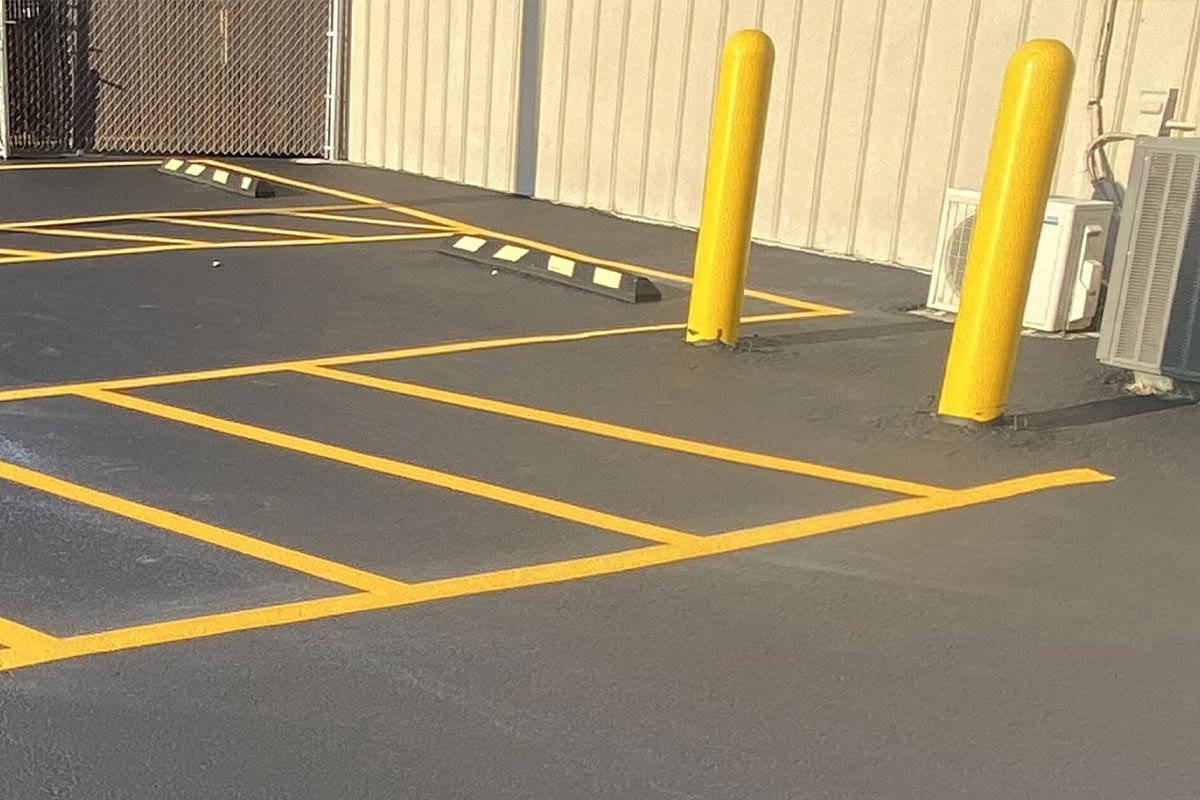
Where Bollards Belong on a Commercial Property
Bollards protect the places where a vehicle and something valuable or fragile meet, and the useful exercise on any property is walking it and asking where a driver could reach that they should not.
The recurring answers are storefronts and glazing, especially where parking faces the building head-on; entry doors and vestibules; utility infrastructure such as gas meters, electrical panels, transformers, and backflow preventers; loading docks and dock equipment; pedestrian areas including outdoor seating, walkways, and drive-through lanes; fuel and charging equipment; and building corners at turning points where trucks swing wide.
The failure that prompts most calls is a pedal error at low speed: a driver in a parking space who intends to brake and accelerates instead. That is a short distance at low speed, which is precisely the scenario a properly placed bollard is good at, and precisely the scenario that does serious damage to a storefront when nothing is there.
Fixed, Removable, and Sleeved
Three configurations, chosen by whether access ever needs to change.
Fixed bollards are set permanently, usually in a concrete footing, and are the default where the protected point never needs vehicle access. Removable bollards drop into a ground socket and lift out with a key or lock, which suits fire access routes, service entrances, and areas that close to traffic only at certain times. Sleeved bollards are a decorative cover over a structural core, and they are the option that most often gets misunderstood.
That misunderstanding is worth naming. A decorative sleeve over a structural pipe is protective. A decorative sleeve over nothing structural is a cosmetic post that looks identical from three feet away and stops nothing. If a bollard is being installed for protection rather than for appearance, what is inside the cover is the whole question.
| Configuration | How it is set | Where it suits |
|---|---|---|
| Fixed | Set permanently, usually in a concrete footing | Points that never need vehicle access: storefronts, glazing, utility meters, building corners |
| Removable | Drops into a ground socket, lifts out with a key or lock | Fire access routes, service entrances, areas that close to traffic only at certain times |
| Sleeved | Decorative cover over a core; protective only if that core is structural | Locations where appearance matters, provided what is inside the cover is specified |
*Footing does the work in every configuration. Embedment, footing size, and whether the core is filled matter more to real-world performance than the appearance above ground.*
Impact Test Methods and Specifying the Right Level
There are published test methods for how much impact a protective device withstands, and knowing they exist changes how you specify. ASTM F3016 is the Standard Test Method for Surrogate Testing of Vehicle Impact Protective Devices at Low Speeds. ASTM F2656 is the Standard Test Method for Crash Testing of Vehicle Security Barriers, which addresses the higher-speed end.
We reference those as the framework the industry uses to describe performance, and we are careful about what that reference means. A test method describes how a device is evaluated; it is not a rating we assert about a product we did not test. Where a property genuinely needs a rated barrier, that is a specified product with documentation behind it, and the honest thing is to say so rather than to imply a bollard is rated because a standard number appears near it.
For most commercial properties the requirement is not a rated security barrier. It is a well-placed, correctly footed bollard sized for low-speed impact at a storefront or a gas meter. Being clear about which of those you need is the difference between money well spent and money spent on the wrong thing.
Footing does the work either way. A bollard is only as good as what holds it, and the embedment, footing size, and whether the core is filled matter more to real-world performance than the appearance above ground.
For a full list of our pavement marking services, visit our parking lot striping in Philadelphia Suburbs page.
Businesses We Serve




How it Works

GET A FREE ESTIMATE
Contact us today and we’ll have a quote to you in 24 hours

SCHEDULE AN INSTALLATION
We’ll have your installation scheduled in less than 7 days, without affecting your business hours

GET A PARKING LOT THAT POPS
For a budget-friendly price, you’ll get a parking lot that looks like new
We proudly work with:


We proudly work with:


Frequently Asked Questions About Bollard Installation in Philadelphia Suburbs, PA
Do I need a permit to install a bollard?
It depends on the municipality and on where the bollard goes. Protective posts on private property in front of a storefront are often treated differently from work affecting a public sidewalk, an easement, or a fire access route, and our service area covers roughly eighty-one municipalities, each of which sets its own requirements. The place to confirm is the township, borough, or city your property sits in, and it is worth doing before installation.
What type of contractor installs bollards?
Site and parking lot contractors typically do, which is why it sits alongside our striping and wheel stop work: the same site knowledge, the same equipment for cutting and coring pavement, and the same visit. General contractors and fence contractors also install them. What matters more than the label is whether whoever does it treats the footing as the main event, because embedment and footing size determine performance far more than the post you can see.
Are decorative bollard covers protective?
Only if there is something structural inside them. A sleeve fitted over a structural steel pipe set in a proper footing is protective, and the cover is finish. A decorative post with nothing structural inside is cosmetic, and it looks identical from a few feet away while stopping nothing. If you are installing bollards because of a real impact risk rather than for appearance, what is inside the cover is the entire question worth asking.
What is the difference between fixed and removable bollards?
Whether the access can change. Fixed bollards are set permanently in a footing and suit points that never need vehicle access. Removable bollards drop into a ground socket and lift out with a key or lock, which suits fire access routes, service entrances, and areas restricted only at certain times. Removable units trade some impact performance for that flexibility, so the choice follows what the location actually needs rather than a preference.
How are bollards rated for impact?
Through published test methods. ASTM F3016 is the Standard Test Method for Surrogate Testing of Vehicle Impact Protective Devices at Low Speeds, and ASTM F2656 is the Standard Test Method for Crash Testing of Vehicle Security Barriers at the higher-speed end. Those describe how a device is evaluated. A rated barrier is a specified product with test documentation behind it, and most commercial properties need a well-placed, properly footed bollard rather than a rated security barrier.