Thermoplastic Striping
In Philadelphia Suburbs, PA
Long-Lasting Pavement Markings
1-800-STRIPER provides professional thermoplastic striping in Philadelphia Suburbs, PA — heat-applied preformed and extruded markings for stop bars, crosswalks, directional arrows, and fire lanes that bond into the pavement instead of drying on top of it, for high-traffic commercial lots across Montgomery, Bucks, Chester, and Delaware counties.
1-800-STRIPER® of Philadelphia Suburbs PROVIDes Thermoplastic Striping Services NEAR YOU
Want to reduce the maintenance requirements for your parking lot?
Thermoplastic pavement markings are a durable, weather and vehicle-resistant striping option for your parking lot or facility.
You can utilize them for stop bars, ADA stalls, no-parking zones, directional arrows, crosswalks, or your entire parking lot.
Benefits:
How Thermoplastic Differs From Traffic Paint
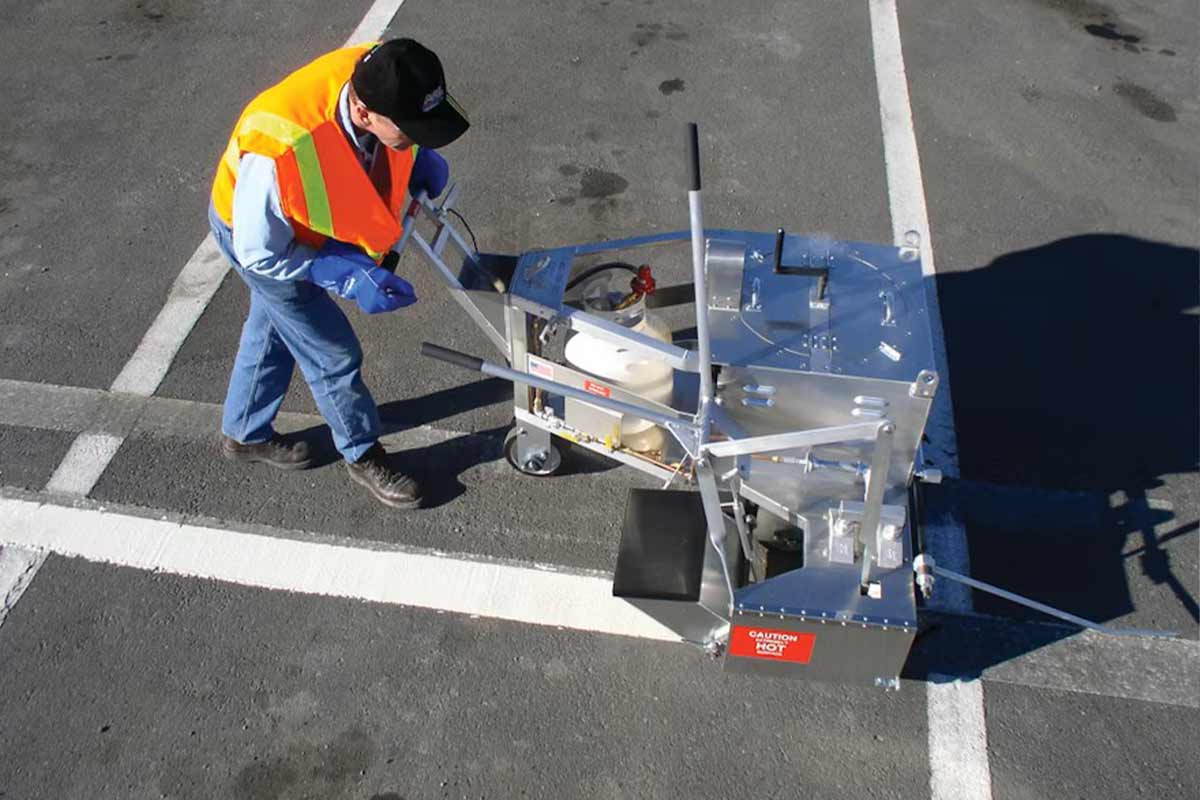
Thermoplastic is not a thicker paint. It is a solid material heated until it flows, applied hot, and then cooled into place, and the difference that matters is where the marking ends up relative to the pavement. Traffic paint dries on top of the surface as a film. Thermoplastic bonds into the surface as a body of material with real thickness.
That single difference drives everything else. A thicker marking wears down rather than wearing off, which is why thermoplastic holds up under the wheel paths, turning movements, and plow blades that strip paint from a busy lot. It also means the marking sits proud of the surface, which changes how it sheds water and how it takes glass beads for retroreflectivity.
It is not the right answer everywhere. Thermoplastic costs more to install, needs the right surface and conditions, and is harder to remove or change than paint. On a lot whose layout may be revised, that permanence is a drawback rather than a feature.
Preformed Versus Extruded
Two forms of the same idea. Preformed thermoplastic arrives as a cut shape, an arrow, a legend, a symbol, or a section of crosswalk bar, laid on the prepared surface and heated in place until it bonds. Extruded thermoplastic is melted in a kettle and applied as a continuous line through a die or screed.
Preformed suits shapes: directional arrows, accessible symbols, lettering such as stop or fire lane, crosswalk blocks, and anything where a crisp repeated form matters. Extruded suits runs: long lines, lane boundaries, and continuous marking where a machine can hold a straight path.
Most jobs use both. A drive lane gets extruded line work and the symbols within it are preformed, because that combination gives consistent geometry on the shapes and a clean continuous edge on the lines.
| Preformed | Extruded | |
|---|---|---|
| Form supplied | Pre-cut shapes and sections | Solid material melted on site |
| Best for | Arrows, legends, symbols, crosswalk bars | Long continuous lines and lane boundaries |
| Application | Placed on the surface and heated in place | Applied hot through a die or screed |
| Typical use in a lot | Directional and accessibility markings | Main drive lanes and boundaries |
Where Thermoplastic Earns Its Place
Thermoplastic belongs where the marking gets punished, not across an entire lot. The places that repay it are drive lanes carrying every vehicle that enters, stop bars and crosswalks at internal intersections, directional arrows at decision points, entrance and exit routing, and fire lane markings that must stay legible.
Standard stall lines in the middle of a lot rarely justify it, because a stall line is driven over far less than the aisle beside it. A sensible specification for most commercial properties is thermoplastic on the circulation elements and traffic paint on the stalls, which puts the money where the wear is.
The other case for it is disruption. If a property is difficult to take offline, a longer-lasting marking on the high-wear elements means fewer return visits, and for some owners that is worth more than the material itself.
Surface and Weather Requirements
Thermoplastic is less forgiving than paint about what it is applied to. The surface must be clean, dry, and sound. Dirt, dust, and salt residue prevent bonding. Oil-saturated areas reject it. A surface that is deteriorating underneath will take the marking with it when it fails.
New asphalt needs time before thermoplastic goes down, and freshly sealed surfaces bring their own compatibility questions. Where a lot has just been resurfaced or sealed, we confirm the surface is ready rather than assuming a date on a calendar.
Weather governs scheduling in this region more than most. Application depends on surface temperature and moisture, which in Montgomery, Bucks, Chester, and Delaware counties means the season is real and the shoulder months need watching. We book thermoplastic around conditions rather than promising a date the weather may not honor.
Standards and Specification
The material standard commonly referenced for thermoplastic pavement marking material is AASHTO M249. It is worth being precise about what that means for a private parking lot: it is a material specification used in highway work, and a highway specification does not bind a commercial property. Referencing it tells you what class of material is being supplied; it does not make your lot a state road.
Application temperature is a question we get and decline to answer with a number. There is no primary public source that fixes one, because it belongs to the individual product’s manufacturer instructions rather than to a standard. Anyone quoting you a single figure as though it were specified is repeating a number rather than citing one.
What we will put in writing is the material form, where each type is being used, and the surface preparation being done. Those are the decisions that determine whether the marking is still there in five years.
For a full list of our pavement marking services, visit our parking lot striping in Philadelphia Suburbs page.
Businesses We Serve



How it Works

GET A FREE ESTIMATE
Contact us today and we’ll have a quote to you in 24 hours

SCHEDULE AN INSTALLATION
We’ll have your installation scheduled restriped in less than 7 days, without affecting your business hours

GET A PARKING LOT THAT POPS
For a budget-friendly price, you’ll get a parking lot that looks like new
We proudly work with:


We proudly work with:

Frequently Asked Questions About Thermoplastic Striping in Philadelphia Suburbs, PA
What is thermoplastic line striping?
A pavement marking made from a solid material that is heated until it flows, applied hot, and cooled into place. Unlike traffic paint, which dries as a thin film on top of the surface, thermoplastic bonds into the pavement as a body of material with real thickness. That thickness is why it survives wheel paths, turning movements, and plow blades far longer than paint, and why it is normally specified for the parts of a lot that take the heaviest traffic.
How long does thermoplastic striping last?
Considerably longer than traffic paint in the same location, though nobody can honestly give you a single figure because it depends on traffic volume, the type of vehicles, snow plowing, surface condition, and where the marking sits in the lot. What we can say with confidence is the comparison: a thermoplastic marking wears down gradually rather than wearing off, so it stays functional through a stage where paint would already need redoing.
What are the disadvantages of thermoplastic?
Three real ones. It costs more to install than paint. It is less forgiving about surface condition and weather, so scheduling in this region has a genuine season. And it is harder to remove or change, which matters if your layout might be revised, since a thermoplastic line is a commitment in a way a painted one is not. That is why we usually specify it selectively rather than across an entire lot.
Can you paint over thermoplastic?
You can apply paint over it, but it is rarely the right answer and it does not make the thermoplastic disappear. Because the material has real thickness, the shape underneath stays visible as a raised profile even when the color above changes, which is why overpainting a layout change tends to leave a confusing ghost. Where a thermoplastic marking is genuinely in the wrong place, removal is the honest fix rather than covering it.
What temperature is thermoplastic applied at?
We do not publish a figure, and you should be cautious about anyone who does. There is no primary public standard that sets an application temperature: it belongs to the specific product’s manufacturer instructions, which vary between materials. A number repeated widely across the trade is not the same thing as a specification. What we can tell you in writing is which material form is being used, where, and what surface preparation it is getting.
Should my whole lot be thermoplastic?
Almost never, and we would advise against it. The value is concentrated where markings get punished: main drive lanes, stop bars, crosswalks, directional arrows at decision points, and fire lane markings. Standard stall lines in the middle of a lot are driven over far less and rarely justify the cost. A sensible specification puts thermoplastic on the circulation elements and traffic paint on the stalls, which is where the wear actually is.