Wheel Stop Installation
In Charlotte, NC
Concrete and Rubber Parking Stops
1-800-STRIPER provides professional wheel stop installation in Charlotte, NC — anchoring concrete, recycled-rubber, and plastic-composite wheel stops at stall heads to protect sidewalks, storefronts, and ADA accessible routes for commercial properties throughout Mecklenburg County.
1-800-STRIPER® of Charlotte PROVIDes Wheel Stops Services NEAR YOU
Need to protect vehicles or walls from accidental damage?
Wheel stops (also called parking blocks) protect your property, enhance safety, and improve parking lot organization.
Benefits:
Wheel stops prevent vehicles from parking too far into a space or overextending into other spots, pedestrian walkways, and other areas, while also helping with vehicle alignment. They can prevent damage to buildings, curbs, or landscaping. Wheel stops also serve as clear visual cues for proper parking and are sometimes used on slopes to prevent cars from rolling.
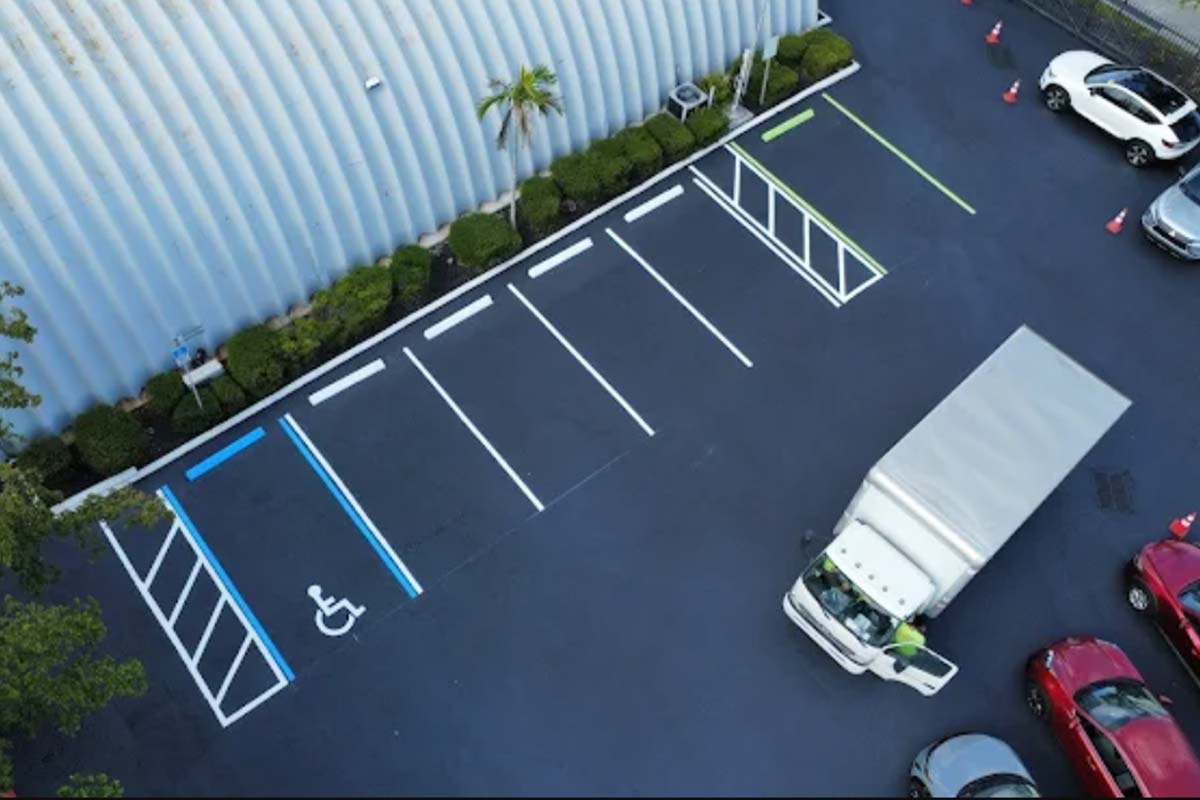
Wheel Stop Installation in Charlotte
Wheel stops do one job: they keep vehicles from rolling past the stall line. When they’re missing, parked cars drift into sidewalks, block ADA accessible routes, and damage storefronts — problems that translate directly into liability exposure for property owners. The fix is straightforward, but only when the right material is selected, anchored correctly, and set at the right distance from the stall head.
1-800-STRIPER installs wheel stops across Charlotte commercial properties, from strip malls and office parks in South End and Ballantyne to warehouse yards in Steele Creek and logistics centers along I-85. Every installation starts with a site walk to check surface condition, stall dimensions, and accessible-route clearance before a single pin goes into the pavement.
Standard wheel stops run roughly six feet long and sit anchored either with steel rebar pins driven into asphalt or anchor bolts set into concrete — the choice depends on your lot surface. Placement typically lands 24 to 36 inches back from the stall head, leaving enough room in front for bumpers and enough clearance behind for pedestrians and accessible routes. Getting that position right matters more than most property managers expect: a stop placed too far forward can reduce the accessible route width below the 36-inch minimum required by the 2010 ADA Standards for Accessible Design.
Charlotte’s growth — new mixed-use developments along the Lynx Blue Line corridor, expanding logistics parks near the airport, and densifying retail in areas like Steele Creek and Cabarrus County — means a lot of new pavement going down every year. Many of those lots get striping and curbing right away, but wheel stops are sometimes treated as an afterthought. Properties that skip them or defer installation often see accelerated sidewalk edge damage, recurring complaints from pedestrians, and ADA exposure that surfaces during a facility audit.
Correct wheel stop installation isn’t complicated, but it requires reading the lot’s surface conditions, accessible parking layout, and traffic patterns together. That combination — material, anchor type, setback distance, and placement relative to accessible routes — is what separates a stop that lasts 15 years from one that shifts after the first winter.
1-800-STRIPER of Charlotte has a 5-star Google rating from 14 local reviews. Call (704) 828-9922 or email Charlotte@1800STRIPER.com for a free estimate.
Concrete vs. Rubber vs. Plastic: Which Wheel Stop Is Right for Your Lot?
Choosing the wrong material means an early replacement — or a wheel stop that shifts, cracks, or creates a trip hazard after a single Charlotte winter. The table below compares the three types on the factors that matter most for commercial properties in the Charlotte metro.
| Feature | Concrete | Recycled Rubber | Plastic Composite |
|---|---|---|---|
| Durability | Very high — resists impact, UV, and moisture; can last 20+ years with proper anchoring | High — absorbs impact well; UV-stabilized rubber holds up through heat cycles | Moderate — lighter construction; may need more frequent replacement in high-traffic lots |
| Weight | Heavy (60–80 lbs typical) — stays in place under repeated impact | Medium (30–50 lbs typical) — easier to reposition if needed | Light (10–25 lbs typical) — fast to install, easier to move |
| Cost Tier | Mid to high upfront; lower lifetime cost | Mid range; balance of upfront cost and service life | Lower upfront; potentially higher over time in heavy-use areas |
| Anchoring | Rebar pins (asphalt) or anchor bolts (concrete slab) | Pre-drilled holes; rebar pins or anchor bolts | Pre-drilled holes; typically anchor bolts or lag screws |
| Climate Suitability (Charlotte) | Excellent — unaffected by NC heat and humidity; no freeze-thaw concern in the Charlotte metro | Good — rubber performs well in heat; stays flexible in temperature swings | Fair — some composites soften in prolonged heat; verify manufacturer’s temperature rating |
For high-volume lots — grocery anchors, big-box centers, distribution facilities in Concord or Gastonia — concrete stops typically offer the best return. Recycled rubber is a strong fit for mixed-use retail and office properties where vehicle contact is lighter and appearance matters. Plastic composite makes sense for lower-traffic areas or temporary installations where future reconfiguration is likely.
ADA Placement: Protecting the 36-Inch Accessible Route
Wheel stops that intrude on an accessible route aren’t just a code issue — they’re a physical barrier for wheelchair users, people using walkers, and anyone with limited mobility.
Under the 2010 ADA Standards for Accessible Design, §403 requires accessible routes to maintain a minimum 36-inch clear width. A wheel stop positioned too far forward — or a stop that has shifted over time — can narrow that corridor below the threshold. The North Carolina State Building Code, Chapter 11 adopts these federal requirements and applies them to new construction and alterations across Charlotte and Mecklenburg County.
Proper placement keeps stops clear of accessible routes: typically set back so the front face of the stop does not project into the accessible aisle or path of travel adjacent to accessible stalls. On lots with designated accessible parking, this means accounting for the access aisle width (minimum 60 inches for standard accessible stalls, 96 inches for van-accessible stalls) in addition to the route behind the stop.
1-800-STRIPER reviews accessible parking configurations before installation. If existing stops are mispositioned, we flag the issue as part of the site assessment so corrections can be made before new anchoring goes in.
Our Installation Process
Wheel stop installation follows a consistent sequence — site conditions vary, but the steps don’t.
- Site assessment. We walk the lot, check surface type (asphalt or concrete), measure stall depth, and confirm accessible-route clearances. Damaged pavement around planned anchor points gets noted before work begins.
- Layout and marking. Stall positions are marked for stop placement, referencing the painted stall lines for alignment. Offset from the stall head is confirmed against ADA clearance requirements.
- Drilling. Anchor holes are drilled at the required spacing for the selected stop type — concrete cores or asphalt boring depending on your lot surface.
- Anchoring. Rebar pins are driven for asphalt; anchor bolts are set and torqued for concrete slabs. Hardware is sized to the stop material and expected vehicle load.
- Final check. Each installed stop is checked for level, secure seating, and correct setback distance. Any freshly drilled spoils are cleared from the pavement surface.
Most installations are completed in a single visit. Larger lots — multi-level parking structures, shopping centers in Huntersville or Matthews — are scheduled in phases to keep parking available during the work.
Where Wheel Stops Protect Commercial Properties in Charlotte
Wheel stops show up in more situations than standard retail parking lots. Across the Charlotte metro, 1-800-STRIPER installs stops at:
- Retail strip centers and shopping plazas — protecting storefronts and sidewalks along corridors in Pineville, Cornelius, and Indian Trail
- Office parks and corporate campuses — securing pedestrian walkways in areas like University Research Park and Ballantyne Corporate Park
- Warehouse and distribution facilities — lining loading dock aprons and staging areas in Steele Creek, Westport, and along the I-485 industrial corridor
- Grocery and big-box anchors — high-turnover lots where stops take regular contact from shopping carts and delivery vehicles
- Healthcare facilities — patient drop-off zones and accessible parking fields at medical office buildings across Mecklenburg and Cabarrus counties
- Multi-family and mixed-use — structured parking garages and surface lots in uptown Charlotte and South End
- Municipal and institutional lots — school parking facilities, government buildings, and community centers throughout the county
Every site has different pavement conditions, traffic patterns, and accessible-route configurations. Getting the material choice and placement right from the start avoids callbacks and early replacements.
Mecklenburg County’s climate plays a role too. Charlotte sits in a mixed-humid zone — hot summers, mild winters, and occasional hard freezes that stress pavement around anchor holes. Concrete stops handle these conditions without issue. Rubber stops with UV-stabilized compounds also perform well. Composite stops vary by manufacturer; properties considering plastic composite in high-sun exposures like west-facing lots should verify the material’s rated temperature range before committing.
For property managers overseeing multiple locations in the Charlotte metro — corporate campus portfolios, retail center groups, HOA-managed parking areas — 1-800-STRIPER can coordinate phased installation schedules across sites to minimize disruption. Contact us at (704) 828-9922 or Charlotte@1800STRIPER.com to discuss your portfolio and get a free site estimate.
Maintenance and Replacement
Wheel stops don’t last forever, but most failures are predictable. Concrete stops crack along anchor-hole stress lines when the sub-base settles or when anchors loosen and the stop begins to rock under repeated vehicle contact. Rubber stops degrade at the anchor holes first — once the bore widens, the stop starts shifting with every bump. Composite stops may fade and become brittle after years of direct UV exposure in Charlotte’s long summers, reaching a point where they crack underfoot and fragment under a tire.
A visual inspection once or twice a year catches most problems before they become hazards. Look for stops that rock when pushed, visible cracks across the body, anchor hardware that has backed out of the pavement surface, or any stop that has migrated from its original marked position. A shifted stop — even a few inches — can block an accessible route or leave a stall head unprotected on one side.
Parking lots that get restriped regularly are good candidates for a concurrent wheel stop review. Faded paint and damaged stops tend to age together, and addressing both in a single scheduled visit keeps the property’s parking field in consistent condition. Properties that were striped years ago with no interim maintenance often have stops that are technically functional but have drifted enough to create alignment issues with updated stall markings.
1-800-STRIPER handles wheel stop replacement alongside any lot-wide striping refresh or as a standalone service. If your property has aging stops due for assessment, call (704) 828-9922 or email Charlotte@1800STRIPER.com and we’ll schedule a free site review.
For a full list of our pavement marking services, visit our parking lot striping in Charlotte page.
Businesses We Serve




How it Works

GET A FREE ESTIMATE
Contact us today and we’ll have a quote to you in 24 hours

SCHEDULE AN INSTALLATION
We’ll have your installation scheduled restriped in less than 7 days, without affecting your business hours

GET A PARKING LOT THAT POPS
For a budget-friendly price, you’ll get a parking lot that looks like new
We proudly work with:


We proudly work with:

Frequently Asked Questions About Wheel Stop Installation in Charlotte, NC
How long does wheel stop installation take for a typical commercial lot in Charlotte?
Most standard retail or office lots — anywhere from 20 to 60 stalls — can be completed in a single day. Larger properties like shopping centers or warehouse facilities with 100-plus stalls are usually phased over two visits to keep sections of the lot open during the work. Surface conditions matter too: freshly sealed asphalt drills faster than aged, oxidized pavement. 1-800-STRIPER provides a timeline estimate during the site assessment before any work is scheduled. Call (704) 828-9922 for a free estimate.
What’s the difference between rebar pins and anchor bolts, and which does my lot need?
The anchor type depends on your pavement surface. Rebar pins — typically steel rod driven into pre-drilled holes — are the standard choice for asphalt lots. They grip the flexible asphalt matrix and hold the stop against lateral movement from vehicle contact. Anchor bolts are used on concrete slabs, where the rigid surface requires a threaded fastener torqued into a sleeve anchor. Using the wrong anchor for your surface leads to early loosening and stop migration. 1-800-STRIPER assesses surface type during the site walk and specifies the correct hardware accordingly.
Can wheel stops be installed near ADA accessible parking stalls?
Yes, and they often need to be — but placement must be planned carefully. The 2010 ADA Standards for Accessible Design require accessible routes to maintain a 36-inch minimum clear width under §403. A wheel stop that encroaches on the access aisle or adjacent pedestrian path reduces that clearance and creates a code violation. Proper setback — typically 24 to 36 inches from the stall head — keeps the stop inside the stall footprint and out of the accessible route. 1-800-STRIPER confirms clearances before installing any stop near accessible parking.
How do I know when a wheel stop needs to be replaced rather than re-anchored?
Re-anchoring works when the stop body is structurally sound but hardware has loosened over time. Replacement is the right call when the stop shows cracks running from anchor holes toward the edge (stress fractures that will spread under impact), when the anchor bores have widened to the point that new hardware won’t grip cleanly, or when a rubber stop has split lengthwise. A composite stop that has become brittle — chalky surface, audible cracking underfoot — should be replaced before it shatters under a vehicle tire and creates a debris hazard. When in doubt, a quick site assessment by 1-800-STRIPER clarifies which stops are worth re-securing and which are due for full replacement.
Do wheel stops work in both asphalt and concrete parking lots?
All three major wheel stop materials — concrete, recycled rubber, and plastic composite — can be installed in either asphalt or concrete lots. The material choice doesn’t change with surface type; the anchor method does. Asphalt gets rebar pins, concrete gets anchor bolts. What does affect material selection is the traffic load and climate exposure at your specific site. Concrete stops are generally the most durable option for high-volume lots regardless of surface. Rubber and composite stops are viable for lighter-use applications on either surface type. 1-800-STRIPER specifies the right combination of material and anchor hardware for your lot’s conditions.
Does Charlotte have any local requirements beyond federal ADA standards for wheel stop placement?
The North Carolina State Building Code, Chapter 11 adopts the federal ADA accessibility requirements and applies them to construction and alterations in Charlotte and across Mecklenburg County. For most commercial parking lots, this means the same 36-inch accessible-route clearance and accessible-stall dimensional requirements that apply federally under the 2010 ADA Standards. Charlotte’s permitting requirements for parking lot work can vary depending on the scope of the project and whether the site triggers a development review under the Charlotte Unified Development Ordinance. For anything involving a major lot reconfiguration, it’s worth checking with Charlotte-Mecklenburg planning before the work begins. 1-800-STRIPER focuses on correct placement per ADA and NC code on every installation.