ADA Parking Lot Striping
In Charlotte, NC
ADA-Compliant Accessible Parking
1-800-STRIPER provides ADA-compliant parking lot striping in Charlotte, NC — installing accessible spaces, van-accessible stalls, access aisles, ISA symbols, and required signage per the 2010 ADA Standards for Accessible Design and the North Carolina State Building Code accessibility provisions.
1-800-STRIPER® of Charlotte PROVIDes ADA Compliance Services NEAR YOU
Need to make your property more accessible?
Upgrade your facility to become fully ADA compliant by partnering with us to create clear, accessible parking for all your visitors.
Our ADA Compliant line striping services include:
ADA Parking Lot Striping in Charlotte
ADA-compliant parking lot striping is a legal obligation, not a discretionary upgrade. The 2010 ADA Standards for Accessible Design and the North Carolina State Building Code, Chapter 11 govern parking accessibility together, and Charlotte properties must satisfy both. Faded lines, missing symbols, or non-compliant dimensions leave property owners exposed to federal civil rights complaints and state code enforcement actions.
1-800-STRIPER of Charlotte installs and refreshes ADA-compliant parking layouts for commercial lots, shopping centers, office parks, healthcare campuses, and municipal facilities across Mecklenburg, Gaston, Cabarrus, and Union counties. Every job follows current ADA Standards dimensions and signage requirements. Call (704) 828-9922 or email Charlotte@1800STRIPER.com for a free estimate.
ADA Accessible Parking Requirements (§502)
Section 502 of the 2010 ADA Standards defines what makes a parking space legally accessible. A compliant accessible space must be at least 96 inches wide, with a dedicated access aisle at least 60 inches wide running alongside it. That aisle cannot be shared between two spaces unless both spaces connect to the same aisle. The pavement within each accessible space and its aisle must have a surface slope no steeper than 1:48 (approximately 2%) in any direction — slopes beyond that threshold make the space technically non-compliant even if the dimensions are correct.
Van-accessible spaces require either a 96-inch access aisle — the more common layout — or an 8-foot-wide space paired with a 60-inch aisle as an alternate configuration. Every accessible space must connect to an accessible route: a continuous path leading to the building entrance without steps, abrupt level changes, or cross-slopes beyond 1:48. Where a lot’s accessible route crosses a drive lane, it must be marked as a pedestrian crossing. The U.S. Access Board publishes detailed technical guidance on these dimensional requirements.
Accessible spaces must sit on the shortest accessible route from the parking area to the entrance they serve. When a lot feeds multiple building entrances, accessible spaces must be distributed so each entrance has coverage — you cannot cluster all compliant spaces at one end of the lot and call it done. Lots that serve multiple buildings or multiple entrances need a thoughtful layout plan, not just a count check.
How Many Accessible Spaces Your Lot Needs (§208.2)
Section 208.2 of the 2010 ADA Standards sets the minimum accessible space count based on total lot capacity. The table below reflects the published scoping requirements directly:
| Total Parking Spaces | Minimum Accessible Spaces |
|---|---|
| 1–25 | 1 |
| 26–50 | 2 |
| 51–75 | 3 |
| 76–100 | 4 |
| 101–150 | 5 |
| 151–200 | 6 |
| 201–300 | 7 |
| 301–400 | 8 |
| 401–500 | 9 |
| 501–1,000 | 2% of total |
| 1,001 and over | 20 + 1 per 100 over 1,000 |
One of every 6 accessible spaces, rounded up, must be van-accessible. A lot with 100 total spaces needs 4 accessible spaces — at least 1 van-accessible. A lot with 150 spaces needs 5 accessible spaces — at least 1 van-accessible. Once you hit 12 accessible spaces, you need at least 2 van-accessible stalls.
These minimums apply per parking area, not per building. If a facility operates separate lots serving different entrances, each lot is calculated independently. A hospital campus with three separate surface lots, for example, calculates each lot on its own total — not a combined count across all three.
The van-accessible fraction is easy to undercount. A lot with 13 accessible spaces needs at least 3 van-accessible stalls (13 ÷ 6 = 2.17, rounded up to 3). Many properties that passed an inspection years ago are now short on van-accessible spaces because their lot expanded or the rounding rule wasn’t applied correctly the first time. Call (704) 828-9922 to walk through your current count against the §208.2 table.
Van-Accessible Stalls & Access Aisles
Van-accessible spaces carry stricter dimensional requirements than standard accessible spaces. The typical configuration requires a 96-inch access aisle — compared to the 60-inch minimum for a standard accessible space. An alternative allows an 8-foot-wide space paired with a 60-inch aisle, but that layout is harder to implement in retrofit situations where existing pavement markings constrain the layout.
The access aisle must be marked “NO PARKING” with diagonal striping across its full width. This discourages drivers from treating it as a travel lane or short-term parking spot. Van-accessible spaces also require a minimum overhead clearance of 98 inches throughout the vehicle path — a dimension that catches many covered garages and canopies off-guard, since standard passenger vehicles clear easily while wheelchair-lift-equipped vans do not.
Every van-accessible space requires a “Van Accessible” supplemental sign mounted directly below the ISA reserved parking sign. The bottom of the sign must be at least 60 inches above the ground. This requirement comes from §502.6 of the 2010 ADA Standards and is one of the more commonly missed items in older lots.
ISA Symbols & Signage
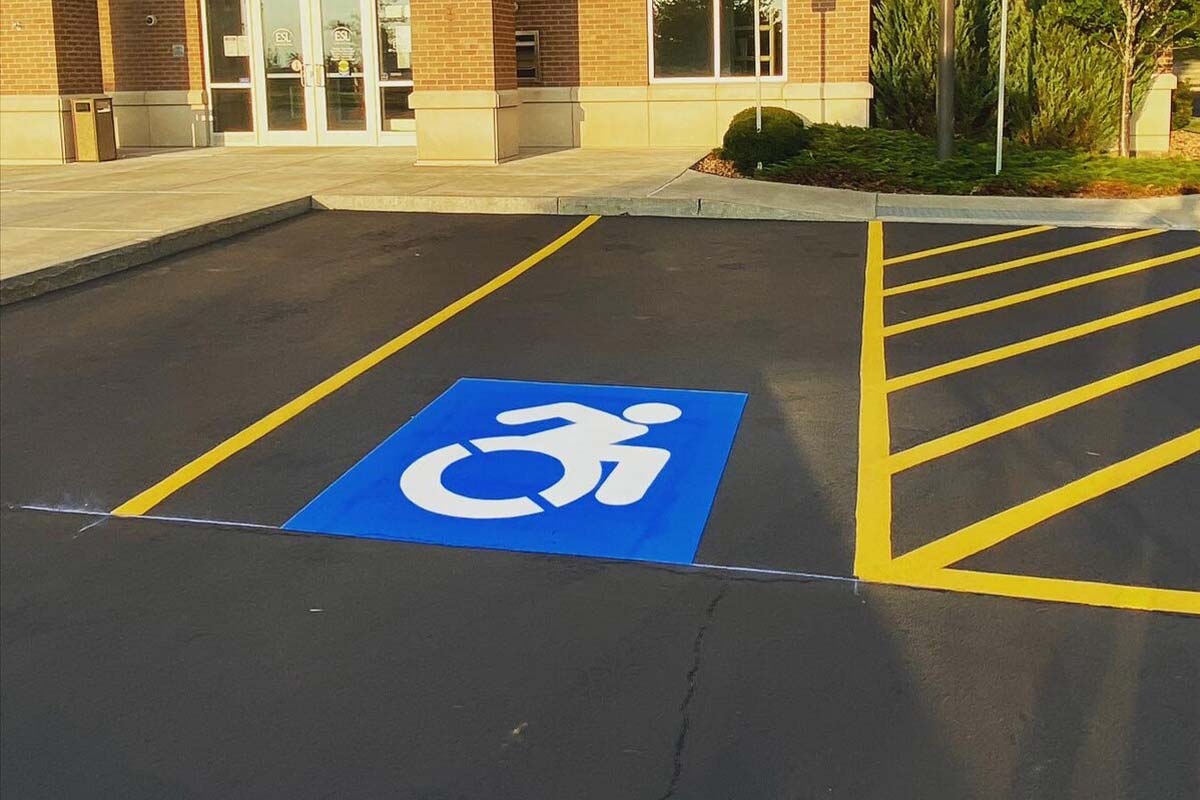
The International Symbol of Accessibility (ISA) pavement marking — the blue wheelchair symbol — is required in every accessible space. A vertical reserved parking sign must also be posted at each space, with the sign bottom mounted no lower than 60 inches above the ground. Signs installed below that height fail the code threshold even if the symbol and space dimensions are otherwise correct. Signs must be located at the head of the space, not the rear or side, so they’re visible from a parked vehicle.
Signage must be readable from the vehicle approaching the space. In lots where accessible spaces aren’t visible from the entrance, directional signs pointing toward those spaces are required at the entry point. Where accessible parking is on an upper level of a parking structure, each stairway and elevator lobby serving that level needs a sign directing users to the accessible spaces.
The ISA pavement marking must be installed at the head of the space — centered within the space boundary, clearly visible, and not obstructed by curb stops or landscaping. Each van-accessible space needs a second sign: “Van Accessible” mounted directly below the ISA reserved parking sign. That supplemental sign is required by §502.6 of the 2010 ADA Standards and is frequently missing in older Charlotte lots that were striped before current enforcement became routine.
Faded ISA pavement markings are the most commonly cited deficiency in ADA parking complaints. Property managers with aging lots sometimes find the painted symbols have fallen below legibility thresholds while the rest of the pavement still looks reasonable. A scheduled re-stripe catches that before a complaint arrives.
Our ADA Striping Process
Every ADA striping job starts with a layout review. Before paint touches the pavement, the crew measures the lot, counts existing accessible spaces against the §208.2 minimums, checks access aisle widths against §502.3, and flags dimensional gaps — undersized aisles, spaces on routes with cross-slopes over 1:48, missing van-accessible stalls, or signs mounted below the 60-inch threshold. That review drives the scope of work.
Surface preparation follows the layout review. Existing markings get pressure-cleaned or mechanically abraded where needed to ensure proper paint adhesion — new paint bonding over chalk-dry or peeling old paint will fail ahead of schedule. For lots where accessible space locations are changing, old markings may need to be blacked out before the new layout goes down to avoid confusing drivers.
New lines go down at required widths: 96 inches for standard accessible spaces, 96-inch aisles for van-accessible stalls, and diagonal hatch patterns with “NO PARKING” text across aisle interiors. Paint and pavement temperatures are checked before application — Charlotte’s summer heat affects drying time and adhesion, and work scheduled during peak afternoon heat on a black-asphalt lot produces different results than a morning start.
ISA symbols and “Van Accessible” supplemental signs are installed after the field markings cure. Documentation of space dimensions and aisle widths as installed is available on request. Contact 1-800-STRIPER at (704) 828-9922 or Charlotte@1800STRIPER.com to schedule a site assessment.
North Carolina Building Code Provisions
North Carolina adopts and amends the International Building Code, with accessibility requirements codified in North Carolina State Building Code, Chapter 11. Chapter 11 incorporates the 2010 ADA Standards accessibility provisions and adds state-specific requirements for certain facility types and occupancy classes. In Charlotte, new construction and substantial renovations are enforced by City of Charlotte Development Services, which reviews plans and issues permits based on the state building code.
For existing lots undergoing re-striping, the federal path-of-travel obligation applies when an owner makes alterations to a primary function area. Under ADA Title III regulations, parking lots serving primary function areas must be upgraded to the extent accessibility work does not exceed 20% of the total alteration cost. A property owner renovating a building entrance, for example, triggers a path-of-travel obligation that can extend to the parking area serving that entrance. North Carolina’s code alignment means a Charlotte property dealing with both state building inspectors and federal ADA complainants faces the same underlying dimensional requirements from both directions.
The ADA and the North Carolina building code are parallel obligations, not interchangeable alternatives. A parking lot that passes a state code inspection is not automatically ADA-compliant, and vice versa. Both apply to most commercial properties in Charlotte, and a compliance gap in either direction leaves the property owner exposed.
Property owners or facility managers sorting out compliance scope — what qualifies as an alteration, how the 20% path-of-travel cap is calculated, which spaces trigger van-accessible requirements — should consult a licensed architect or accessibility consultant familiar with both the ADA and the North Carolina State Building Code. Call (704) 828-9922 for a parking layout assessment from 1-800-STRIPER of Charlotte.
For a full list of our pavement marking services, visit our parking lot striping in Charlotte page.
Businesses We Serve




How it Works

GET A FREE ESTIMATE
Contact us today and we’ll have a quote to you in 24 hours

SCHEDULE AN INSTALLATION
We’ll have your installation scheduled in less than 7 days, without affecting your business hours

GET A PARKING LOT THAT POPS
For a budget-friendly price, you’ll get a parking lot that looks like new!
We proudly work with:


We proudly work with:


Frequently Asked Questions About ADA Parking Lot Striping in Charlotte, NC
How often does ADA parking striping need to be refreshed?
No federal rule sets a specific repaint schedule. The practical standard is visibility: if the ISA symbol, space boundaries, or access aisle markings can’t be clearly read from an approaching vehicle, they need repainting. In Charlotte’s climate, traffic-grade latex paint on asphalt typically stays legible for two to four years depending on traffic volume and sun exposure — high-traffic lots often need attention sooner. Faded markings are the most common deficiency cited in ADA parking complaints. Regular visual checks catch the problem before a complaint does.
Does ADA apply to private parking lots open to the public?
Yes. ADA Title III covers any place of public accommodation — a private business open to the public falls under the law regardless of property ownership. Shopping centers, office parks, medical offices, restaurants, and retail stores all qualify. Purely residential parking areas and lots that serve only employees with zero public access are different situations, but most commercial properties in Charlotte see public visitors and must meet the accessible parking requirements in §208 and §502 of the 2010 ADA Standards for Accessible Design.
What is the minimum access aisle width for a standard accessible space?
The minimum is 60 inches (5 feet) per §502.3 of the 2010 ADA Standards. Van-accessible spaces require a 96-inch aisle under the standard configuration, or an 8-foot space width paired with a 60-inch aisle as an alternative layout. Either way, the aisle must be marked to prohibit parking — diagonal hatching and “NO PARKING” text handle this. One aisle can be shared between two adjacent accessible spaces as long as both spaces connect to it and the aisle meets the wider of the two dimensional requirements.
Can a van-accessible space share an access aisle with a standard accessible space?
Yes, with one condition: the shared aisle must be at least 96 inches wide, satisfying the van-accessible requirement while also exceeding the 60-inch standard. Two accessible spaces flanking a single 96-inch aisle is a permitted and space-efficient layout under §502.3.1 of the 2010 ADA Standards. Both spaces on either side still need to meet their own dimensional requirements — the shared aisle doesn’t change the width requirements for the spaces themselves.
What happens if a parking lot doesn’t meet ADA requirements?
Non-compliant parking exposes a property owner to complaints filed with the U.S. Department of Justice, private civil rights lawsuits under ADA Title III, and state code enforcement through the North Carolina State Building Code, Chapter 11. ADA Title III cases can produce injunctive relief — a court order requiring the lot to be brought into compliance — plus attorney’s fees and civil penalties in DOJ-initiated actions. In most situations the resolution is correction. Call 1-800-STRIPER at (704) 828-9922 for a layout assessment.
How long does ADA parking lot striping take?
Timeline depends on lot size and scope. A standard commercial lot needing accessible space repainting, aisle markings, and ISA symbols typically runs one to three hours of field work, plus dry time before the lot reopens to normal use. Traffic-grade latex paint in Charlotte’s climate is touch-dry in roughly 30 minutes under typical conditions and reaches pedestrian traffic hardness within an hour. Larger jobs — full lot re-striping combined with ADA compliance work — take longer and may be staged in sections to keep most of the lot accessible during the job. Call (704) 828-9922 for a time estimate on your specific lot.