Fire Lane Striping
In Charlotte, NC
Code-Compliant Fire Lane Markings
1-800-STRIPER provides professional fire lane striping in Charlotte, NC — marking compliant fire lanes, curbs, and no-parking zones per the North Carolina Fire Prevention Code for commercial properties throughout Mecklenburg and Gaston counties.
1-800-STRIPER® of Charlotte PROVIDes Fire Lane Striping Services NEAR YOU
Is your parking lot ready for first responders?
Our team is well-versed in local fire regulations and will parter with you to design a fire lane striping plan that creates unobstructed emergency access to protect your customers and property.
Core Services:
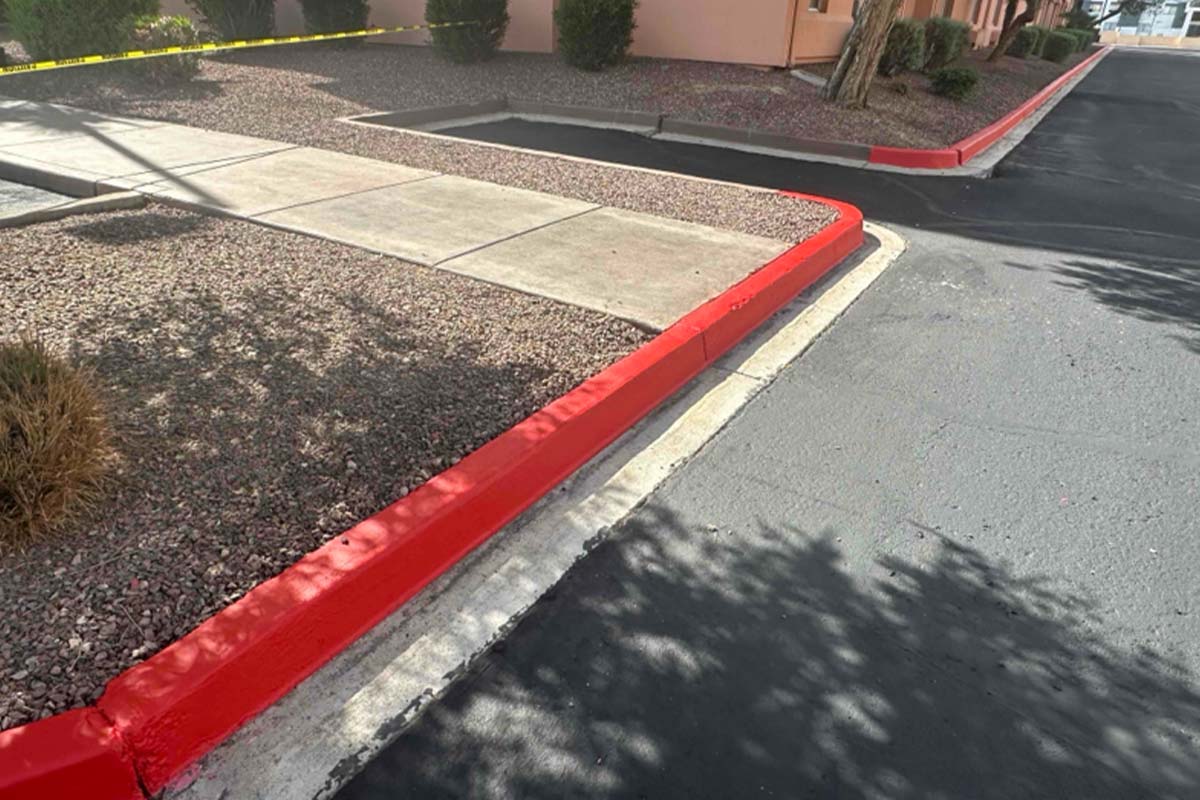
Fire Lane Striping in Charlotte
Fire lane striping is one of those jobs where getting it wrong isn’t just a citation risk — it can delay fire department access when every second counts. Charlotte commercial property owners face inspection pressure from the Charlotte Fire Department, which enforces the North Carolina Fire Code as the authority-having-jurisdiction (AHJ) for all fire-apparatus access requirements across Mecklenburg and surrounding counties.
1-800-STRIPER handles fire lane marking for shopping centers, warehouses, medical campuses, apartment complexes, and industrial facilities across the Charlotte metro. That includes properties in Concord, Gastonia, Huntersville, Matthews, and beyond. Whether you’re responding to a fire marshal inspection notice or refreshing faded markings ahead of an annual review, our crews understand what inspectors look for and mark to those exact specifications.
Red curb paint, bold “NO PARKING FIRE LANE” stenciling, and directional arrows are painted to the dimensions and color standards required by the applicable code. We coordinate with property managers and building owners to minimize disruption during the striping window, then photograph completed work for your records.
The Charlotte metro’s commercial real estate mix runs the full spectrum — older strip centers along Independence Boulevard that haven’t had a fresh coat in years, newer mixed-use developments in South End and NoDa that need their first fire lane layout, industrial parks off I-85 with multi-building campuses and long access roads. Each property type has different markings challenges, and we’ve worked across all of them. The fire lane striping Charlotte properties need is handled by crews who show up with the right equipment, not a rented line painter and a can of red paint from a hardware store.
Call (704) 828-9922 or email Charlotte@1800STRIPER.com to schedule a site walk and free estimate.
Fire Lane Code Requirements
Code requirements for fire lanes in Charlotte are set by the state-adopted fire code. The North Carolina Fire Code establishes the standards for fire-apparatus access roads. Local enforcement rests with the Charlotte Fire Department as the AHJ.
Key dimensional standards under those codes:
- Minimum clear width: 20 feet for fire-apparatus access roads (wider widths may apply for aerial truck access on certain structures)
- Vertical clearance: 13 feet 6 inches minimum — gates, canopies, and tree canopies cannot encroach
- Curb marking: Red paint on all curbing within the fire lane boundary
- Signage lettering: “NO PARKING FIRE LANE” in white letters on red background, sized to be legible from the street or drive aisle
- Posting intervals: Signs posted at regular intervals along the lane, typically not more than 50 feet apart, unless the AHJ specifies otherwise
Properties that fail to maintain legible, compliant markings can be cited by the fire marshal. Faded paint, missing stencils, and encroached clearance zones are the three most common deficiencies found during routine commercial inspections in Charlotte and across Mecklenburg County. Staying current on your fire lane striping is the simplest way to stay compliant — far less expensive than a re-inspection fee or a code violation notice. Call us for a free estimate rather than waiting for an inspection to flag the issue.
It’s also worth understanding that code compliance isn’t a one-time box to check. Building use changes, tenant expansions, and parking lot reconfigurations can all shift where a fire lane is required or how wide it needs to be. If your property has gone through any significant layout changes since the last fire marshal visit, a fresh review of your fire lane layout against current North Carolina Fire Code requirements is worth the call. 1-800-STRIPER can assess whether your existing markings still match what the code requires, not just whether the paint is still visible.
What We Stripe & Mark
Fire lane work covers more than a painted curb. A complete fire lane marking scope for a typical commercial property in Charlotte includes:
Red curb paint — The most visible signal to drivers and one of the first things a fire marshal checks. We apply a durable exterior-grade red paint matched to fire-lane standards, covering the full length of the designated no-parking zone.
“NO PARKING FIRE LANE” stenciling — Block lettering stenciled at the appropriate intervals along the lane. Letter size and spacing follow the fire code and local AHJ guidance to ensure legibility from a vehicle at normal approach speed.
No-parking zone boundaries — Yellow or white boundary lines marking the edges of the fire lane where it meets drive aisles, parking fields, or loading areas. These prevent driver confusion about where the restriction begins and ends.
Directional arrows — Used on one-way fire lanes and at intersections within the access road to guide emergency vehicles to the building’s fire connection points.
Handicap clearance zones adjacent to fire lanes — Where a fire lane runs parallel to an accessible parking area, we can coordinate the marking so ADA clearance paths and fire lane boundaries don’t conflict.
Curb extensions and loading dock approaches — Facilities with loading docks frequently have secondary fire lanes at dock approaches. We mark those to the same standard as the primary lane.
Turning radius markings — Multi-story buildings and large warehouse facilities often have designated turning areas for fire apparatus. These are marked with painted arcs or supplemental signage to ensure ladder trucks and pumper trucks can maneuver without obstruction.
Visibility enhancements — On properties where visibility is limited at night, retroreflective paint or supplemental delineators can be added to fire lane boundaries. These are especially useful for parking structures and facilities where drivers move through the lane after dark.
Property owners sometimes underestimate the scope of a fire lane project until an estimator walks the site. A shopping center with four retail tenants and a restaurant pad often has more linear footage in fire lanes than the building perimeter itself — side lanes, rear service roads, and cross-access drives all factor in. Getting an accurate measurement upfront prevents surprises on the day of the job.
1-800-STRIPER of Charlotte carries the equipment to handle any lot size — from a strip mall with a single fire lane running the building front to a large warehouse or medical campus with multiple access roads and turning radii that need marking.
Our Fire Lane Process
Here’s how we move from your call to a finished, inspection-ready fire lane:
- Site assessment and measurement — A 1-800-STRIPER estimator visits the property to walk the fire lane route, measure total linear footage, identify curb sections, and note any faded or missing stencils. We photograph existing conditions before any work begins so you have a baseline record.
- Code confirmation — We confirm the applicable AHJ requirements with reference to the North Carolina Fire Code. If your property has had a recent fire marshal inspection with noted deficiencies, we review that report and mark directly to the cited requirements.
- Surface prep — Old markings that are chipped, peeling, or in the wrong position are addressed before new paint goes down. Loose material is removed. Oil spots or contamination that would prevent adhesion are cleaned. Good surface prep is what separates a marking that lasts three to five years from one that starts peeling in six months.
- Layout and stencil placement — We dry-lay stencils and snap chalk lines to confirm placement before a single drop of paint hits the asphalt. Spacing, letter alignment, and boundary-line widths are all checked against your site plan.
- Painting and stenciling — Red curb paint goes on first, followed by boundary lines, then stencil lettering and arrows. We use traffic-grade paint formulated for the mid-Atlantic climate — a Charlotte summer will cycle through heat and humidity that weaker formulations won’t hold up against.
- Post-job documentation — Once the paint is dry, we photograph the completed fire lane from multiple angles. You receive those photos along with a completed job record you can present to your property manager, insurer, or the fire marshal at the next inspection.
From initial call to finished job, most straightforward fire lane projects are completed in one visit. Properties requiring significant surface prep or re-layout of existing markings may take two visits. We’ll tell you upfront which category your job falls into.
For a full list of our pavement marking services, visit our parking lot striping in Charlotte page.
Businesses We Serve




How it Works

GET A FREE ESTIMATE
Contact us today and we’ll have a quote to you in 24 hours

SCHEDULE AN INSTALLATION
We’ll have your installation scheduled in less than 7 days, without affecting your business hours

GET A PARKING LOT THAT POPS
For a budget-friendly price, you’ll get a parking lot that looks like new
We proudly work with:


We proudly work with:

Frequently Asked Questions About Fire Lane Striping in Charlotte, NC
How often should fire lane striping be repainted in Charlotte?
There’s no fixed re-paint interval written into the fire code — the standard is that markings must be “clearly visible and legible.” In practice, most Charlotte commercial properties repaint every two to four years, depending on traffic volume and sun exposure. High-traffic lots with heavy truck movement tend to show wear faster. A good rule of thumb: if you can see significant fading from 20 feet away, the fire marshal likely can too. Scheduling a repaint before your annual inspection is the straightforward way to avoid a deficiency citation.
What does the North Carolina Fire Code say about fire lane width?
The North Carolina Fire Code sets a minimum 20-foot clear width for fire-apparatus access roads. For buildings requiring aerial apparatus access — typically structures over 30 feet in height — wider widths and additional turning radius requirements apply. Vertical clearance must be at least 13 feet 6 inches. The Charlotte Fire Department, as the local AHJ, has authority to require more stringent dimensions on a project-by-project basis, so we always confirm current local requirements before starting a job.
Can you restripe a fire lane that was originally in the wrong location?
Yes. Relocating a fire lane involves removing or blacking out the old markings and painting the new route to code dimensions. We assess whether the existing layout meets current AHJ requirements before recommending a change, and we can coordinate with your fire marshal contact if a formal approval is needed for the new route. Blacking out old paint lines is included in our scope when a re-layout is required — we don’t leave ghost lines that confuse drivers or inspectors.
Do you handle fire lane striping for apartment complexes and HOAs?
Yes. Multi-family residential properties — apartment complexes, condominiums, and planned developments — are subject to the same fire-apparatus access requirements as commercial properties in Charlotte. Common areas, parking structures, and drive aisles serving residential buildings all fall under the fire code. We work with property managers and HOA boards to schedule work during low-traffic hours to reduce disruption to residents. For a free estimate, call (704) 828-9922 or reach us at Charlotte@1800STRIPER.com.
How long does fire lane paint last on asphalt vs. concrete?
On well-prepared asphalt, traffic-grade fire lane paint typically holds for two to four years under normal conditions. Concrete tends to hold paint longer when properly etched and primed beforehand, but is more susceptible to chipping at high-traffic edges. Climate factors specific to Charlotte — summer heat, UV exposure, and occasional winter freeze-thaw cycles — do accelerate paint wear compared to more temperate climates. Surface prep quality has the biggest impact on longevity regardless of substrate: clean, dry pavement with no oil contamination gives you the longest-lasting result.
What information should I have ready when I call for a fire lane striping estimate?
The more detail you can provide, the faster we can turn around an accurate estimate. Useful information includes: approximate linear footage of curb to be painted, number of stencils needed, whether any old markings need to be blacked out, whether you’ve received an inspection notice with specific deficiencies listed, and your preferred scheduling window. If you have a site plan or a recent fire marshal inspection report, bring it to the site walk. No detailed prep is required on your end before calling — our estimator gathers what’s needed during the site assessment. Reach 1-800-STRIPER of Charlotte at (704) 828-9922.