Parking Lot Pressure Washing
In Charlotte, NC
Surface Prep Before Restriping
1-800-STRIPER provides professional parking lot pressure washing in Charlotte, NC — removing oil stains, gum, dirt, and tire marks from parking lots, garages, and concrete surfaces, with wash-water managed per EPA stormwater discharge regulations for commercial properties across the Charlotte metro.
1-800-STRIPER® of Charlotte PROVIDes Parking Lot Power Washing Services NEAR YOU
Need to blast away years of grime?
If your parking lot or parking garage looks dull and dirty, our professional crew can wash away grime, oil, stains, and slippery buildup to restore the appearance of your property.
Benefits:
Parking Lot Pressure Washing in Charlotte
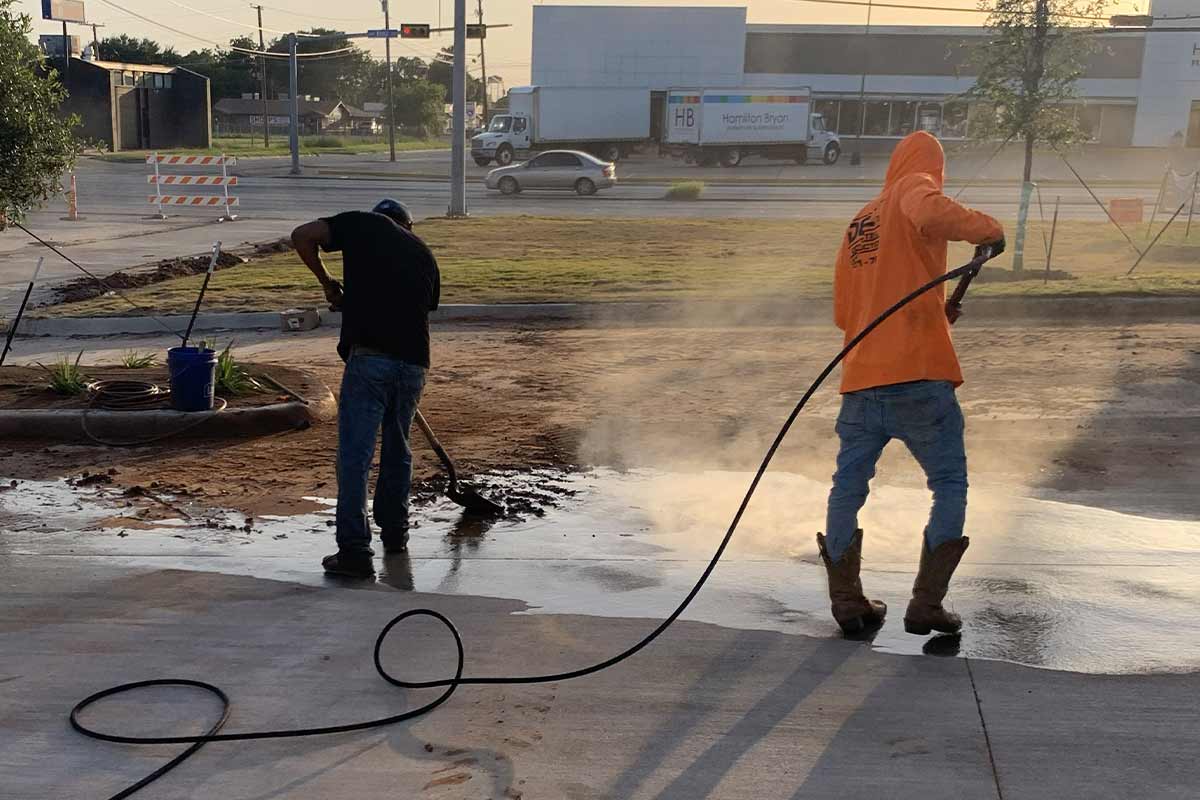
Commercial parking lots take a beating. Motor oil drips from parked vehicles, brake fluid oxidizes on concrete, tire rubber smears across drive lanes, and foot traffic grinds gum and food debris into surface pores. None of that goes away on its own — rain redistributes it, summer heat bakes it in, and every wet-dry cycle works it deeper into the pavement.
Charlotte’s climate makes the problem worse than in drier markets. Humidity through the summer months encourages mold and algae to take hold wherever organic material settles — tree debris, food spills, standing water in low spots. Asphalt absorbs heat and holds it, which softens binders near the surface and lets vehicle fluids penetrate rather than sitting on top. By fall, a lot that was clean in spring can have six months of embedded contamination.
The consequences are real. Heavy grease and oil deposits on concrete sidewalks and entry areas create slip-and-fall hazard conditions, particularly after rain when surface tension drops. Line markings buried under grime become unreadable — ADA symbols, fire lane zones, directional arrows, and stall numbers all rely on visibility to function. Pavement surfaces that go uncleaned for years develop staining that does not respond to standard washing and may require more aggressive remediation.
Regular pressure washing takes care of contamination before it reaches that point. A lot that gets cleaned on a consistent schedule stays cleaner with less effort each time — built-up layers of oxidized rubber and caked-on grease are much harder to remove than fresh accumulation. That means a maintained lot costs less per cleaning and holds up better over a longer pavement lifecycle.
1-800-STRIPER handles commercial pressure washing across the Charlotte metro — Mecklenburg, Gaston, Cabarrus, Union, and surrounding counties including Concord, Gastonia, Huntersville, Cornelius, Matthews, and Monroe — for strip mall lots, office complex surface lots, multi-level garages, warehouse aprons, drive-through lanes, and loading dock areas. Call (704) 828-9922 for a free estimate.
What We Clean
Parking lot cleaning covers a wide range of surfaces and contaminant types. The nature of the contamination drives the cleaning approach — oil stains require different treatment than biological growth, and asphalt behaves differently from concrete under pressure. The table below outlines what is typically found on each surface type.
| Surface | Common Contaminants |
|---|---|
| Asphalt parking lots | Motor oil, brake fluid, tire rubber, dirt, organic debris |
| Concrete lots and aprons | Oil stains, gum, grease, algae, mold, efflorescence |
| Parking garages (deck surfaces) | Oil drips, exhaust residue, tire marks, joint sealant runoff |
| Concrete sidewalks and curbs | Gum, food waste, algae, biological staining |
| Drive-through lanes | Grease, food spillage, tire rubber, organic buildup |
| Loading dock aprons | Hydraulic fluid, forklift grease, oil pooling |
Oil and grease on asphalt and concrete require high-pressure hot-water extraction to break the bond between the petroleum compound and the pavement face. Cold water alone at high pressure moves surface debris but does not dissolve oil — heat is the active agent that breaks down the hydrocarbon chains. Pre-treatment with a degreaser on heavily saturated spots allows the surfactant to work before pressure is applied, which produces cleaner results with fewer repeat passes.
Gum requires sustained heat at close range combined with targeted nozzle pressure. It cannot be pressure-rinsed away without prior heating — the material needs to be softened before it releases from the surface. High-traffic pedestrian areas in retail centers tend to accumulate the heaviest gum buildup near entry points and drive-through windows.
Biological growth — algae, mold, and mildew — responds to detergent pre-treatment followed by a thorough pressure rinse. In Charlotte’s humid climate, shaded areas of a lot stay wet long enough after rain for algae to re-establish quickly. North-facing concrete walls, covered walkways, and spots under heavy tree cover are the highest-risk zones for biological staining.
Efflorescence on concrete — the white crystalline salt deposits that migrate to the surface as water evaporates — requires a different approach. It is not a contaminant in the usual sense but it creates a rough, porous surface texture that traps other debris and looks worn. Pressure washing at the right PSI removes surface efflorescence, though deeper mineral migration may reappear over time.
Surface type also governs how much pressure can be applied safely. Concrete generally tolerates higher PSI without damage. Asphalt at close range under excessive pressure can lose surface aggregate — the fine stone particles that make up the top layer of asphalt — leaving a rougher, more porous surface. On lots with both concrete and asphalt sections, settings are adjusted zone by zone.
Parking garages present an additional consideration: deck drains on upper levels often connect directly to the building’s drain system rather than to a surface storm inlet. Wash water on a garage deck needs the same containment attention as a surface lot — the path to discharge may just be less visible. Pre-work walkthroughs on garage jobs include identifying all drain locations and their routing before washing begins.
Pressure Washing as Restriping Prep
Paint laid over contaminated pavement fails early. Oil and debris sitting between the substrate and fresh paint reduce adhesion strength, and lines on a dirty lot tend to fade, chip, or peel well ahead of the expected service life. Getting maximum life out of a parking lot restriping job depends heavily on the condition of the surface before paint goes down.
Any restriping project involving oil-contaminated or heavily soiled pavement starts with a surface preparation step. The sequence below is what that process looks like from inspection through striping:
- Initial surface inspection — walk the entire lot to locate oil-saturated zones, active drip points, concentrated gum deposits, and any areas with standing moisture or soft asphalt. These areas get flagged for pre-treatment before pressure is applied.
- Pre-treatment application — apply a commercial degreaser to oil-heavy sections and allow dwell time for the surfactant to break down the contaminant. Skipping dwell time reduces effectiveness — the chemical needs time to work before the pressure rinse begins.
- High-pressure hot-water wash — work systematically across the lot from the high end downward, directing wash water toward containment points or collection booms rather than toward storm drain inlets. This step handles the bulk of loosened contamination.
- Surface rinse — a clean rinse pass removes residual detergent and suspended debris from the pavement face. Any soap film left on the surface can interfere with paint adhesion the same way grease can.
- Dry-time assessment — confirm that surface moisture has fully dissipated before applying traffic paint or thermoplastic. Both surface temperature and ambient humidity factor into this check. Charlotte summers can extend drying time significantly compared to the same conditions in a drier climate, and concrete holds moisture longer than asphalt.
- Line striping — once the surface is clean, dry, and at the right temperature, striping proceeds. Clean, dry pavement produces sharper line edges, stronger adhesion, and a longer service life for the markings.
Skipping the prep step on a contaminated lot is the most common reason parking lot line paint fails ahead of schedule. Proper surface preparation is not a premium add-on — it is what makes the restriping last.
Stormwater & EPA NPDES Compliance
Wash water collected from a commercial parking lot carries petroleum compounds, heavy metals from brake dust, surfactants, and suspended solids. That makes it contaminated runoff, not clean water — and contaminated runoff cannot be discharged to storm drains without treatment under federal law.
The EPA NPDES stormwater program establishes the federal framework. The National Pollutant Discharge Elimination System prohibits unpermitted discharge of pollutants from commercial and industrial sites to waterways or municipal separate storm sewer systems (MS4). Parking lot wash water containing oil or grease is a regulated discharge category under this framework.
At the state level, the North Carolina DEQ Stormwater Program administers NPDES permits and enforces stormwater discharge requirements in NC. Commercial property owners who generate contaminated wash water during maintenance operations are responsible for preventing that water from entering the MS4 untreated. This is a genuine legal obligation — not a technicality — because oil-laden runoff that reaches storm drains flows to local creeks and waterways without further treatment.
Locally, Charlotte-Mecklenburg Storm Water Services maintains the storm drain network across Mecklenburg County and handles spill prevention and discharge enforcement at the local level. Introducing oil-contaminated wash water to Charlotte’s storm drains is an enforcement matter at the local level, independent of state and federal oversight.
Compliant pressure washing on commercial lots uses wash-water containment methods to prevent contaminated runoff from reaching drain inlets. Common approaches include containment berms placed around active drain inlets, collection booms to redirect runoff flow, and wet-vacuum recovery systems that pull collected water up for proper disposal. The right method depends on lot slope, the number and location of drain inlets, and the volume of wash water expected. On flat lots with multiple drains, more containment points are needed than on a sloped lot that drains to a single inlet.
For property managers operating under a stormwater pollution prevention plan (SWPPP), using a contractor who actively manages wash-water collection and disposal is part of meeting the facility’s compliance obligations. When requesting quotes from any pressure washing contractor, ask specifically how they handle wash-water containment and where the collected water goes.
For a full list of our pavement marking services, visit our parking lot striping in Charlotte page.
Businesses We Serve


How it Works

GET A FREE ESTIMATE
Contact us today and we’ll have a quote to you in 24 hours

SCHEDULE AN INSTALLATION
We’ll have your installation scheduled in less than 7 days, without affecting your business hours

GET A PARKING LOT THAT POPS
For a budget-friendly price, you’ll get a parking lot that looks like new
We proudly work with:


We proudly work with:
Frequently Asked Questions About Parking Lot Pressure Washing in Charlotte, NC
How often should a commercial parking lot be pressure washed?
Cleaning frequency depends on traffic volume, tenant type, and lot conditions. High-traffic retail centers with food service tenants build up grease and food debris quickly — quarterly cleaning is common for those properties. Lower-traffic office lots may need only one or two cleanings per year. Any lot scheduled for restriping should be pressure washed before paint goes down regardless of its regular maintenance cycle. Call (704) 828-9922 to talk through a schedule that fits your property’s specific conditions.
Will pressure washing damage asphalt or concrete pavement?
On sound pavement with appropriate pressure settings, washing does not cause damage. Pavement that is already cracked, spalled, or has loose aggregate near the surface is more vulnerable if pressure is too high or the nozzle is held too close. A walkthrough inspection before washing identifies problem areas so settings can be adjusted. Generally, asphalt sections are washed at lower PSI than concrete to avoid disturbing surface aggregate on older or thinner pavement.
Is it legal for wash water to drain into a storm drain?
No — not when that water carries oil, grease, or other contaminants. The EPA NPDES stormwater program prohibits discharge of polluted water to storm sewer systems or waterways without a permit. The North Carolina DEQ Stormwater Program enforces these rules at the state level, and Charlotte-Mecklenburg Storm Water Services handles enforcement in Mecklenburg County. Compliant contractors use containment systems to collect wash water before it reaches drain inlets.
Does the parking lot need to be pressure washed before restriping?
On lots with significant oil contamination, yes. Traffic paint does not bond reliably to oil-saturated or heavily soiled pavement — lines on dirty surfaces tend to fade or peel well ahead of schedule. On cleaner lots, removing loose debris, dust, and oxidized rubber still improves adhesion and extends the service life of the markings. Pavement condition is assessed during the estimate visit to determine how much prep work is needed before striping can begin.
What is the difference between pressure washing and power washing?
The terms get used interchangeably, but there is a technical distinction. Power washing uses heated water; pressure washing uses ambient-temperature water at high PSI. For commercial parking lots with oil stains and grease, heated water is significantly more effective at breaking down petroleum-based contaminants than cold water at the same pressure. Hot-water extraction is the standard approach for heavily soiled commercial surfaces, where temperature is as important as pressure in getting oil to release from the pavement.
How long does pavement need to dry after washing before striping can start?
Surface moisture needs to fully dissipate before traffic paint is applied. In dry, warm conditions that may take two to four hours. Charlotte’s summer humidity or cooler months can extend drying considerably. Concrete retains moisture differently than asphalt — concrete surfaces often take longer to dry out completely. Both surface temperature and ambient humidity are checked before striping begins to confirm that conditions are suitable for proper paint adhesion.