Parking Lot Sign Installation
In Charlotte, NC
ADA, Fire Lane, and Directional Signage
1-800-STRIPER provides professional parking lot sign installation in Charlotte, NC — installing ADA accessible-space signs, fire lane “No Parking” signs, directional signage, and tow-away warning signs per the 2010 ADA Standards for Accessible Design, MUTCD, and the North Carolina State Building Code for commercial properties throughout Mecklenburg County.
1-800-STRIPER® of Charlotte PROVIDes Signage Installations Services NEAR YOU
Are you communicating clearly?
We install new signs in adherence with local regulatory standards and can repair or replace damaged signs so you can clearly communicate your parking requirements.
Parking Lot Sign Installation in Charlotte
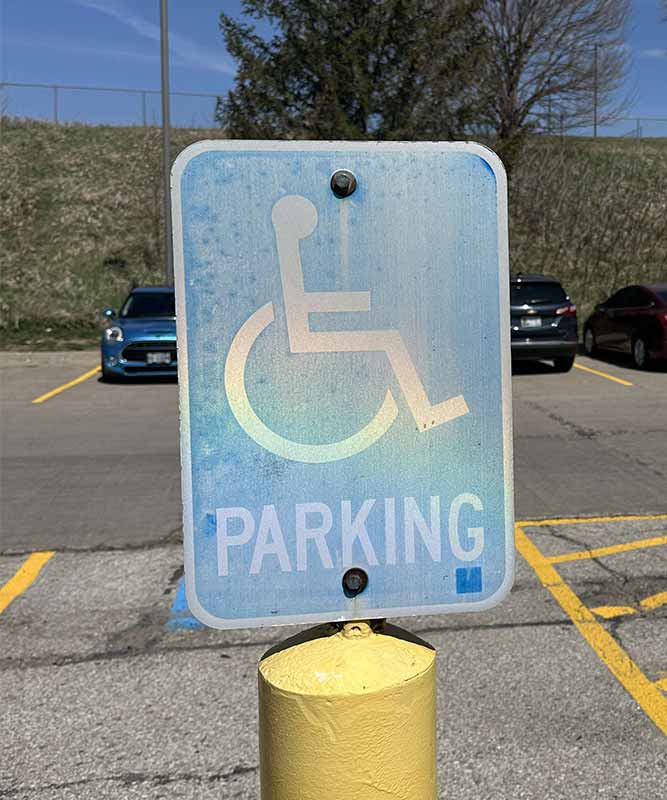
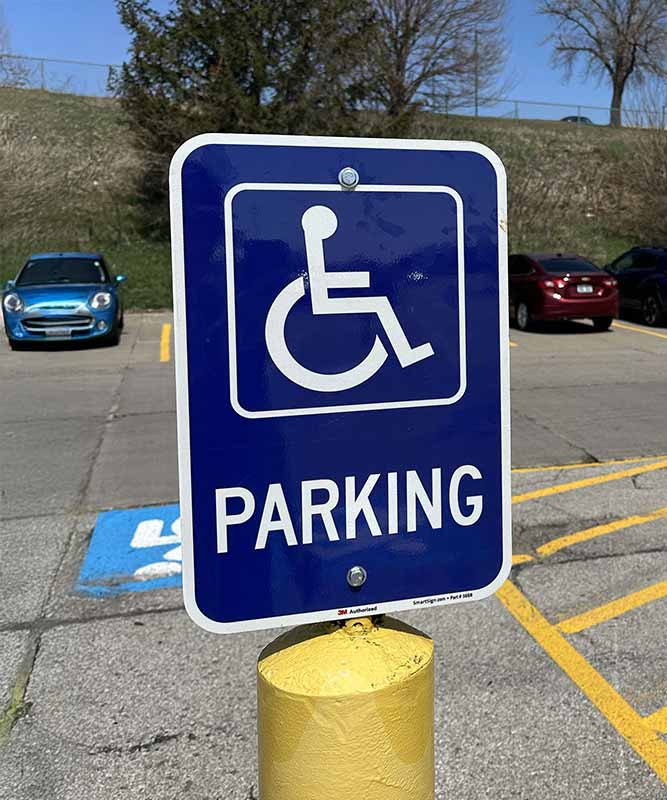
Parking lot signs do more than point people in the right direction — they establish who parks where, keep fire lanes clear, and protect property owners from liability when they are posted correctly. A missing ADA van-accessible sign can trigger a federal compliance violation. A fire lane marker mounted at the wrong height may not satisfy the local authority having jurisdiction (AHJ) during a fire marshal inspection.
1-800-STRIPER of Charlotte installs the full range of commercial parking signs: ADA accessible-space and van-accessible designations, R7-series “No Parking” and fire lane signs, tow-away warning panels, directional arrows, speed limit placards, and reserved-space markers. Every installation follows the 2010 ADA Standards for Accessible Design, the Manual on Uniform Traffic Control Devices, and the North Carolina State Building Code, Chapter 11 accessibility provisions. Contact us for a free estimate — (704) 828-9922.
Signs We Install
Commercial lots in the Charlotte metro need a layered sign package. Each sign type carries its own code requirements for placement, mounting height, and retroreflective sheeting grade. Getting the mix right matters — property managers who handle only ADA signs but skip fire lane markers can still face enforcement action from the fire marshal.
ADA accessible-space signs (R7-8 / R7-8a) — Required at every accessible stall and van-accessible stall. Mounted on a post or wall so the bottom of the sign face is at least 60 inches above the finished grade of the adjacent parking surface, per the 2010 ADA Standards for Accessible Design §502.6. Both the standard accessible-space sign and the van-accessible designation must be in place for the stall to count toward ADA minimum ratios.
Fire lane “No Parking” signs (R7-1) — Posted at fire lane boundaries to maintain unobstructed emergency vehicle access. The Manual on Uniform Traffic Control Devices standardizes the R7-1 sign face, while the Mecklenburg County AHJ sets local spacing requirements along fire access roads. Signs posted too far apart, or absent entirely, leave the property open to code citations during routine fire inspections.
Tow-away warning panels — Installed in combination with ADA and fire lane signs to give enforcement authority. North Carolina requires specific language and tow company contact information on panels paired with accessible-space signs; without a compliant tow-away notice, vehicles in accessible stalls without a placard cannot be legally towed.
Directional and wayfinding signs — One-way arrows, entry/exit markers, pedestrian crossing signs, and speed limit placards that guide traffic flow and reduce conflict points. Well-placed directional signage also reduces vehicle damage and liability exposure in high-turnover retail lots.
Reserved and tenant signs — Custom-text panels for numbered spaces, management parking, loading zones, and other designated areas. These are typically installed alongside ADA and fire lane work, making a single mobilization the most cost-effective approach.
Unsure what your lot needs? 1-800-STRIPER can walk the property and identify missing, damaged, or non-compliant signs before you schedule installation. Call (704) 828-9922 for a free assessment.
ADA Accessible-Space Signage (R7-8, Van Accessible)
Every accessible parking space requires a dedicated sign. Van-accessible spaces need a second sign — either a separate “Van Accessible” marker (R7-8a) or a combined R7-8 sign with the van-accessible designation incorporated — mounted above the standard accessible-space sign on the same post or independently on a wall.
The 2010 ADA Standards for Accessible Design §502.6 sets the minimum bottom-of-sign height at 60 inches above finished grade. This measurement matters: signs mounted too low can be obscured by vehicle hoods, particularly in lots where SUVs and pickup trucks are common. The North Carolina State Building Code, Chapter 11 adopts this federal standard and applies it to all commercial facilities within the state.
The Manual on Uniform Traffic Control Devices governs the R7-8 sign face design — the International Symbol of Accessibility (ISA) background color, legend, and retroreflective sheeting requirements. MUTCD-compliant sheeting ensures the sign is legible at night and in low-light conditions, which matters for early-morning and late-evening enforcement.
A common compliance gap in older Charlotte lots is a missing van-accessible designation. Under the 2010 ADA Standards §208.2.4, at least one of every six accessible spaces (or one per parking structure) must be van accessible. If your lot was striped before 2012, there is a good chance that designation has never been signed correctly.
Post, Footing & Mounting Specs
Sign posts must be set so the sign remains plumb, resists wind load, and does not become a hazard if struck by a vehicle. The table below captures the standard installation specifications 1-800-STRIPER uses for ground-mounted parking signs. Wall-mount and canopy-mount applications vary by substrate — we assess the mounting surface before specifying hardware.
| Sign Type | MUTCD Code | Post Height (above grade) | Bottom of Sign (min) | Footing Depth | Post Spec |
|---|---|---|---|---|---|
| Accessible Space | R7-8 | 84 in | 60 in | 24 in | 2-in sq. galvanized steel or U-channel |
| Van Accessible | R7-8a | 84–96 in (second sign stacked above R7-8) | 60 in (lower sign) | Shared post with R7-8 | Same post as R7-8 with slip-fit extension |
| No Parking – Fire Lane | R7-1 | 84 in | 60 in | 24 in | 2-in sq. galvanized steel or U-channel |
| No Parking – General | R7-1 variant | 84 in | 60 in | 24 in | 2-in sq. galvanized steel or U-channel |
| Tow-Away Warning Panel | Supplemental (below R7-8 / R7-1) | Below primary sign | Paired with primary | Shared post | Same post as primary |
| Directional / Wayfinding | Various | 84 in | 60 in | 24 in | 2-in sq. galvanized steel or U-channel |
Post height figures represent the distance from finished grade to the top of the post. Footing depth is for undisturbed soil in a standard Charlotte-area lot — rocky substrate, soft fill, or high-traffic vehicle-impact zones may require deeper footings or breakaway post bases. We assess site conditions as part of every estimate.
Retroreflective sheeting is a spec requirement that often gets skipped in budget installations. The Manual on Uniform Traffic Control Devices requires that R7-series signs use engineering-grade or higher retroreflective material so the sign face remains legible to drivers at night. Signs printed on non-reflective stock fade quickly and fail nighttime visibility requirements. All sign faces installed by 1-800-STRIPER meet MUTCD retroreflectivity standards.
Breakaway post bases are worth considering in vehicle-impact zones — along drive aisles or near end-stall posts where overhang incidents are common. A sign post that snaps at the base during a low-speed strike is safer for pedestrians and easier to repair than a post that bends or pulls the footing out of the ground. We note high-risk placement locations during the site walk and can specify breakaway hardware where appropriate.
Local Sign Code & Permitting
Parking lot signs in Charlotte are subject to two overlapping regulatory layers: the federal/state access codes described above, and the city’s on-premises sign regulations under the Charlotte Unified Development Ordinance.
The Charlotte UDO governs on-premises signage in commercial districts — including ground-mounted parking signs — and specifies when a sign permit is required before installation. ADA-required accessibility signs generally qualify for an exemption from the UDO sign permit process, but wayfinding signs, directional markers, and tenant-identification panels may require a permit depending on sign area, location, and zoning district.
Property owners bear responsibility for obtaining the correct permits. 1-800-STRIPER handles the physical installation; we recommend confirming permit requirements with Mecklenburg County Code Enforcement or the City of Charlotte Zoning Administration before work begins on a new or expanded sign package. We can provide installation documentation — post depth records, sign heights, GPS coordinates — that supports a permit application or a compliance inspection.
Properties in municipalities outside the City of Charlotte but within the metro — Concord, Gastonia, Huntersville, Matthews, and others — fall under their own jurisdiction’s sign ordinances rather than the Charlotte UDO. Requirements vary, so confirm locally before installation if your property sits outside Charlotte city limits. The underlying federal ADA and MUTCD requirements apply everywhere regardless of local ordinance.
Call (704) 828-9922 to talk through what your lot needs and what documentation will be required for your specific location.
For a full list of our pavement marking services, visit our parking lot striping in Charlotte page.
Businesses We Serve




How it Works

GET A FREE ESTIMATE
Contact us today and we’ll have a quote to you in 24 hours

SCHEDULE AN INSTALLATION
We’ll have your installation scheduled in less than 7 days, without affecting your business hours

GET A PARKING LOT THAT POPS
For a budget-friendly price, you’ll get a parking lot that looks like new
We proudly work with:


We proudly work with:

Frequently Asked Questions About Parking Lot Sign Installation in Charlotte, NC
How many ADA accessible-space signs does my parking lot need?
Every accessible parking stall requires its own R7-8 sign, and every van-accessible stall requires a separate R7-8a designation (or a combined sign that includes both). The 2010 ADA Standards for Accessible Design §208.2 sets the minimum number of accessible spaces based on total lot size — for example, a 100-space lot requires at least four accessible spaces, one of which must be van accessible. If your lot has never been audited against the current 2010 Standards, there is a reasonable chance both the stall count and the signage are out of date.
What is the required mounting height for parking lot signs in Charlotte?
The 2010 ADA Standards for Accessible Design §502.6 requires that the bottom of an accessible-space sign be at least 60 inches above the finished grade of the adjacent parking surface. This applies to ground-mounted and wall-mounted signs alike. The North Carolina State Building Code, Chapter 11 adopts this standard statewide. Non-ADA parking signs — R7-1 fire lane markers, directional arrows, reserved-space panels — are generally installed with the bottom of the sign face at or above 60 inches per MUTCD guidance, keeping them visible over vehicle rooflines while avoiding a strike hazard.
Do parking lot signs in Charlotte require a permit from the city?
It depends on the sign type. ADA-required accessible-space signs (R7-8 / R7-8a) are typically exempt from the City of Charlotte’s on-premises sign permit process under the Charlotte Unified Development Ordinance. Wayfinding signs, directional panels, and tenant markers may require a permit depending on sign area and zoning. We recommend checking with Mecklenburg County Code Enforcement or the Charlotte Zoning Administration before installing any new ground-mounted sign package beyond the ADA minimum.
What does a fire lane sign installation include?
A standard fire lane sign installation covers the R7-1 “No Parking Fire Lane” sign face, post, footing, and any supplemental tow-away warning panel required by North Carolina Fire Code or the Mecklenburg County AHJ. Spacing intervals and placement at fire lane entrances and along fire access road edges are determined by local fire code requirements. We can also coordinate with fire lane striping work — combining red-painted curbs, “FIRE LANE NO PARKING” pavement lettering, and R7-1 signage into a single visit.
How long does parking lot sign installation take?
Most parking lots can be signed in a single visit. A straightforward accessible-space sign package for a mid-size commercial lot — replacing or adding R7-8 and R7-8a signs — typically takes a few hours from post-setting to final plumb check. Larger projects with multiple R7-1 fire lane markers, directional signs, and tow-away panels will take longer depending on the number of posts and the complexity of the layout. We assess the site before scheduling and give you a realistic time estimate upfront. Call (704) 828-9922 for a free on-site assessment.
Can you handle both sign installation and parking lot striping at the same time?
Yes. 1-800-STRIPER of Charlotte installs signs and stripes parking lots, so you can schedule both services together and avoid two separate mobilizations. A combined visit is especially practical when you are bringing an older lot up to ADA compliance — the striping work (accessible stall dimensions, access aisles, ISA symbols) and the signage (R7-8, R7-8a, tow-away panels) are reviewed against the same 2010 ADA Standards for Accessible Design requirements, and doing them together reduces the chance that the sign placement and stall layout end up misaligned. Contact us for a free estimate.