
Bollard Installation
In Charlotte, NC
Safety and Security Bollards
1-800-STRIPER provides professional bollard installation in Charlotte, NC — installing fixed, removable, and embedded steel bollards to protect storefronts, pedestrians, and utilities, with crash-rated options per ASTM F3016 and ASTM F2656 for commercial properties across the Charlotte metro.
1-800-STRIPER® of Charlotte PROVIDes Bollard Installation Services NEAR YOU
Want to prevent accidents and protect your property?
Bollards provide physical protection for your customers and your property.
Safety and security:
Bollards create a physical barrier between vehicles and pedestrians, protecting people in walking areas from accidental or intentional vehicle intrusions.
Bollards act as a protective barrier around storefronts, gas stations, and other vulnerable areas, minimizing the risk of costly damage from vehicle impacts.
Strategic Placement Locations:
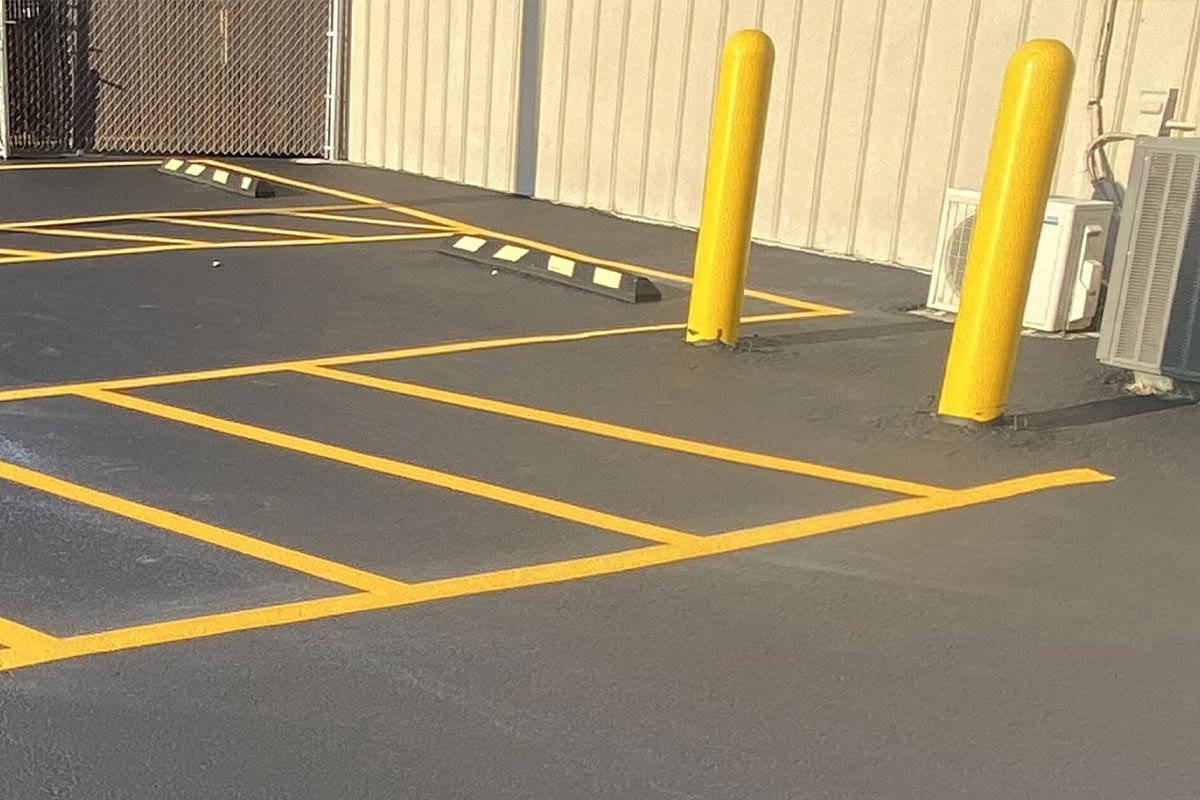
Bollard Installation in Charlotte
Steel bollards put a physical wall between vehicles and whatever they’re rolling toward — a storefront, a pedestrian path, a gas meter, an electrical panel. 1-800-STRIPER installs fixed, removable, and embedded steel bollards at commercial properties across Mecklenburg, Gaston, Cabarrus, Union, and the surrounding counties, matching the bollard spec to the actual risk at each site. Standard pipe bollards run 4 to 6 inches in diameter, concrete-filled, and driven 24 to 36 inches deep into a poured footing.
Charlotte property managers typically call about bollards when a loading dock shares a lane with foot traffic, when a retail storefront opens directly onto a parking lot, or when exterior utility equipment is sitting exposed with nothing between it and moving vehicles. Before any core drilling starts, the crew walks the site to map drive lanes, pedestrian routes, and underground utilities.
Shopping centers and strip malls in areas like Pineville, Matthews, and Kannapolis often have parking lots that run directly up to storefront glass — no curb, no setback, nothing slowing a vehicle before it hits the building. Industrial properties near the airport corridor or along I-85 in Concord face a different version of the same problem: forklifts and delivery trucks share tight yards with employees on foot. In both cases, a correctly placed bollard line resolves the exposure without altering traffic flow or access for legitimate users. The key is matching bollard type, spacing, and embedment to the specific conditions at each site rather than applying a one-size layout everywhere.
Bollard Types: Fixed, Removable, and Embedded
Pick the wrong bollard type and you either block access you needed or leave a gap where you needed protection.
| Bollard Type | How It Works | Crash-Rated Option | Best Use Case |
|---|---|---|---|
| Fixed | Welded cap, permanently set in concrete footing | Yes (ASTM F2656-certified models available) | Storefronts, utility protection, permanent perimeter |
| Removable | Drops into a locking ground sleeve; keyed lock controls access | Limited (select models) | Loading docks, emergency-vehicle lanes, event plazas |
| Embedded | Flush-mount or retractable hydraulic unit; fully recessed when lowered | Yes (high-end automated units) | Pedestrian plazas, drive-through entrances, secured facilities |
Fixed bollards are the default for retail and warehouse sites — they go in once and there’s nothing to operate or maintain beyond the occasional inspection. Removable bollards use a locking ground sleeve, so an authorized user with a key can lift the post clear when a loading zone needs temporary vehicle access. Embedded and retractable units are for higher-security or automated-entry situations where the opening needs to open and close on a schedule or under electronic control.
Crash-Rated Bollards and ASTM Standards
A bollard marketed as “crash-rated” without a test report behind it isn’t actually rated — it’s a claim. Independent testing under published ASTM standards is what separates a rated product from an unverified one.
ASTM F3016 covers low-speed impact scenarios — a 2,500 lb vehicle at 5 to 30 mph — and is the standard most commonly referenced for retail storefront protection on commercial corridors and in strip malls. ASTM F2656 steps up to heavier test vehicles at speeds reaching 50 mph, and shows up in perimeter-security specifications for facilities with higher threat exposure.
When a project calls for rated protection, 1-800-STRIPER sources bollards that ship with certified ASTM test reports from the manufacturer. The penetration class (F3016) or K/M-rating (F2656) gets documented before installation, so the property owner has the compliance record on file — useful for insurance reviews and tenant documentation. Call (704) 828-9922 or email Charlotte@1800STRIPER.com to schedule a free site estimate and specification review.
Storefront and Pedestrian Protection in Charlotte
A vehicle doesn’t need to be going fast to do serious damage. At 10 mph, a 3,000 lb vehicle has enough energy to take out a glass storefront, an outdoor dining partition, or a utility cabinet. Charlotte’s commercial corridors — South End, Uptown, the Concord Mills area, Steele Creek — see the same mix of distracted drivers, parking-lot mistakes, and medical incidents that hit retail centers everywhere.
Bollards placed along the building face create a deceleration gap before the glass line. Beyond storefronts, the same approach covers outdoor seating areas, pedestrian queues alongside drive-through lanes, exterior mechanical and electrical equipment, and bike-parking zones. Spacing on a pedestrian-barrier run is typically 3 to 5 feet on center — enough clearance for wheelchairs and maintenance access, not enough for a car to slip through. Where a bollard line crosses an ADA-accessible route, spacing is checked against the North Carolina State Building Code, Chapter 11 so the accessible path stays clear.
Multi-tenant properties present a specific planning consideration: when one tenant’s entrance shares a drive aisle with another’s loading area, a removable bollard array can separate the zones during business hours and open the full lane during off-hours deliveries. That kind of zoning is harder to solve with paint alone — paint communicates, bollards enforce.
New development in the Charlotte metro — mixed-use projects in NoDa, infill retail in Plaza Midwood, logistics facilities in the Gaston County corridor — often includes bollard requirements in the site plan before a shovel goes in the ground. Retrofit installs are common too, driven by insurance requirements, lease renewals, or an incident that made the risk visible. 1-800-STRIPER of Charlotte works with property managers, general contractors, and facilities teams on both scenarios across Mecklenburg and the surrounding counties. Call (704) 828-9922 or email Charlotte@1800STRIPER.com to set up a site assessment.
For a full list of our pavement marking services, visit our parking lot striping in Charlotte page.
Businesses We Serve




How it Works

GET A FREE ESTIMATE
Contact us today and we’ll have a quote to you in 24 hours

SCHEDULE AN INSTALLATION
We’ll have your installation scheduled in less than 7 days, without affecting your business hours

GET A PARKING LOT THAT POPS
For a budget-friendly price, you’ll get a parking lot that looks like new
We proudly work with:


We proudly work with:


Frequently Asked Questions About Bollard Installation in Charlotte, NC
How deep are bollards installed, and why does depth matter?
Standard steel pipe bollards go 24 to 36 inches into a poured concrete footing. That embedment depth is what pushes the impact load down into the ground instead of just bending the post at the surface. Thinner slabs sometimes require a shallower core, but the footing design gets adjusted to compensate. Soil type, slab thickness, and proximity to underground utilities all factor into the depth called out during the site walk.
What is the difference between ASTM F3016 and ASTM F2656?
ASTM F3016 tests low-speed impact — a 2,500 lb vehicle at 5 to 30 mph — which covers most storefront and retail-corridor scenarios. ASTM F2656 runs heavier vehicles at higher speeds and shows up in perimeter-security specs for facilities that need to meet formal vehicle-barrier standards. Both standards produce test reports that ship with the bollard as part of the product documentation, giving the property owner a traceable compliance record tied to the specific unit on-site.
Can bollards be removed seasonally or for special events?
Yes, if they’re the removable type. A removable bollard drops into a locking ground sleeve that sits flush with the surface when the post is out. Someone with the keyed lock can pull the post clear in seconds — enough to open a lane for a delivery truck, a temporary event setup, or emergency-vehicle access. Drop it back in, lock it, and the opening is secured again. The sleeve handles repeated cycles and stays below the wear surface when the bollard is removed.
How much surface prep is required before bollard installation?
Before any coring, the crew contacts the local one-call service to mark underground utilities. Then the concrete or asphalt is cored to diameter, the footing cavity is formed based on slab thickness, and the bollard is set plumb before the concrete goes in. The pavement around the core gets patched on the way out. Where coring isn’t an option — thin slab, post-tension deck, subsurface conflicts — surface-mounted anchor-bolt alternatives exist and get discussed during the site assessment.
Do bollards require ongoing maintenance?
Not much, but a periodic check makes sense. Painted steel can develop surface rust where the finish is chipped, and Charlotte’s occasional winter weather means de-icing chemicals sometimes reach parking-lot bollards. Powder-coated or galvanized finishes hold up longer. Removable bollards benefit from occasional sleeve-lock lubrication so the post drops in and releases cleanly. Any bollard that took a vehicle hit — even a slow one — should be looked at for deformation before being counted on for protection again.
Does 1-800-STRIPER handle bollard installation as part of a larger parking lot project?
Yes. Bollard work frequently gets combined with parking lot striping, ADA stall repainting, curb painting, and wheel stop installation on the same mobilization. Fewer site visits, one crew handling multiple compliance items, and everything done in a single project window. Reach out to 1-800-STRIPER of Charlotte at (704) 828-9922 or Charlotte@1800STRIPER.com to talk through the scope and get a free estimate.