Parking Lot Restriping
In Charlotte, NC
Restripe Existing Lines and Markings
1-800-STRIPER provides professional parking lot restriping in Charlotte, NC — refreshing faded lines, ADA stalls, fire lanes, and directional arrows with durable fast-dry traffic paint for commercial properties across the Charlotte metro area.
1-800-STRIPER of Charlotte PROVIDes Restriping Services NEAR YOU
Need to brighten up your faded parking lot?
Keep your parking lot safe and attractive by restriping annually to freshen up lines and symbols that have faded from the sun, weather, and traffic. Nothing beats a fresh coat of paint!
Benefits:
Parking Lot Restriping in Charlotte
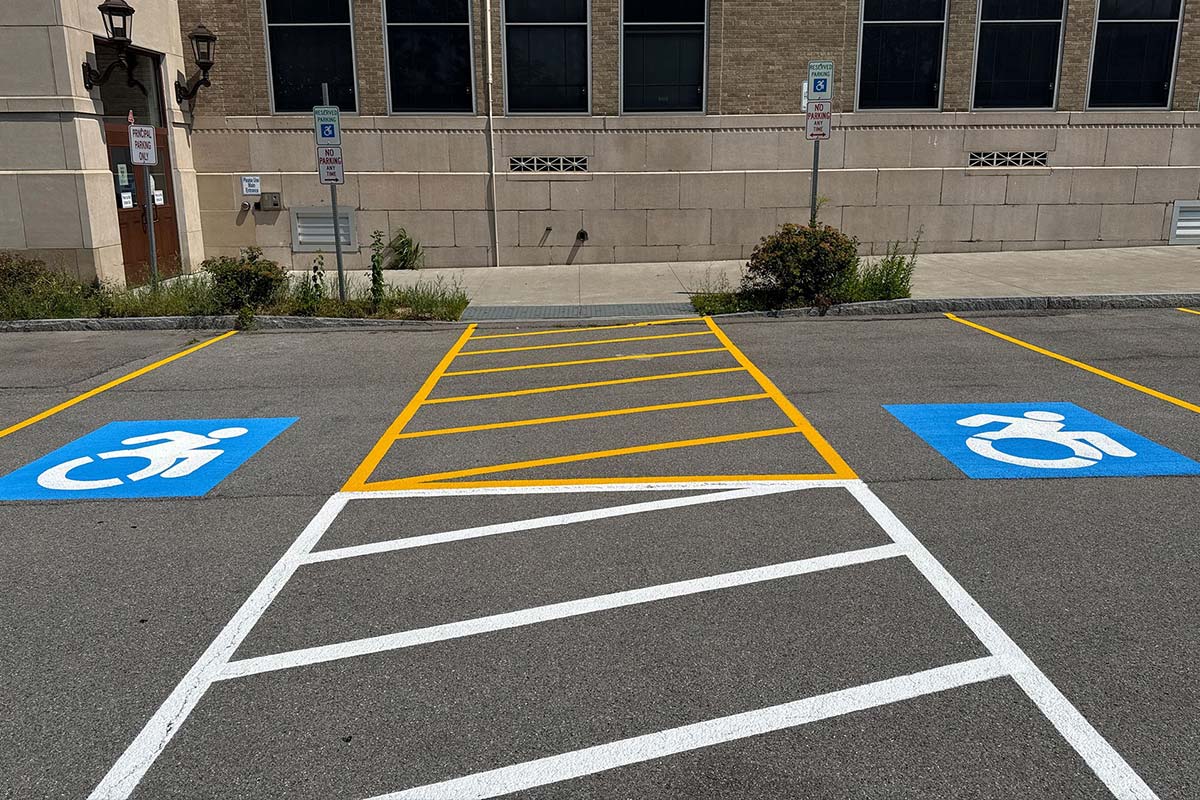
Faded lines aren’t just an eyesore — they’re a liability. When stalls are hard to read, ADA markings have worn through, or fire-lane designations can’t be confirmed at a glance, you’re exposed. 1-800-STRIPER of Charlotte restores parking lot markings across Mecklenburg, Gaston, Cabarrus, Union, and Iredell counties using fast-dry waterborne traffic paint that holds through Charlotte’s wet springs and brutal summer heat. If your lot’s markings are harder to see than they were last season, that’s your signal.
When to Restripe
Most property managers know they need a restripe when they see it — drivers ignoring stall lines and parking wherever, or ADA symbols worn down to a ghost. Four situations push the call forward: lines faded to the point where drivers navigate on instinct; ADA stalls, access aisles, or van-accessible signage that no longer meets the minimum width and contrast requirements under the 2010 ADA Standards for Accessible Design; fire-lane markings worn below the curb-marking and stencil thresholds in the North Carolina Fire Code; or directional arrows so faint they no longer move vehicles the way the Manual on Uniform Traffic Control Devices requires them to.
Charlotte’s UV load and freeze-thaw cycles cut the practical life of standard traffic paint to two to four years on busy surfaces. Lots that take heavy delivery trucks or steady through-traffic often wear faster. A quick walkthrough — or even your phone camera — will show you where contrast has dropped below what the code requires.
Our Restriping Process
Every restripe follows the same sequence. Each step sets up the one after it, and cutting one is how paint fails early or ADA layouts end up out of spec.
- Site assessment. We walk the lot and photograph every existing marking — stall counts, ADA ratios, fire-lane runs, and any layout changes the property needs before a single line goes down.
- Surface cleaning. The pavement gets blown clear of debris and moisture. Paint over dirty or wet asphalt doesn’t bond — it flakes. This step doesn’t get skipped.
- Layout verification. We measure from existing reference points and chalk the layout before opening paint. ADA corrections — stall width, access aisle, van-accessible designation — are dimensioned to the 2010 ADA Standards for Accessible Design before the first stripe goes down.
- Line striping. Standard stalls, ADA stalls, fire lanes, directional arrows, crosswalks, stop bars, and any specialty markings go down in fast-dry waterborne traffic paint. We sequence the work so completed sections can cure before adjacent traffic moves through.
- Quality check. Every section gets compared against the original layout photos and code dimensions. Fire-lane widths and ADA access aisles get a tape-measure confirmation.
- Site clear. Cones and equipment come out. We do one final walkthrough and photograph the finished markings before we leave.
What We Restripe
Most commercial lots in Charlotte share the same core set of markings. We handle all of them.
Standard stalls and layout. A full lot restripe covers standard parking stalls, driving lanes, entry and exit lanes, and the internal flow markings that keep traffic moving — arrows, yield lines, stop bars.
ADA accessible spaces. ADA restriping isn’t just slapping the symbol back on the pavement. We reconfirm stall width (minimum 8 feet), access aisle width (5 feet standard, 8 feet for van-accessible), and cross-slope. The 2010 ADA Standards for Accessible Design are the governing document; the North Carolina State Building Code, Chapter 11 reinforces the same requirements statewide.
Fire lanes. Curb markings and pavement stencils get refreshed to conform with the North Carolina Fire Code — the “NO PARKING FIRE LANE” legend and any red-curb marking the local fire marshal requires.
Crosswalks and pedestrian paths. High-traffic pedestrian crossings come back to current dimensions and coverage. Where a crosswalk ties into an accessible route, ADA dimensions apply.
Specialty markings. Loading zones, reserved stalls, directional arrows, carpool spaces, EV charging zone designations, and no-parking zones are all in scope.
Restriping vs. New Striping
A fresh layout from scratch and a restripe solve different problems. Here’s how they split.
| Factor | Restriping | New Striping (new layout) |
|---|---|---|
| What it fixes | Faded, worn, or non-compliant markings on an existing layout | A new pavement surface, a layout change, or a complete redesign |
| Existing layout required | Yes — ghost lines or reference photos need to be there | No — layout is built from scratch |
| ADA corrections | Yes — stall widths and access aisles can be corrected mid-job | Yes |
| Common trigger | Paint faded, compliance due, ADA complaint received | New construction, repaved lot, major layout redesign |
| Relative cost | Lower — follows existing geometry | Higher — full layout planning and field measurement |
| Pavement condition | Must be structurally sound | New or recently resurfaced |
When the existing layout is serviceable and the pavement is solid, restriping is almost always the right call. If the lot was just repaved and ghost lines are gone, or ADA deficiencies require stall repositioning rather than just a repaint, that’s when a new layout earns its cost. 1-800-STRIPER of Charlotte will tell you which one you actually need.
Why 1-800-STRIPER of Charlotte
1-800-STRIPER of Charlotte has a 5-star Google rating from 14 local reviews. That tells you jobs here finish the way they’re supposed to. Restriping comes down to two things — measurement accuracy and surface prep — and those are exactly where shortcuts show up fast, either on a tape measure or at a code inspection.
We cover commercial properties across Mecklenburg, Gaston, Cabarrus, Union, Iredell, Lincoln, and Catawba counties in North Carolina, and reach into York and Lancaster counties in South Carolina. That means properties in Concord, Gastonia, Huntersville, Cornelius, Matthews, Mint Hill, Mooresville, Monroe, Indian Trail, Kannapolis, Pineville, Fort Mill, and Rock Hill. Charlotte metro lot — we’re there.
Call (704) 828-9922 or email Charlotte@1800STRIPER.com for a free estimate.
Restriping for Retail, HOA & Industrial Lots
What’s at stake shifts depending on the lot you’re running.
Retail and shopping centers. Customer-facing lots get graded on appearance before anyone walks inside. Faded stalls read as neglect. Retail lots also carry the sharpest ADA audit exposure — a worn-out van-accessible symbol or a missing access aisle can trigger a complaint before the property manager even knows the marking is gone. A restripe fixes the compliance gap and lifts the curb appeal at the same time.
HOA and residential communities. Charlotte HOAs deal with assigned stall enforcement, guest parking control, and fire-lane compliance along unit rows. Clear markings cut down disputes that come from ambiguous stall lines and keep fire-lane inspections clean. Restriping is the practical annual maintenance item that prevents those problems.
Industrial and warehouse facilities. OSHA 29 CFR 1910.22 requires aisle markings in industrial facilities to be visible and maintained. Pedestrian/vehicle separation markings that have faded aren’t a cosmetic problem — they’re a compliance failure. We work in Charlotte’s distribution and manufacturing corridors, including properties near I-485 and I-85.
For a full list of our pavement marking services, visit our parking lot striping in Charlotte page.
Businesses We Serve



How it Works

GET A FREE ESTIMATE
Contact us today and we’ll have a quote to you in 24 hours

SCHEDULE AN INSTALLATION
We’ll have your installation scheduled in less than 7 days, without affecting your business hours

GET A PARKING LOT THAT POPS
For a budget-friendly price, you’ll get a parking lot that looks like new
We proudly work with:


We proudly work with:

Frequently Asked Questions About Parking Lot Restriping in Charlotte, NC
How do I know if my parking lot needs restriping or a completely new layout?
If the existing layout is geometrically sound and the pavement is in reasonable shape, restriping is almost always the right answer. You need a full new layout when the lot has been resurfaced and the old ghost lines are gone, or when ADA stall ratios require repositioning — not just repainting. The 2010 ADA Standards for Accessible Design define what the layout has to include; if yours meets those requirements geometrically, restriping restores the markings without touching the geometry. Call (704) 828-9922 and we’ll give you a straight answer on-site.
How long does parking lot restriping take to dry, and when can traffic return?
Fast-dry waterborne traffic paint typically reaches surface-dry in 15 to 30 minutes under decent conditions — temperatures above 50°F, low humidity, no rain coming. Full cure, where the paint hits its rated adhesion and abrasion resistance, takes longer and depends on conditions. We work in sections, so completed areas open to traffic while adjacent sections cure. Don’t drive or walk on freshly painted markings until they’re visibly dry and no longer tacky.
Do you handle ADA restriping, and what does that include?
Yes. It’s more than painting the wheelchair symbol. We verify each accessible stall is at least 8 feet wide, access aisles hit 5 feet minimum (8 feet for van-accessible), and the total stall count meets the required ratio for the lot. Both the 2010 ADA Standards for Accessible Design and the North Carolina State Building Code, Chapter 11 apply. If the layout has deficiencies that require physically moving stalls rather than repainting them, you’ll hear that before we start, not after.
How often should a commercial parking lot in Charlotte be restriped?
On high-traffic surfaces — retail, industrial, multi-family — standard traffic paint holds up for about two to four years before contrast drops enough to matter. Lower-traffic lots go longer. Charlotte adds some pressure here: high UV exposure and seasonal freeze-thaw cycles wear paint faster than in milder climates. Two visual checks a year, spring and early fall, is a practical way to catch fading before it turns into a liability.
Are fire-lane markings part of restriping, and what are the requirements?
Yes — fire lanes are standard scope on any parking lot restripe. The North Carolina Fire Code sets the marking requirements: pavement legends, and red-curb marking where the local fire marshal calls for it. Charlotte-area fire marshals check fire-lane compliance on commercial properties. Keeping the markings crisp and the stencils legible is the simplest way to avoid corrective items after an inspection.
What surfaces can you restripe?
Asphalt and concrete. Asphalt is what most Charlotte commercial lots are paved with; concrete shows up in structured parking and some industrial facilities. Surface condition matters — paint over oil-contaminated or deteriorating pavement won’t adhere properly. We check surface condition during the site visit. If the pavement has structural issues that would prevent the paint from holding, you’ll hear about it before the job starts, not after the stripes peel.