Sports Court Striping
In Charlotte, NC
Multi-Sport Court Line Marking
1-800-STRIPER provides professional sports court striping in Charlotte, NC — marking pickleball courts to USA Pickleball specifications, basketball courts, tennis courts, and playground game markings using durable acrylic traffic paint.
1-800-STRIPER® of Charlotte PROVIDes Sport Court and Playground Markings Services NEAR YOU
Want to get people to come out to play?
Brighten up your faded sport courts or turn your playground into a safe, colorful, and engaging space that entices people to come out and play.
Sport Court Specialties:
Sports Court Striping in Charlotte
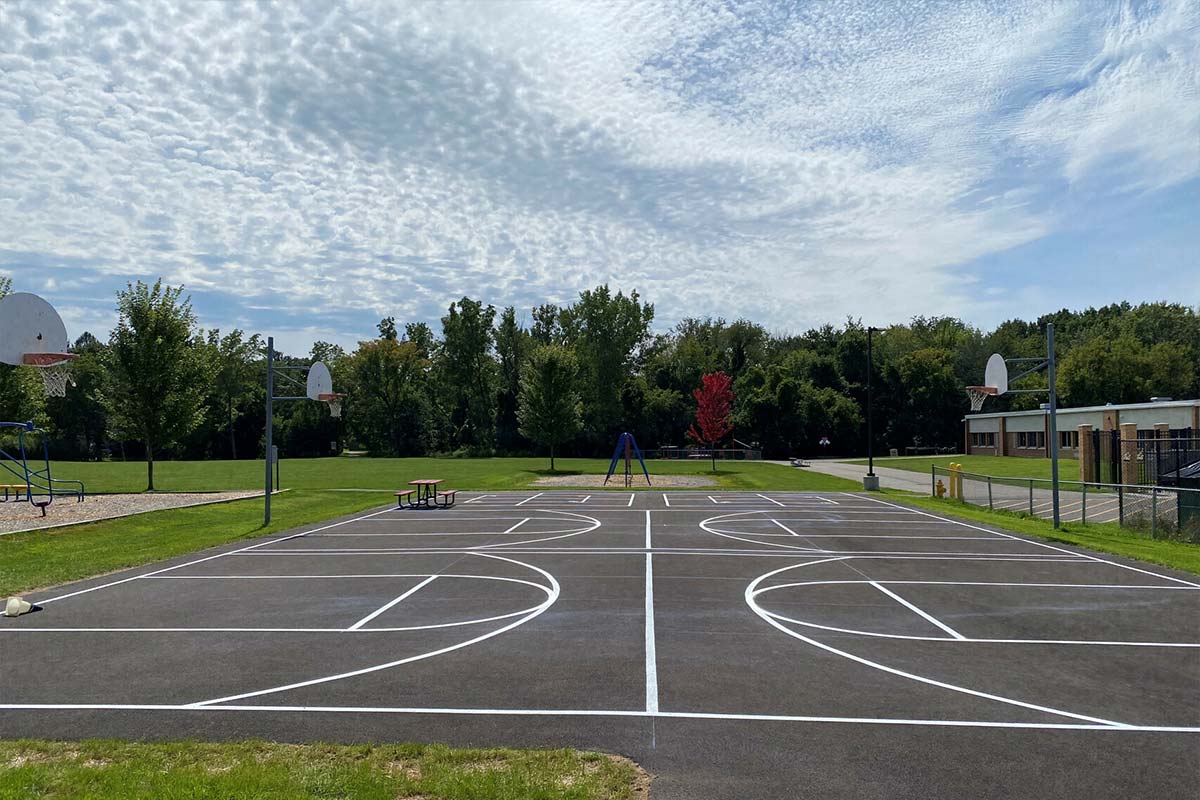
Off-dimension lines and missing non-volley zones do not just look sloppy — they generate rule disputes and erode the value of a space players actually want to use. Court markings need to be placed right the first time. 1-800-STRIPER of Charlotte handles sports court striping on asphalt and concrete surfaces throughout Mecklenburg, Gaston, Cabarrus, and Union counties.
Pickleball complexes, community center lots, school recreational areas, apartment amenity spaces — the work is the same regardless of scale: precise line placement, proper surface prep, and paint that stays put. 1-800-STRIPER of Charlotte applies the same spec-first discipline to court work that we bring to parking lots, adjusted for court dimensions instead of stall widths. Call (704) 828-9922 or email Charlotte@1800STRIPER.com for a free estimate.
We serve commercial properties, homeowner associations, municipalities, and educational facilities throughout Mecklenburg, Gaston, Cabarrus, and Union counties — and across the South Carolina border into York and Lancaster counties as well.
Pickleball Courts
Pickleball courts have specific dimensions, and players who know the game will notice when they are wrong. The USA Pickleball Official Rulebook calls for a play area of 20 feet wide by 44 feet long, with a recommended total court envelope of 30 by 60 feet to give players room to move behind the baselines and along the sidelines. The non-volley zone — the kitchen — runs 7 feet from the net on both sides. Net height is 34 inches at center, 36 inches at the posts.
We stripe pickleball courts on new and existing hard-court surfaces. Parking lot end zones and recreational pads are common conversion candidates across the Charlotte area. Lines go down with durable acrylic court paint that holds up through the humidity and UV exposure that comes with a North Carolina summer. For properties adding pickleball to an existing tennis court, we overlay the pickleball lines in a contrasting color — clean separation so neither game’s markings bleed into the other.
Mecklenburg County property owners have been converting underused surface space into active pickleball courts at a steady pace, and the demand has not slowed. Single-court setups or numbered multi-court layouts with color coding — we work from whatever dimensions you have and lay out a finished configuration that meets the rulebook specs.
Basketball Courts
Regulation full-court basketball runs 94 feet by 50 feet under NBA and NCAA rules. Many commercial and community installs go half-court — 47 by 50 feet — which drops into a parking lot end zone, a courtyard, or a school blacktop without a lot of site work. FIBA Official Basketball Rules set international dimensions at 28 meters by 15 meters (roughly 91.9 by 49.2 feet), and those apply to facilities that need to meet international standards.
Standard markings cover the center circle, three-point arc, free throw line and lane, and boundary lines. We verify placement against the applicable ruleset before any paint goes down — full-court and half-court alike. Acrylic paint gives you clean contrast on concrete and asphalt without tearing out a surface that is otherwise in decent shape.
Half-court is the format that actually fits most commercial outdoor spaces: apartment amenity areas, employee recreation pads, parks. Where a 94-foot run is not on the table, a half-court layout still gives players a proper, correctly dimensioned surface to play on.
Tennis Courts
Singles tennis runs 78 feet by 27 feet. Doubles widens to 36 feet at the same length. The United States Tennis Association recommends a total court envelope of at least 60 by 120 feet — that buffer matters when you are trying to fit a new court into a property with limited room behind the baselines. Properties with less run-off space than recommended should know the constraint before they commit to a layout, not after we have finished measuring.
Markings cover the baseline, service boxes, service center line, and both the singles and doubles sidelines. Net posts sit 3 feet outside the doubles sidelines on each side. Multi-court facilities get consistent color coding and center mark indicators so the layout reads cleanly across the whole complex — useful for facilities running lessons, leagues, or drop-in sessions where multiple courts run simultaneously. On existing surfaces, we clean the stripe zone before application; adhesion and edge sharpness both suffer on a dusty or contaminated surface, so that step does not get skipped.
Playground & Game Markings
Courts are not the only option. Playgrounds and multi-use recreational surfaces across Charlotte regularly get four square grids, hopscotch layouts, numbered path sequences, alphabet trails, shuffleboard lanes, and fitness circuit graphics — markings that make a slab of blacktop into something kids and adults actually use.
The same acrylic paint that goes on court lines works here, in whatever colors contrast well against the surface. Playground game dimensions are not set by a governing body the way basketball or tennis rules are, so we work with the property manager to size each game to the available space. Circulation paths need to stay clear — tight layouts on small blacktop areas can crowd out movement if the games are not spaced with some thought. For facilities where kids are supervised, we can factor sight lines into the layout planning during the site visit.
A single surface can carry four square, a hopscotch path, and an alphabet trail side by side without feeling cramped if the layout is done right. Properties in Concord, Gastonia, Huntersville, Cornelius, Matthews, Mint Hill, and the broader Charlotte metro are all within our service area — call (704) 828-9922 for a free estimate.
Court Dimension Specs
Published dimensions from each sport’s governing body — no guesswork in the layout.
| Court Type | Play Area (L × W) | Key Interior Mark | Source |
|---|---|---|---|
| Pickleball | 44 ft × 20 ft play area (30 × 60 ft recommended total) | Non-volley zone: 7 ft from net each side; net center height: 34 in | USA Pickleball Official Rulebook |
| Basketball — Full (NBA/NCAA) | 94 ft × 50 ft | Center circle, 3-pt arc, free throw lane | FIBA Official Basketball Rules |
| Basketball — Half-court | 47 ft × 50 ft | 3-pt arc, free throw lane, midcourt line | FIBA Official Basketball Rules |
| Tennis — Singles | 78 ft × 27 ft | Service boxes, baselines, center service mark | United States Tennis Association |
| Tennis — Doubles | 78 ft × 36 ft | Same as singles + doubles sidelines | United States Tennis Association |
Recommended envelope dimensions — total surface including run-off zone — vary by sport. We check the available footprint during estimating and confirm what fits before any paint goes down.
Our Court Striping Process
Court markings are unforgiving — a boundary placed two feet off throws the whole layout. The layout work happens before any paint goes down, and each step builds on the one before it.
- Site assessment — Surface condition, existing markings, and available dimensions are reviewed. Cracked or spalling pavement gets flagged upfront; paint over a deteriorating surface will not hold, and repairs need to come first.
- Measurement and layout — Boundaries, interior lines, and critical marks (non-volley zones, free throw lanes, service boxes) are measured and chalked or snapped before any paint opens. Dimensions are confirmed against the ruleset for the specific court type.
- Surface cleaning — The stripe zone is cleared of loose debris, dust, and contamination. Clean surface contact is what gives acrylic paint its adhesion and keeps edge lines sharp.
- Paint application — Acrylic court paint goes down by line striping machine — consistent width, clean edges. For multi-court layouts and color-coded overlays, colors are sequenced so each one cures before the adjacent line is applied.
- Final inspection — Line positions and widths are checked against the layout measurements. Edge irregularities get touched up on-site before the job is closed.
We cover the full Charlotte metro — Concord, Gastonia, Huntersville, Matthews, Fort Mill SC, Rock Hill SC, and the surrounding area. Call (704) 828-9922 for a free estimate.
For a full list of our pavement marking services, visit our parking lot striping in Charlotte page.
Businesses We Serve




How it Works

GET A FREE ESTIMATE
Contact us today and we’ll have a quote to you in 24 hours

SCHEDULE AN INSTALLATION
We’ll have your play space restriped in less than 7 days, without affecting your playtime

GET A PARKING LOT THAT POPS
For a budget-friendly price, you’ll get a parking lot that looks like new
We proudly work with:


We proudly work with:

Frequently Asked Questions About Sports Court Striping in Charlotte, NC
How long does sports court striping take to dry in Charlotte’s climate?
Acrylic court paint typically touches dry within 30 to 60 minutes under normal conditions. Light foot traffic is usually fine within a few hours. Full cure — the point where heavy play and wheeled equipment will not damage the lines — takes 24 to 48 hours. Charlotte’s summer humidity can stretch those windows out. We plan the schedule around adequate drying time and will give you a realistic timeline at the estimate stage.
Can you stripe pickleball courts on an existing tennis court surface?
Yes — pickleball overlays on existing tennis courts are one of the more common requests we get. Lines go down in a contrasting color so tennis and pickleball markings stay visually separate. The USA Pickleball Official Rulebook sets the required play area and non-volley zone dimensions, and we position the pickleball layout within the existing surface to hit those numbers. Color selection matters here — we look at the existing line colors and surface color together during the site assessment and pick something with clear contrast on both counts.
What type of paint do you use for outdoor sports courts?
Durable acrylic court paint — formulated for hard outdoor surfaces, not general-purpose traffic paint. Acrylic bonds to both concrete and asphalt, holds up through Charlotte’s heat, humidity, and winter temperature swings, and gives the color contrast and crisp edge definition that court markings need. It is a different product from the water-based paint we use on parking lot stalls — court paint is built for a higher-wear recreational environment. For product specifics, reach out directly.
Do sports court markings require any permits in Charlotte or Mecklenburg County?
Striping an existing hard surface is typically treated as surface maintenance in Charlotte and Mecklenburg County, not new construction — so a separate permit is not usually required. Where new court construction or full surface resurfacing is part of the project, building permits may come into play depending on scope and site. Check with the Charlotte Unified Development Ordinance or your local code office if structural work is involved beyond the line markings themselves. Our scope is the striping — permitting questions for construction components are the property owner’s call to resolve.
How do I know when my sports court lines need to be restriped?
Visible fading, blurry edges, and color that no longer reads against the court surface are the obvious signals — Charlotte’s UV load and wet seasons accelerate all three. A heavily used court shared by multiple groups wears faster than a lightly used recreational surface. If players are having trouble reading lines from playing position, or if surface repairs have compromised the layout accuracy, it is time for a refresh. Restriping is also a good chance to fix any lines that were not placed to spec in the first place.
Can you stripe multiple court types on the same surface?
Yes, and it is more common than people expect — pickleball overlaid on tennis, basketball and four-square sharing a recreational pad, multi-game playground surfaces. Color coding is what makes it work: each court type gets its own line color so players are not reading the wrong lines mid-game. We work out the layout sequence during estimating, confirm that the combined footprint fits the available envelope, and verify that each court type’s dimensions meet the governing-body specs before we start painting.