
Bollard Installation
In South Atlanta, GA
Safety and Security Bollards
1-800-STRIPER provides professional bollard installation in South Atlanta, GA — steel, concrete-filled, and bolt-down bollards protecting storefronts, fuel pumps, and pedestrian zones per ASTM F3016 vehicle-impact and ASTM F2656 crash-rated security standards for commercial properties across the south metro.
1-800-STRIPER® of Atlanta OTP South PROVIDes Bollard Installation Services NEAR YOU
Want to prevent accidents and protect your property?
Bollards provide physical protection for your customers and your property.
Safety and security:
Bollards create a physical barrier between vehicles and pedestrians, protecting people in walking areas from accidental or intentional vehicle intrusions.
Bollards act as a protective barrier around storefronts, gas stations, and other vulnerable areas, minimizing the risk of costly damage from vehicle impacts.
Strategic Placement Locations:
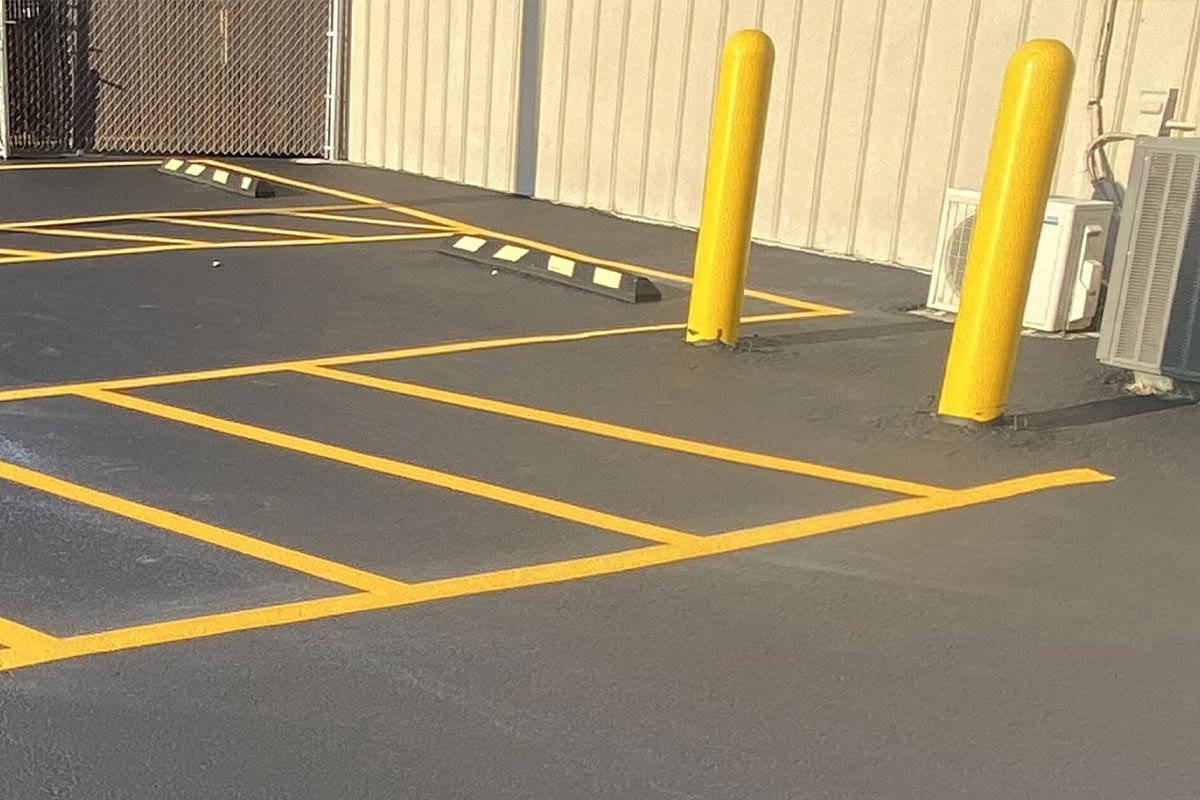
Bollard Installation Services in South Atlanta, GA
Crews core-drill and anchor steel or concrete-filled posts where a site needs fixed, high-strength protection. Where speed of install matters more than maximum impact resistance, bolt-down posts go straight onto existing pavement instead. Each job gets sized to the level of protection the entrance, fuel island, or walkway actually needs.
Bollard Types — Steel, Concrete-Filled, Bolt-Down
Steel pipe bollards filled with concrete are the standard, highest-strength option for storefronts and fuel islands, anchored in a core-drilled footing below grade. Bolt-down bollards mount to a surface base plate instead, trading some fixed-post strength for faster installation and, where needed, removability. An unfilled steel pipe alone resists less impact than one packed with concrete, which adds mass and rigidity to the post. All three types can be finished with reflective sleeves or powder-coated covers that improve low-light visibility and help protect against corrosion.
ASTM F3016 vs. F2656 Impact & Crash Ratings
ASTM F3016 and ASTM F2656 rate two different levels of vehicle-impact protection. Which one applies depends on the risk at a given entrance: F3016 covers lower-speed impacts typical of a storefront or fuel-pump strike, while F2656 covers higher-speed, anti-ram scenarios at perimeter or high-risk access points.
| Standard | What It Rates | Typical Use |
|---|---|---|
| ASTM F3016 | Low-speed vehicle-impact resistance, roughly 10–30 mph | Storefront, fuel-pump, and pedestrian-zone protection |
| ASTM F2656 | High-speed crash and anti-ram penetration resistance | Perimeter security and high-risk entry points |
Most commercial storefront and fuel-pump jobs in South Atlanta call for an F3016-rated bollard; F2656-rated crash bollards are reserved for higher-security perimeter applications.
Storefront, Fuel-Pump & Pedestrian Protection
Bollards go wherever a vehicle path crosses a storefront entrance, a fuel dispenser, a pedestrian walkway, or exposed utility equipment. At a storefront, they keep vehicles from striking glass entries or building corners, and at a fuel island, they protect the dispenser itself — a location where fuel-dispenser protection is commonly addressed under NFPA 30A. Along walkways, the posts separate foot traffic from drive lanes while preserving the accessible route width required for ADA-compliant paths. Exposed utility equipment — gas meters, electrical transformers, and ground-mounted HVAC units — gets the same treatment anywhere a delivery truck or forklift could reach it.
Installation & Core-Drilling Process
1-800-STRIPER installs embedded bollards through a core-drilled footing, then anchors and fills the post before the site reopens to traffic:
- Mark bollard locations and verify utility clearance before drilling.
- Core-drill the footing to depth.
- Set and plumb the post in the footing.
- Fill with concrete and allow it to cure before removing barricades. Bolt-down bollards skip the drilling step and anchor directly to existing pavement or a concrete pad, which shortens install time where a full embedded footing isn’t required.
For a full list of our pavement marking services, visit our parking lot striping in South Atlanta page.
Businesses We Serve




How it Works

GET A FREE ESTIMATE
Contact us today and we’ll have a quote to you in 24 hours

SCHEDULE AN INSTALLATION
We’ll have your installation scheduled in less than 7 days, without affecting your business hours

GET A PARKING LOT THAT POPS
For a budget-friendly price, you’ll get a parking lot that looks like new
We proudly work with:


We proudly work with:


Frequently Asked Questions About Bollard Installation in South Atlanta, GA
Is there a code for bollards?
There’s no single nationwide “bollard code” — coverage comes from a few different sources depending on what the bollard is protecting. Fuel-dispenser protection is commonly addressed under NFPA 30A. Pedestrian routes near bollards must keep the 36-inch minimum clear width required by the 2010 ADA Standards §403, and the bollard’s impact resistance is rated to ASTM F3016 (low-speed) or ASTM F2656 (crash-rated) depending on the application.
What’s the difference between ASTM F3016 and F2656?
ASTM F3016 rates a bollard’s resistance to lower-speed vehicle impacts, roughly the range of a storefront or fuel-pump strike, while F2656 rates resistance to higher-speed, anti-ram impacts used at perimeter or high-security access points. Most storefront and fuel-island jobs in South Atlanta call for F3016; F2656 is reserved for higher-risk security applications.
Where should bollards be placed?
Bollards typically go at storefront entrances, fuel-pump islands, pedestrian walkways, and around exposed utility equipment like gas meters, transformers, or HVAC units. Placement depends on where a vehicle path could cross a protected point (storefronts and fuel islands are usually the priority), and spacing must keep any adjacent pedestrian route clear per ADA §403.
Steel vs. concrete-filled bollards — what’s the difference?
A steel pipe bollard on its own offers some impact resistance, but filling that pipe with concrete adds mass and rigidity that meaningfully increases how much force the post can absorb. For storefront and fuel-pump protection rated to ASTM F3016, concrete-filled steel is the standard choice; unfilled steel pipe is typically used for lower-impact, delineation-only applications.
Core-drilled vs. bolt-down bollards — which is better?
Core-drilled (embedded) bollards anchor into a deeper footing and hold up to more impact force, so they’re the choice for storefronts and fuel islands. Bolt-down bollards anchor to the surface instead of a drilled footing, installing faster and, in some cases, allowing removal — a good fit for pedestrian-only areas that don’t need full crash protection.
How far apart should bollards be spaced?
Bollards protecting an entrance or walkway typically sit about 4 to 5 feet apart on center — close enough to block a vehicle from passing between posts. Where bollards sit along or near an accessible route, spacing has to preserve the 36-inch minimum clear width required by the 2010 ADA Standards §403.