
Fire Lane Striping
In Philadelphia Suburbs, PA
Code-Compliant Fire Lane Markings
1-800-STRIPER provides professional fire lane striping in Philadelphia Suburbs, PA — marking fire lanes, curbs, and no-parking zones to the fire-prevention ordinance each township adopts for itself under the Pennsylvania Uniform Construction Code, for commercial properties across Montgomery, Bucks, Chester, and Delaware counties.
1-800-STRIPER® of Philadelphia Suburbs PROVIDes Fire Lane Striping Services NEAR YOU
Is your parking lot ready for first responders?
Our team is well-versed in local fire regulations and will parter with you to design a fire lane striping plan that creates unobstructed emergency access to protect your customers and property.
Core Services:
Who Actually Sets Fire Lane Rules in Pennsylvania
Your township does, and that answer is more specific than the one most contractors give. Pennsylvania does not adopt a free-standing statewide fire code. Under 34 Pa. Code Section 403.21(a)(8), the Uniform Construction Code takes up the International Fire Code of 2021 only to the extent it is referenced by other ICC codes adopted in that chapter. There is no blanket statewide fire code adoption behind it, and the National Fire Protection Association’s model fire code is not adopted at all.
What fills the gap is municipal. A municipality that enforces the Uniform Construction Code adopts it by its own ordinance. It may keep ordinances that were in effect on July 1, 1999 where those standards equal or exceed the state code. It may also elect not to administer and enforce the code at all, in which case a different arrangement applies.
The practical result is visible inside our own service area. Abington Township‘s fire prevention chapter adopts the BOCA National Fire Prevention Code from 1990, a different model code family from the ICC set the Uniform Construction Code uses, and enforcement runs through the Township Fire Marshal. A neighboring township may sit somewhere else entirely. This is why a contractor who tells you your fire lane must be marked a particular way statewide is telling you something Pennsylvania law does not say.
What Gets Marked: Lanes, Curbs, and No-Parking Zones
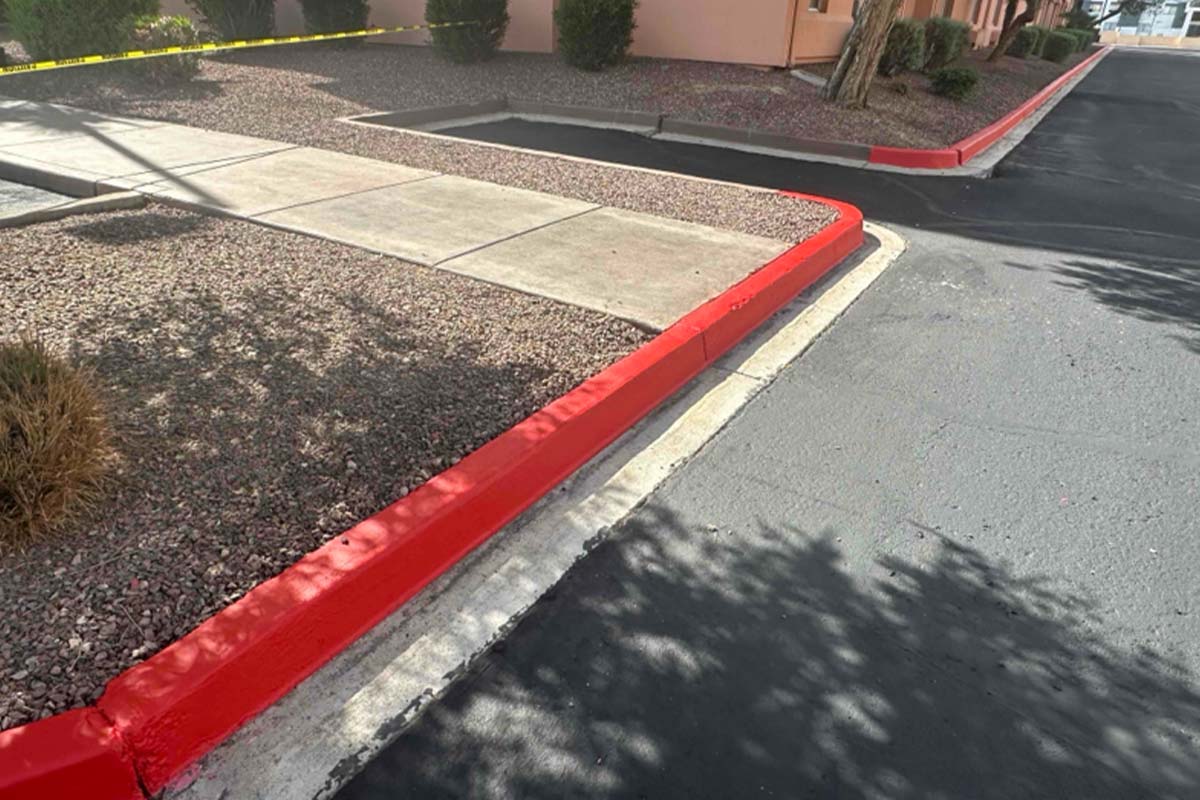
A fire lane is a route, not a stripe, and marking it is about making that route unmistakable to a driver looking for somewhere to leave a car for five minutes. The elements typically involved are the lane boundary itself, curb painting along the length of the restricted section, lettering inside or beside the lane, and signage at intervals along it.
Because the governing instrument is local, the specifics genuinely vary: which color the curb takes, how tall the lettering has to be, what wording is required, how far apart signs must sit, and whether the lane boundary is a single line, a double line, or hatching. We resolve those against the municipality with jurisdiction over your address before any layout goes down.
Two things stay constant regardless. The marking has to remain legible, because a fire lane that cannot be read is not doing its job and worn markings on a required route are a maintenance matter under the property maintenance code adopted across much of this region. And the lane has to stay clear, which is a marking and signage problem as much as an enforcement one.
How a fire lane project runs
- Identify the municipality with jurisdiction over the property.
- Confirm the fire prevention instrument that municipality has adopted.
- Contact or reference the Fire Marshal’s requirements for lane marking, lettering, and signage.
- Survey the route, curb lengths, and existing signage positions.
- Lay out lane boundaries, curb painting, and lettering to the confirmed requirement.
- Install or replace signage at the required spacing and mounting height.
- Document what was installed so the property has a record for inspection.
Working With Your Township Fire Marshal
The Fire Marshal is the person whose opinion decides whether the lane passes, and the cheapest moment to involve that office is before the paint comes out rather than after a re-inspection. In Abington, the fire prevention code is enforced by the Township Fire Marshal, and the Board of Commissioners holds a power to modify provisions on written application where strict compliance creates practical difficulties. Other municipalities structure it differently.
We are comfortable working from a requirement the Fire Marshal states, from a plan an inspector has already marked up, or from a violation notice a property has received. If you have been cited, bring the notice: it usually names the specific defect, which is faster and more reliable than inferring the requirement from the model code.
Where a property spans multiple municipalities, or where a management company runs sites across several townships, the requirement is confirmed per site. Four counties and eighty-six ZIP codes is a lot of jurisdictional variation to assume away.
For a full list of our pavement marking services, visit our parking lot striping in Philadelphia Suburbs page.
Businesses We Serve




How it Works

GET A FREE ESTIMATE
Contact us today and we’ll have a quote to you in 24 hours

SCHEDULE AN INSTALLATION
We’ll have your installation scheduled in less than 7 days, without affecting your business hours

GET A PARKING LOT THAT POPS
For a budget-friendly price, you’ll get a parking lot that looks like new
We proudly work with:


We proudly work with:


Frequently Asked Questions About Fire Lane Striping in Philadelphia Suburbs, PA
Does Pennsylvania require fire lanes to be marked a specific way?
Not at state level. Pennsylvania’s Uniform Construction Code adopts the International Fire Code of 2021 only to the extent other adopted ICC codes reference it, under 34 Pa. Code Section 403.21(a)(8), and does not adopt the National Fire Protection Association model fire code at all. The binding requirement comes from the municipality, which adopts its own fire prevention ordinance. That is why the answer for your property depends on which township it sits in.
What color should fire lane markings be?
That is set locally rather than by a single statewide rule, which is exactly why we confirm it before starting. Red is the common convention and it has a basis: 29 CFR 1910.144 assigns red as the basic color for identifying fire protection equipment and danger. But convention is not the same as the requirement your township has adopted, and marking a lane the wrong color is a re-do rather than a discussion.
How do I find out what my township requires?
Start with the Fire Marshal’s office for the municipality your property sits in, not the county. Pennsylvania pushes this decision down to the municipal level, so the township, borough, or city is the authority. If you have received a violation notice it will usually name the defect directly. We can also make that call for you as part of scoping the work, since we need the answer before laying anything out.
Do fire lanes need signs as well as painted markings?
Usually yes, and the two work together. Painted lane boundaries and curb marking tell a driver where the restriction is; signs tell them what it is and what happens if they ignore it. Spacing, wording, letter height, and mounting height are set by the municipality. We install signage alongside the marking so the lane is complete rather than half-marked, and so an inspection is not failed on the element that was left out.
Our fire lane markings have faded. Is that urgent?
Treat it as urgent for two reasons. First, a lane that cannot be read stops functioning, and the entire point of the marking is that a driver recognizes the restriction without thinking about it. Second, the 2024 International Property Maintenance Code adopted across much of this region requires that parking areas and similar surfaces be kept in a proper state of repair, so worn markings on a required route are a maintenance obligation rather than a cosmetic one.
Can you re-mark a fire lane while the property stays open?
Yes. Fire lanes sit at building frontages, so the work is normally sectioned so that access is maintained throughout and no entrance is blocked at any point. We coordinate around delivery windows and peak hours, barricade fresh work, and confirm each section as it becomes ready. For properties where the lane is also the main drive aisle, early morning or overnight work usually causes the least disruption.