
Warehouse Line Painting
In Charleston, SC
OSHA-Compliant Safety Markings
1-800-STRIPER provides professional warehouse line painting in Charleston, SC — marking permanent aisles, pedestrian walkways, and safety zone markings per OSHA 29 CFR 1910.176(a) for distribution centers and industrial facilities across Charleston, Dorchester, and Berkeley counties.
1-800-STRIPER® of Charleston PROVIDes Warehouse Floor Markings Services NEAR YOU
Want your indoor space to operate more efficiently?
Warehouse and interior markings ensure clear traffic lanes, organized storage zones, and designated spaces designed to help your business operate safely and efficiently.
Benefits:
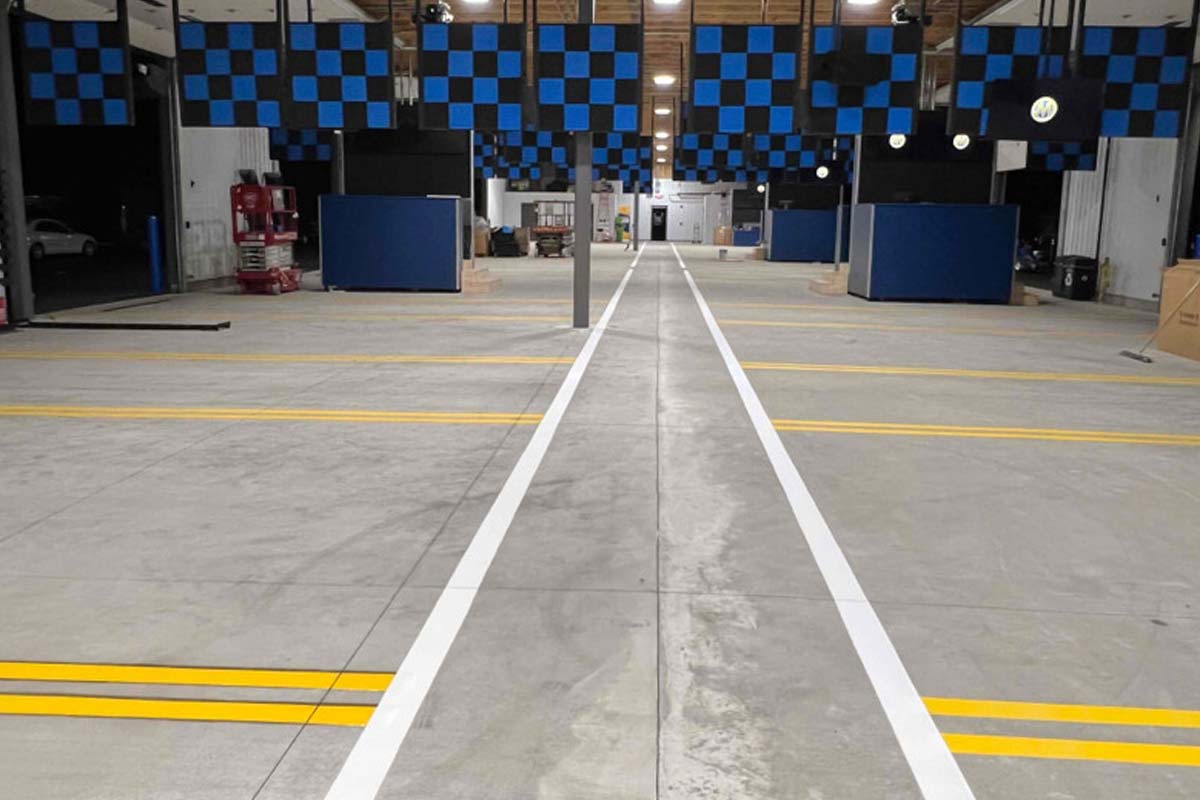
Warehouse Line Painting in Charleston, SC
Warehouse floor marking is a federal requirement with a deliberately open standard — which is why so much of what people “know” about it is wrong.
We mark warehouse and distribution floors across the Charleston market: aisles and cross-aisles, pedestrian walkways, forklift routes, staging and racking footprints, dock approaches, equipment footprints, and keep-clear zones at exits and electrical panels. The Lowcountry’s industrial base — distribution around the port, the Ladson and Summerville corridors, light manufacturing in North Charleston — runs on exactly this kind of floor.
What OSHA Actually Requires
One sentence carries the requirement — but read the whole subsection it sits in, because the scope clause comes first. OSHA’s materials-handling standard, 29 CFR 1910.176(a), is titled “Use of mechanical equipment” and reads in full:
“Where mechanical handling equipment is used, sufficient safe clearances shall be allowed for aisles, at loading docks, through doorways and wherever turns or passage must be made. Aisles and passageways shall be kept clear and in good repair, with no obstruction across or in aisles that could create a hazard. Permanent aisles and passageways shall be appropriately marked.”
Three phrases do the work: where mechanical handling equipment is used, permanent, and appropriately.
Where mechanical handling equipment is used is the condition, and it’s worth being precise about how far it reaches — because we’d rather be precise than convenient. Grammatically, that clause governs the clearances sentence it opens. The marking sentence is its own sentence and carries no trigger of its own; it sits under a subsection headed “Use of mechanical equipment,” which is why the standard reading in the trade — ours included — is that the whole subsection is about buildings that run powered handling equipment. Read it that way and forklifts, pallet jacks or order pickers put you inside 1910.176(a).
We’ll say plainly what that does and doesn’t get you. It is a reading, not the text, and we’re not going to tell you how it comes out for a floor with no powered handling equipment. What we will tell you is that nobody can point at 1910.176(a) and produce a color or a width. That part isn’t a reading; that’s the text.
Permanent scopes which aisles. If an aisle is a fixed feature of how your building operates, it needs marking. A staging lane that moves with the season doesn’t automatically qualify — though marking it is often still the right call for safety, just not because 1910.176(a) compels it.
Appropriately is the standard, and it’s deliberately performance-based. OSHA is telling you the marking has to suit the hazard, the traffic, and the building. It is not telling you how.
What OSHA Does NOT Require: No Color, No Line Width, No Aisle Width
This is where the industry sells a specification that doesn’t exist.
We read 29 CFR 1910.176 end to end. It contains no color requirement, no line width, and no minimum aisle width. The words yellow, color, width, inches, and stripe do not appear in the standard at all. Any contractor who tells you “OSHA requires 4-inch yellow lines” is quoting a rule that does not exist.
Where does the belief come from? Almost certainly from a different standard — 29 CFR 1910.144, the “Safety color code for marking physical hazards.” That one is about color. It says “yellow shall be the basic color for designating caution and for marking physical hazards such as: Striking against, stumbling, falling, tripping, and ‘caught in between,'” and it makes red the basic color for fire protection equipment, danger, and stop controls.
But 1910.144 is a hazard color code, not an aisle-marking rule. The word aisle appears in it zero times. So the two standards get welded together in the trade — 1910.176’s marking duty plus 1910.144’s yellow — and the result gets sold as a spec OSHA never wrote.
Why this is worth knowing rather than just interesting: if the requirement were a fixed 4-inch yellow line, compliance would be a purchasing decision. Because the real standard is “appropriately marked,” compliance is a judgment about your building — and one you may have to explain. A yellow line is still an excellent default: it’s what everyone reads as “caution,” it aligns with 1910.144’s logic, and it’s what your people already expect. But the reason to choose it is that it suits the hazard, not that a regulation dictates it.
Where color genuinely earns its keep is in making distinctions your staff have to make at a glance: travel aisles reading differently from pedestrian walkways, keep-clear zones at panels and exits reading differently again. That’s a scheme built around how your floor actually works. We’ll help you choose one and apply it consistently — consistency is what makes marking work, and it’s also the easiest thing to defend.
Layout for Forklift Traffic and Pedestrian Separation
The marking plan is downstream of the traffic plan. Before we paint, we walk the floor with your team and establish where powered equipment travels, where people walk, and where the two have to cross.
The recurring problems in Lowcountry distribution buildings are the same ones everywhere: pedestrians cutting a rack aisle because the marked route is longer than the desire line; a dock apron where forklift and foot traffic converge at the busiest hour; a keep-clear zone at an electrical panel that quietly becomes a pallet parking spot.
Marking answers each of those differently:
- Aisles and cross-aisles — marked as permanent routes per 1910.176(a), with clearances that suit your equipment. Aisle width is your engineering decision, driven by your trucks’ turning radius and load width; OSHA sets no number, but where mechanical handling equipment is used it requires “sufficient safe clearances.”
- Pedestrian walkways — a marked route people will actually use. If a walkway loses to the desire line, the walkway is in the wrong place; re-route it rather than repaint it.
- Crossing points — where routes must meet, marked so both parties see the conflict early.
- Keep-clear zones — panels, exits, eyewash stations, extinguishers. A marked footprint is the cheapest way to stop a zone silently becoming storage.
- Racking and equipment footprints — marked positions so the floor is legible when it’s full.
Surface matters. Warehouse slabs are usually sealed or coated concrete, and coatings vary in how well they accept paint. We check the surface and its coating before we commit to a product, because the failure mode on a warehouse floor isn’t fading — it’s lifting under wheel traffic.
Aisles also have to be “kept clear and in good repair” under 1910.176(a). Worn marking on a busy travel lane stops doing its job long before it disappears, and re-marking is a small job compared to what a faded crossing can cost.
One more thing the standard’s wording quietly gives you. Because 1910.176(a) requires marking to be “appropriate” rather than to match a fixed spec, your marking plan is allowed to be better than a generic one — and that’s the opportunity, not the burden. If your building runs reach trucks down narrow rack aisles and counterbalance trucks across an open dock apron, those are different hazards, and a scheme that reads differently in each place is more defensible than one uniform line width applied everywhere. The question an inspector asks is whether the marking suits the hazard. A plan built around your actual traffic answers that question directly; a plan copied off a supplier’s catalog doesn’t.
For a full list of our pavement marking services, visit our parking lot striping in Charleston page.
Businesses We Serve




How it Works

GET A FREE ESTIMATE
Contact us today and we’ll have a quote to you in 24 hours

SCHEDULE A STRIPING
We’ll have your space restriped in less than 7 days, without affecting your business hours

GET A PARKING LOT THAT POPS
For a budget-friendly price, you’ll get a parking lot that looks like new
We proudly work with:


We proudly work with:


Frequently Asked Questions About Warehouse Line Painting in Charleston, SC
Does OSHA require yellow lines in a warehouse?
No. This is the most common misconception in the trade. OSHA 29 CFR 1910.176(a) requires only that “permanent aisles and passageways shall be appropriately marked” — the standard specifies no color, no line width, and no aisle width. The words yellow, color, and width don’t appear in it. The yellow belief comes from a different standard, 1910.144, which is a safety color code for physical hazards and never mentions aisles. Yellow is a sensible default because it reads as caution and your staff already expect it — but it’s a choice you make, not a rule you follow.
How wide do warehouse aisles need to be?
OSHA doesn’t set a number. 1910.176(a) requires that “where mechanical handling equipment is used, sufficient safe clearances shall be allowed for aisles, at loading docks, through doorways and wherever turns or passage must be made.” That makes aisle width an engineering decision driven by your equipment’s turning radius, load width, and traffic volume — not a figure you can look up. We’ll help you mark what your operation actually needs.
Which aisles have to be marked?
Permanent ones. 1910.176(a) requires that “permanent aisles and passageways shall be appropriately marked” — routes that are a fixed feature of how the building runs. Temporary staging lanes aren’t automatically caught by the rule, though marking them is often still worth doing on safety grounds. The practical test is whether the route is part of how the building works rather than how it happens to be arranged this month. If an aisle would still be there next quarter, treat it as permanent and mark it — the standard also requires aisles be “kept clear and in good repair.”
Can you paint while the warehouse is running?
Usually yes, in sections. We plan the sequence around your shifts and mark zones in an order that keeps your operation moving, then let each section cure before traffic returns. Fully live floors with no possible closure window are the hard case — tell us your constraints and we’ll tell you honestly what’s achievable.
Will warehouse line painting hold on the floor coating we already have?
We check it before we quote. Sealed and coated concrete slabs differ a lot in how well they take marking paint, and the failure on a warehouse floor is usually lifting under wheel traffic rather than fading. If your slab has a coating that won’t hold paint, it’s better to know at the walk-through than after the first week of forklift traffic.