Wheel Stop Installation
In Salt Lake City, UT
Concrete and Rubber Parking Stops
1-800-STRIPER provides professional wheel stop installation in Salt Lake City, UT — anchoring precast concrete and recycled-rubber stops at stall heads so parked vehicles cannot overhang the accessible routes that Section 502.7 of the 2010 ADA Standards requires be kept clear.
1-800-STRIPER® of Salt Lake City PROVIDes Wheel Stop Installation Services NEAR YOU
Need to protect vehicles or walls from accidental damage?
Wheel stops (also called parking blocks) protect your property, enhance safety, and improve parking lot organization.
Benefits:
Wheel stops prevent vehicles from parking too far into a space or overextending into other spots, pedestrian walkways, and other areas, while also helping with vehicle alignment. They can prevent damage to buildings, curbs, or landscaping. Wheel stops also serve as clear visual cues for proper parking and are sometimes used on slopes to prevent cars from rolling.
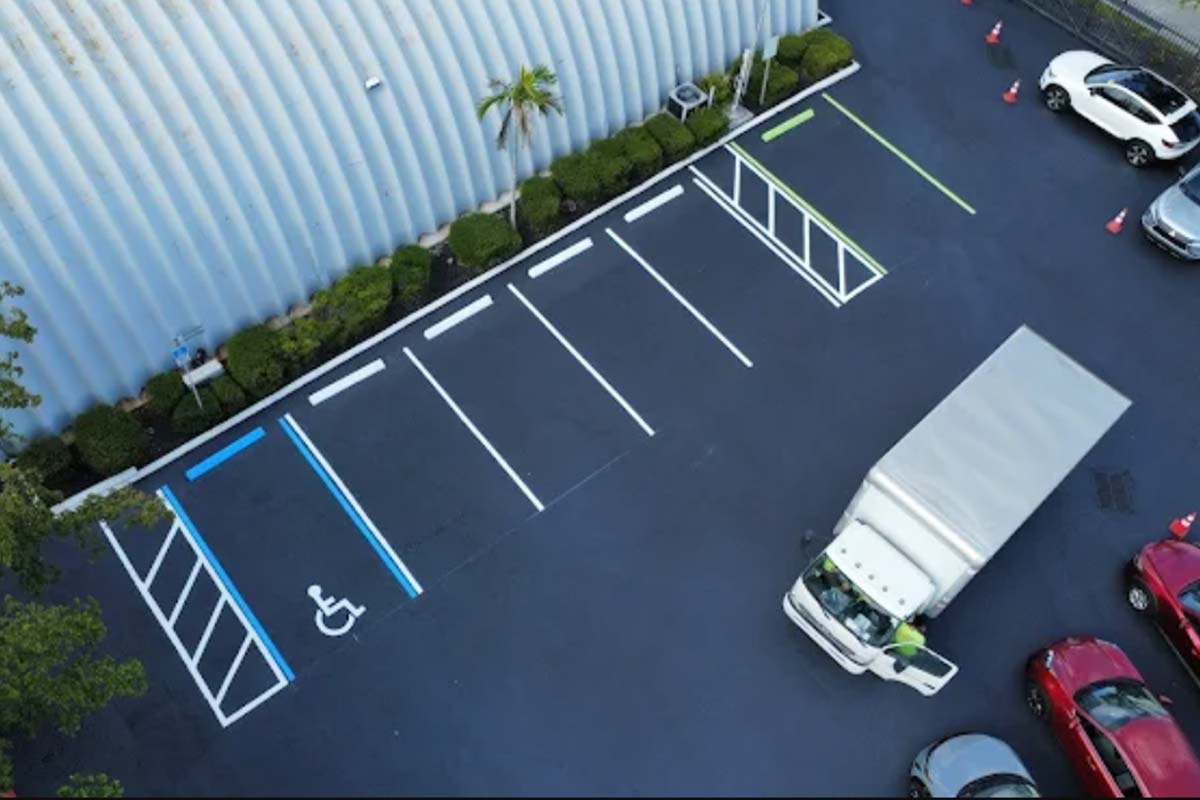
Wheel Stop Installation in Salt Lake City, UT
A wheel stop does one job: it decides where a vehicle’s front wheels stop, and therefore where the rest of the vehicle ends up. That sounds trivial until you look at what sits in front of the stall: a sidewalk, a storefront, a utility cabinet, a landscaped bed, or an accessible route. The stop is what keeps two feet of truck hood out of all of them.
The regulation people reach for here is Section 502.7 of the 2010 ADA Standards for Accessible Design, and it is worth quoting exactly, because it is almost always paraphrased into something it does not say: “Parking spaces and access aisles shall be designed so that cars and vans, when parked, cannot obstruct the required clear width of adjacent accessible routes.”
Read it closely and notice what is absent from the requirement: no device is named. The rule states an outcome — a parked vehicle must not eat the clear width of the accessible route next to it — and leaves the means open. Wheel stops are one means. A deeper stall is another. Relocating the route is a third. A curb the vehicle physically cannot reach is a fourth.
The Access Board’s own Advisory to 502.7 says wheel stops are “an effective way to prevent vehicle overhangs from reducing the clear width of accessible routes.” That is a recommendation of a means, not a requirement of one — which is worth knowing in both directions. It means nobody can cite 502.7 to tell you wheel stops are mandatory, and it means the device we install is the one the Access Board names when it names any.
That distinction matters because it changes the conversation from “does the ADA require wheel stops” (it does not) to “does anything on your lot overhang an accessible route” (it might, and that is the real exposure). The classic failure is a stall backing onto a sidewalk that doubles as the accessible route to the entrance: the striping is correct, the stall dimensions are correct, and the route is still non-compliant every time a pickup parks there. We design for the outcome first and then pick the means that suits the site, because every wheel stop on a Salt Lake City lot is also an object a plow driver has to work around all winter.
Concrete, Rubber, and Where Each Belongs
The two materials fail differently, and in this climate that matters more than the spec sheet does.
Precast concrete is heavy, rigid, and the traditional choice. Its weight is its main virtue, since a concrete stop stays where it was set even under repeated contact, and it takes sun without degrading. Its weakness is brittleness: concrete chips and cracks at the corners, and a plow blade that catches one can break it. It is also the harder material to reposition if the layout changes.
Recycled rubber is lighter, flexes rather than fractures, and shrugs off the impacts that chip concrete. It is easier to handle, easier to relocate, and it does not spall. Its trade-off is that being light, it depends entirely on its anchoring, and molded-in color can fade under sustained UV at elevation.
| Precast concrete | Recycled rubber | |
|---|---|---|
| Weight | Heavy; resists displacement on mass alone | Light; relies on anchors |
| Impact behavior | Chips and cracks at corners | Flexes and rebounds |
| Plow contact | Can break on a caught edge | More forgiving, but can be dragged |
| Repositioning | Difficult | Straightforward |
| Visibility | Painted surface, repaintable | Often molded-in color |
| Best fit | Permanent layouts, heavy vehicles | Changing layouts, plowed lots, high-contact stalls |
No service-life figures are published here for either material. None were sourced. Anyone quoting you a specific lifespan for a wheel stop in this climate is estimating, and we would rather say so.
Anchoring is where installations actually succeed or fail. On asphalt, stops are pinned with driven spikes that grip the mat. On concrete, they are bolted into drilled anchors. Both need the hole positions right the first time. A relocated stop leaves its old anchor holes behind, and on asphalt those become water entry points that freeze and spall the surface around them. In a freeze-thaw market that is a real consideration rather than a cosmetic one.
For a full list of our pavement marking services, visit our parking lot striping in Salt Lake City page.
Businesses We Serve




How it Works

GET A FREE ESTIMATE
Contact us today and we’ll have a quote to you in 24 hours

SCHEDULE AN INSTALLATION
We’ll have your installation scheduled restriped in less than 7 days, without affecting your business hours

GET A PARKING LOT THAT POPS
For a budget-friendly price, you’ll get a parking lot that looks like new
We proudly work with:


We proudly work with:


Frequently Asked Questions About Wheel Stop Installation in Salt Lake City
Concrete or rubber — which should I use?
It depends on what happens to it. If the layout is settled and the stalls take heavy vehicles, precast concrete’s weight works in your favor and it stays put on mass alone. If your lot gets plowed hard, sees frequent contact, or might be reconfigured, recycled rubber is the better bet — it flexes instead of chipping, it survives blade contact that would break concrete, and it can be lifted and moved without demolition. On most Salt Lake City commercial lots the plow is the deciding factor.
How are they actually anchored?
On asphalt, driven spikes long enough to grip the mat below the surface course. On concrete, bolts into drilled anchors. The surface dictates the hardware, and its condition dictates whether the anchor holds at all: spikes driven into soft or crumbling asphalt work loose inside a season.
Does the ADA require wheel stops at accessible spaces?
No, and this is the most common misunderstanding about them. Section 502.7 requires that spaces and access aisles be designed so that parked cars and vans cannot obstruct the required clear width of the accessible routes next to them. Notice that the requirement names no device — it states an outcome and leaves the means to you. Wheel stops are one means. A deeper stall is another. Relocating the route, or a curb the vehicle physically cannot reach, will do it too. The Advisory published alongside 502.7 does mention wheel stops, calling them “an effective way to prevent vehicle overhangs from reducing the clear width of accessible routes” — a recommended means, not a mandated one. So the right question is not whether you are required to install wheel stops, because you are not. It is whether anything parked on your lot currently overhangs an accessible route, because that is the thing the rule actually cares about. If your stall geometry already keeps overhang off the route, you are compliant without a single stop on the property.
Where exactly do they go in the stall?
Far enough back that the vehicle stops before its overhang reaches whatever you are protecting, and far enough forward that a driver can still use the full stall. That is a geometry question specific to your site — the answer differs for a stall fronting a sidewalk versus one fronting an open landscaped bed. Set them too far forward and drivers straddle or ride over them; too far back and you have given away usable stall depth for nothing. We measure against what is actually in front of the stall rather than applying a default.
What about snowplow damage — is this a losing battle in Utah?
It is a real cost and it is manageable. Stops are obstacles in a plow path, and the ones at the ends of rows take the worst of it. Three things help: choosing rubber where blade contact is likely, setting stops so they sit square to the plow’s travel rather than at an angle that catches, and marking them so they are visible against snow. Painting the stops in a high-contrast color is the cheapest protection there is — most damage happens because the driver could not see them.
How many does a lot need?
Only as many as there are stalls with something in front of them worth protecting. This is where lots most often over-buy. A stall facing open pavement needs nothing. Stalls fronting sidewalks, storefronts, utility equipment, or an accessible route are the ones that earn a stop.
Does it matter whether my lot is asphalt or concrete?
For the installation method, yes — spikes into asphalt, bolted anchors into concrete. For the choice of stop, mostly no. What does change is repair exposure: anchor holes in asphalt are water entry points, and in a freeze-thaw climate water that gets in and freezes will spall the surface around the hole. That is why we would rather get placement right on the first pass than reposition later, and why relocated stops on asphalt get their old holes sealed.
Can damaged stops be replaced individually?
Yes, and that is usually the right call. Wheel stops fail one at a time: a cracked concrete stop at the end of a row, a rubber one dragged loose by a plow. There is no reason to replace a full run because two units broke, and matching an existing run is straightforward in either material. One thing worth watching, though. If a lot is losing several stops every winter in the same few locations, that is a plow-routing problem wearing a materials problem’s clothes, and replacing the stops again will not fix it.