Warehouse Line Painting
In Salt Lake City, UT
Indoor Line Striping for Warehouses and Facilities
1-800-STRIPER provides professional warehouse line painting in Salt Lake City, UT — marking permanent aisles, pedestrian walkways, and storage zones to satisfy the aisle-marking duty Utah adopts at 29 CFR 1910.176(a) for industrial and distribution facilities across the Wasatch Front.
1-800-STRIPER® of Salt Lake City PROVIDes Warehouse Line Painting Services NEAR YOU
Want your indoor space to operate more efficiently?
Warehouse and interior markings ensure clear traffic lanes, organized storage zones, and designated spaces designed to help your business operate safely and efficiently.
Benefits:
What 29 CFR 1910.176(a) Requires
The duty is one sentence long. 29 CFR 1910.176(a) states that permanent aisles and passageways shall be appropriately marked. That is the whole of it.
What makes it bind a Utah warehouse is a second step most pages skip. Utah runs its own occupational safety program under the Utah Occupational Safety and Health Act at Utah Code 34A-6-101 and following, so a Utah facility is inspected by UOSH against the Utah Administrative Code, not directly against the federal volume. Utah then adopts the federal standard wholesale: Utah Administrative Code R614-1-4(A)(3) incorporates 29 CFR 1910.6 and 1910.21 through the end of Part 1910, at the July 1, 2025 edition, by reference. 1910.176 sits inside that range. So the accurate citation for a Salt Lake City warehouse is 29 CFR 1910.176(a), as incorporated by Utah Administrative Code R614-1-4(A)(3). Federal text, state instrument, one inspector.
There is a trap in reading the Utah rule directly: R614-1 contains no occurrences of the word “aisle”, because Utah incorporates the federal standard rather than restating it. Search the state rule for the duty and it looks like Utah carved it out. It did the opposite.
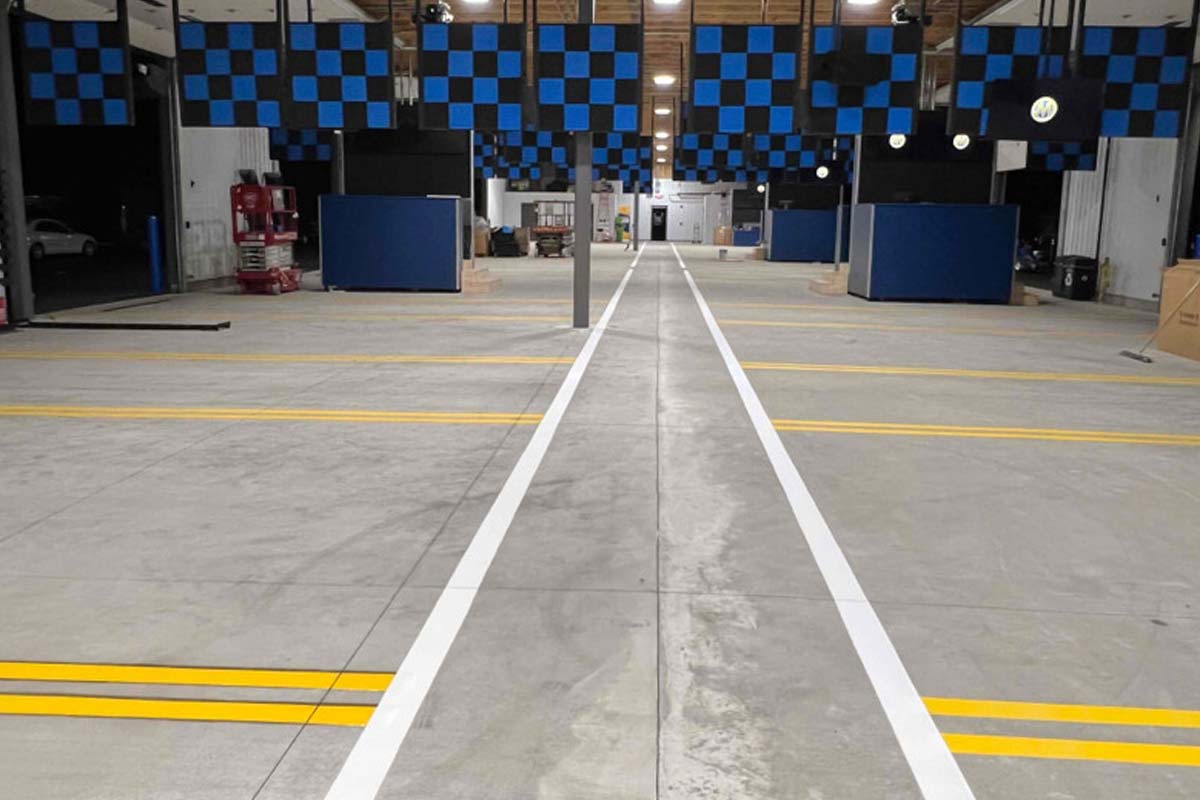
And now the part almost nobody publishes: the regulation specifies no color and no width. It requires that permanent aisles and passageways be marked and that they be appropriately marked. It does not tell you yellow, it does not tell you four inches, and it does not tell you where the line goes. That silence is not a loophole, because an unmarked aisle still fails. What it does mean is that any contractor quoting you a mandatory color or a mandatory line width is quoting an industry convention and calling it a regulation.
Warehouse Floor Markings in Salt Lake City, UT
The color system below is the convention most Utah facilities follow, the widely used safety-color scheme, consistent with how UOSH inspectors expect to see a floor read. It is presented as what facilities do, not as what the rule commands, because the rule commands neither.
Facilities running 5S visual management use the same markings as the backbone of the system: color-coded areas define where material belongs, outline forklift paths, and mark pedestrian safe zones. For warehouses along the I-80 and I-15 industrial corridors — West Valley City, North Salt Lake, and the Inland Port areas — that is usually where the work starts. We apply the full system to match your facility’s safety plan, using coatings rated for heavy forklift traffic.
| Color | Conventional meaning | Common warehouse use |
|---|---|---|
| Yellow | Caution / traffic | Aisle boundaries, forklift paths |
| Red | Danger / fire | Fire extinguisher zones, exit routes |
| Orange | Warning | Inspection areas, charging stations |
| Green | Safety | First aid stations, safety equipment |
| Blue | Information | Raw material storage, loading areas |
| White | Storage / production | General storage zone boundaries |
| Red and white diagonal | Keep clear at all times | Fire exits, emergency access |
For a full list of our pavement marking services, visit our parking lot striping in Salt Lake City page.
Businesses We Serve




How it Works

GET A FREE ESTIMATE
Contact us today and we’ll have a quote to you in 24 hours

SCHEDULE A STRIPING
We’ll have your space restriped in less than 7 days, without affecting your business hours

GET A PARKING LOT THAT POPS
For a budget-friendly price, you’ll get a parking lot that looks like new
We proudly work with:


We proudly work with:

Frequently Asked Questions About Warehouse Line Painting in Salt Lake City
Are warehouse floor markings required, and by what exactly?
Yes. The operative provision is 29 CFR 1910.176(a): permanent aisles and passageways shall be appropriately marked. In Utah that reaches you through the state’s own program, because Utah Administrative Code R614-1-4(A)(3) incorporates 29 CFR 1910.21 through the end of Part 1910 by reference, so a UOSH inspector applies the federal text through a state rule. Facilities running powered industrial trucks carry the strongest exposure: an unmarked aisle where forklifts and people share space is a struck-by hazard.
What color does the regulation require?
None. That lands badly with people who have been sold a color chart, so to be precise: 1910.176(a) requires that permanent aisles and passageways be appropriately marked, and it specifies no color and no line width anywhere. Yellow-for-traffic is convention. Good convention, near-universal, what an inspector expects to see. Still not a citation.
How do forklift lanes and pedestrian walkways get separated?
With a marked pedestrian corridor that is continuous, rather than with edge lines alone. The distinction matters in practice: a walkway defined only by the edge of the forklift aisle disappears the moment a pallet is set down near it, whereas a corridor marked as its own path stays legible. High-traffic crossing points get hatching or stenciling so both parties can see the conflict coming. In facilities with constant forklift and foot interaction, that single change does more for near-miss rates than any other marking decision.
Is warehouse line painting the same as warehouse floor markings?
Yes. Same work, two names, and this page answers to both. “Warehouse floor markings” describes what ends up on the slab: aisle lines, walkways, storage footprints, hazard zones. “Warehouse line painting” describes the trade doing it. Some facilities managers search one, some the other, and written specifications use them interchangeably, which is why we would rather answer the question than let it cost you a phone call. If you asked for one and got quoted the other, you were quoted the right thing. Under either name the scope is the same: aisle and passageway marking, pedestrian corridors, storage and staging outlines, hazard and keep-clear zones, and dock markings. The only place the distinction has ever mattered is in a specification that names one term and an invoice that names the other, and that is a paperwork problem rather than a scope one.
Paint or tape, and how often does it need redoing?
Paint for permanent, high-traffic installations. Properly applied on a sealed slab it takes forklift and pallet-jack wear far better, and it will not lift at the edges. Tape installs with no dry time and comes up cleanly, which makes it right for layouts you expect to move: seasonal reconfiguration, a trial layout, a leased space. On refresh timing the honest answer is that traffic decides it, not the calendar. Main aisles, receiving docks, and pedestrian crossings wear first, and the trigger to watch for is any safety-critical marking becoming hard to read from a working distance. Walk it once a year after a floor wash or an equipment move.