Fire Lane Striping
In Salt Lake City, UT
Fire Lane and Fire Curb Striping Services
1-800-STRIPER provides professional fire lane striping in Salt Lake City, UT — marking fire-apparatus access lanes, red curbs, and no-parking legends to the specification set by the authority having jurisdiction, which under Utah Administrative Code R710-9 may be the State Fire Marshal or your local fire authority.
1-800-STRIPER® of Salt Lake City PROVIDes Fire Lane Striping Services NEAR YOU
Is your parking lot ready for first responders?
Our team is well-versed in local fire regulations and will parter with you to design a fire lane striping plan that creates unobstructed emergency access to protect your customers and property.
Core Services:
Who Sets the Fire Lane Spec in Utah
This is the question every fire lane page should open with and almost none do, because the answer in Utah is not “the state”.
Utah Administrative Code R710-9 at R710-9-3(1) defines the authority having jurisdiction as “the State Fire Marshal, authorized deputies, or the local fire enforcement authority.” Three possible offices, and which one holds your property decides what your markings have to look like. Inside Salt Lake City limits it is the city fire authority. In unincorporated Salt Lake County — Millcreek, Holladay, Cottonwood Heights and the rest — it is the county-level fire authority. Schools and certain public buildings answer to the State Fire Marshal directly.
R710-9-15(2) reinforces how local this is: a city, county, or fire district may decline to establish its own method for hearing fire code appeals, in which case the state board hears them instead. The default is local control, with the state as fallback, not the other way around.
So the first thing we do on a fire lane job is establish which office holds your address, and confirm the current expectation with them. It is a phone call, and it is the difference between markings that pass and markings that get re-cut.
Utah Has No Statewide Fire Code Amendments
Here is the finding that makes the point above enforceable rather than a hedge. R710-9-12 states, verbatim: “There are currently no amendments and additions adopted by the board for application statewide.” And R710-9-6(8) provides that the division maintains a list of fire code amendments granted to individual jurisdictions.
Read together, those two provisions say something specific about Utah: the state fire board has layered nothing on top of the model code for everyone, and whatever variation exists has been granted jurisdiction by jurisdiction. Utah is the mirror image of a state that adopts a model fire code and then strikes or rewrites a section statewide. There, one state-level answer covers every property. Here there is no state-level overlay, and the operative detail lives with your local authority.
That is why “confirm the spec with your local fire authority” appears on this page as a sourced statement rather than as a contractor hedging. The rule says the amendments are local. We are telling you to go where the rule says the answer is.
Fire Lane Requirements in Salt Lake City, Utah
Fire lane striping in Salt Lake City is governed by a combination of federal, state, and local fire codes. The Salt Lake City Fire Department enforces fire access requirements within city limits, while the Unified Fire Authority (UFA) covers unincorporated Salt Lake County areas including Millcreek, Holladay, and Cottonwood Heights. Both agencies follow the International Fire Code (IFC), aligned with standards from the National Fire Protection Association (NFPA), which Salt Lake City has adopted as part of its municipal code.
Under IFC §503, fire apparatus access roads must maintain a minimum unobstructed width of 20 feet — wide enough for a fire engine to pass without delay. Dead-end fire lanes and curves require 26 to 28 feet of clearance. Vertical clearance must be at least 13 feet 6 inches throughout the access route. These dimensions apply to the clear travel path, meaning parked vehicles, dumpsters, or landscaping encroaching on the asphalt surface within the marked lane are violations even if the striping itself is correct.
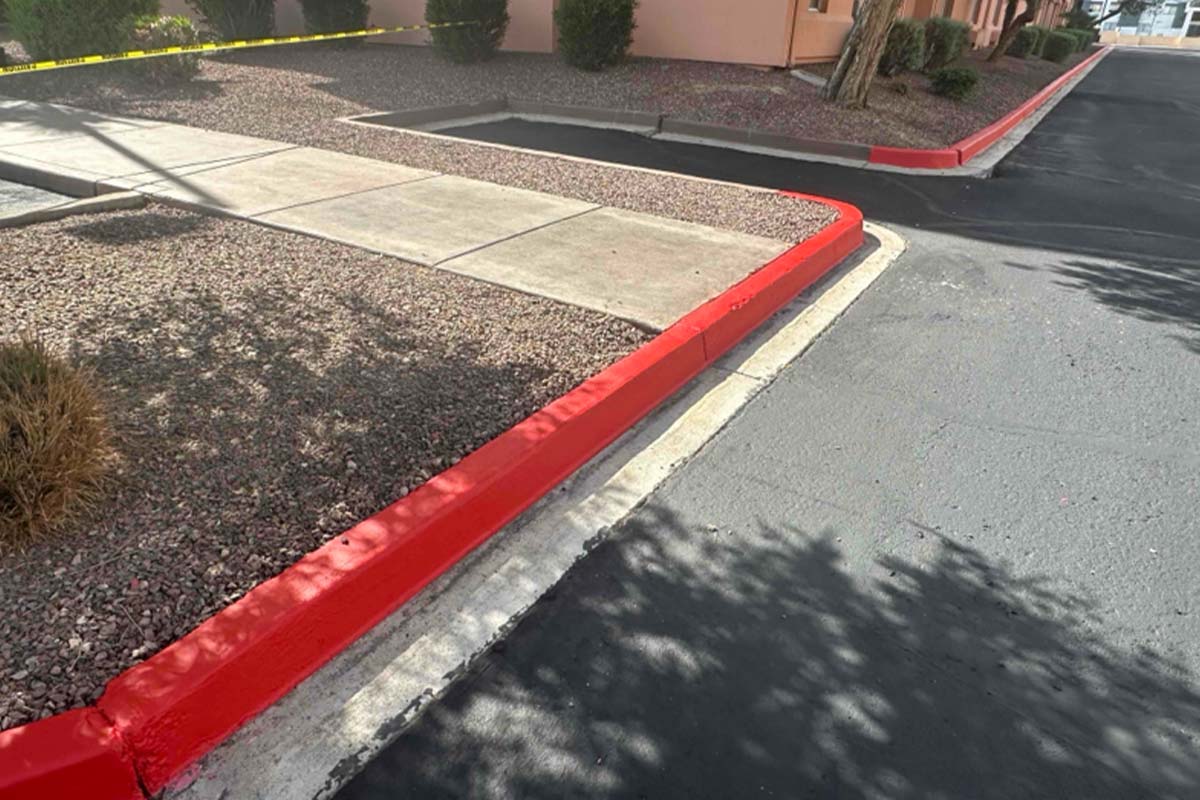
Required fire lane markings include red curb painting with white “FIRE LANE — NO PARKING” lettering, pavement text at regular intervals, and posted signage. Relying on a single element — curb paint alone, for example — rarely satisfies inspection requirements. Property owners in Salt Lake City who fail to maintain compliant fire lane markings risk failed inspections, denial of Certificate of Occupancy, and liability exposure if a delayed emergency response is linked to blocked or unmarked fire access.
Fire lane maintenance in Salt Lake City demands more frequent attention than in milder climates. Utah’s winters bring snowplow blade contact that strips red curb paint faster than standard traffic markings. Salt and de-icing chemicals accelerate paint breakdown on asphalt surfaces. Most commercial properties need fire lane repainting every 12 to 18 months — inspect every spring after snowplow season and schedule services before your next fire marshal inspection. Shopping centers, multi-family housing complexes, medical facilities, warehouses, and schools all require marked fire lanes, though requirements vary by property type and traffic volume.
The table below summarizes fire lane requirements by property type in the Salt Lake City area. For a free fire lane striping estimate, call 1-800-STRIPER at (385) 472-3389 — most jobs are scheduled within 7 days.
| Property Type | Min Lane Width | Curb Marking | Signage Required | SLC-Specific Notes |
|---|---|---|---|---|
| Shopping Centers | 20 ft | Red curb | Yes — every 50 ft | UFA inspects annually |
| Multi-Family (3+ stories) | 26 ft | Red curb | Yes — at each end | Certificate of Occupancy requirement |
| Medical Facilities | 20 ft | Red curb | Yes — with ADA access | Ambulance access lanes also required |
| Warehouses / Industrial | 20 ft | Red curb | Yes — at loading docks | OSHA coordination for interior fire lanes |
| Schools / Public Buildings | 20 ft | Red curb | Yes — at main entrances | State Fire Marshal jurisdiction |
Red Curbs, Lane Lines, and Legends
A compliant fire lane is rarely one marking. In practice it is three working together, and inspections fail on the missing one rather than the faded one. Red curb is the continuous visual signal along the access route, and it is the element Utah winters destroy fastest, because a plow blade rides the curb line. Legends are the “FIRE LANE — NO PARKING” text, painted at intervals along the lane so the message is readable from a stopped vehicle rather than only at the ends. Signage carries the message at driver eye height, where curb paint under snow cannot. Wording, letter height, and interval are exactly the details that vary by jurisdiction, which is why we confirm them before the stencils come out.
For a full list of our pavement marking services, visit our parking lot striping in Salt Lake City page.
Businesses We Serve




How it Works

GET A FREE ESTIMATE
Contact us today and we’ll have a quote to you in 24 hours

SCHEDULE AN INSTALLATION
We’ll have your installation scheduled in less than 7 days, without affecting your business hours

GET A PARKING LOT THAT POPS
For a budget-friendly price, you’ll get a parking lot that looks like new
We proudly work with:


We proudly work with:

Frequently Asked Questions About Fire Lane Striping in Salt Lake City
Who decides what my fire lane has to look like?
Your authority having jurisdiction, which Utah Administrative Code R710-9-3(1) defines as the State Fire Marshal, an authorized deputy, or the local fire enforcement authority. Inside Salt Lake City that is the city fire authority. In unincorporated county areas it is the county fire authority, and some public buildings answer to the State Fire Marshal directly. This is not a formality. The office holding your address sets the wording, the interval, and the signage expectation, and those are precisely the details that vary between them.
Doesn’t Utah have one statewide fire lane standard we can just follow?
No, and the rule says so outright, which is unusual enough to be worth quoting. R710-9-12 states that there are currently no amendments and additions adopted by the board for application statewide. R710-9-6(8) then has the division maintaining a list of amendments granted to individual jurisdictions. Put those together and Utah’s structure is clear: there is no state-level overlay to look up, and whatever variation exists was granted jurisdiction by jurisdiction. That is the opposite of a state that adopts a model fire code and then rewrites a section for everyone, where one answer covers every property. Here the answer lives with your local authority by design. The practical consequence for a property manager with sites in more than one Utah city is the part that catches people: a specification that passed inspection in one of them is useful evidence for the next one, and it is not proof.
Do I need red curb, pavement legends, and signs — or is one enough?
In practice, all three. Curb paint alone is invisible under snow and hard to read at a distance. Signs alone get obscured or removed. Pavement legends alone do not carry at night. The standard compliant package on a Salt Lake City commercial property is red curb with white lettering, legends repeated along the lane, and posted signs at the intervals your jurisdiction expects. We install the complete package rather than the cheapest element.
How often does fire lane marking need repainting here?
More often than the rest of your lot. Red curb takes the worst of it, because plow blades ride the curb line and de-icing chemicals attack the film from underneath. Most commercial properties in the valley run a 12 to 18-month cycle on fire lane work while their stall lines go two years. The practical trigger is legibility: if the red has gone chalky or pink, or the lettering cannot be read from a stopped vehicle, it is due. Inspect every spring once plowing season ends.
What exactly should the legend say?
That is a jurisdiction question, not a national one, and it is the single most common thing we get asked to re-cut. Wording, letter height, and how often the legend repeats are the details local authorities differ on, and Utah’s structure guarantees that difference because amendments are granted per jurisdiction. We confirm the current expectation with the office holding your address before stencils go down, which costs a phone call and avoids repainting a lane twice.
What does fire lane striping cost?
It scales with curb footage, how many access-road sections are in scope, how many legends the lane needs, and whether signage is included. Campuses with long access routes get quoted on footage. We would rather walk it than guess at it. Free estimate within 24 hours.