Parking Lot Restriping
In Salt Lake City, UT
Restripe Existing Lines and Markings
1-800-STRIPER provides professional parking lot restriping in Salt Lake City, UT — refreshing faded stalls, ADA access aisles, fire lanes, and directional arrows with waterborne traffic paint on lots worn by Wasatch Front freeze-thaw cycles and winter plow abrasion.
1-800-STRIPER of Salt Lake City PROVIDes Parking Lot Restriping Services NEAR YOU
Need to brighten up your faded parking lot?
Keep your parking lot safe and attractive by restriping annually to freshen up lines and symbols that have faded from the sun, weather, and traffic. Nothing beats a fresh coat of paint!
Benefits:
When a Wasatch Front Lot Needs Restriping
Most commercial parking lots in Salt Lake City need restriping every 12 to 24 months. High-traffic retail locations — grocery stores, shopping centers, and restaurants along State Street or in the Sugar House district — typically need fresh parking lot line markings annually. Office parks and apartment complexes in the Salt Lake Valley can stretch to a two-year cycle if traffic volume is moderate.
Signs your lot needs restriping services include faded stall lines that drivers ignore, worn ADA markings that no longer meet the ADA Standards for Accessible Design, illegible directional arrows, and customer complaints about confusing parking layouts. If drivers are parking crooked or straddling spaces, the lines have lost enough contrast to be ineffective.
Restriping differs from a new parking lot layout design in one important way: the existing stall positions, aisle widths, and traffic flow pattern remain unchanged. Restriping refreshes faded markings over the original layout. If the layout itself needs changes — adding spaces, reconfiguring traffic flow, or updating accessible space count — that is a layout redesign job, which 1-800-STRIPER also handles for properties across the Salt Lake City area.
Freeze-Thaw and Plow Abrasion
Utah’s climate accelerates asphalt surface wear faster than most property managers expect. Salt Lake City averages over 50 inches of snowfall per year, and snowplow blades scrape directly across painted parking spaces and directional arrows. Freeze-thaw cycles crack the asphalt surface and cause paint delamination — water seeps under the paint film, freezes, expands, and lifts the coating. Add sustained UV exposure at elevation, and parking lot line markings fade significantly faster than at sea level.
Three distinct wear mechanisms run on a Wasatch Front lot, and they do not fail the same way. Abrasion is mechanical: a plow blade takes the paint film off in strips, worst on the high side of any crown and across every directional arrow and stencil that sits proud of the surface. Delamination is a bond failure, driven by water that gets under the film and then freezes; it lifts paint in sheets and leaves a clean edge, which is how you tell it apart from wear. Fading is chemical, a UV attack on the pigment that shows first in the colors that carry the most compliance weight — the red of a fire lane and the blue of an access aisle both go before white does.
Reading which mechanism is running on your lot changes the recommendation. A lot losing paint to plow contact does not need a different paint; it needs the markings that sit in the blade path re-cut differently and the schedule moved to spring so the fresh film is not asked to survive a winter it has not cured through. A lot delaminating needs the surface addressed first, because more paint over a failing bond fails again on the same line. We tell you which one you have on the estimate walk rather than after.
What We Restripe
One pass covers every marking class on a commercial lot, which matters because the compliance-bearing ones are usually not the ones that prompt the call:
- Stalls and aisle lines — the standard 4-inch line, laid over the existing layout.
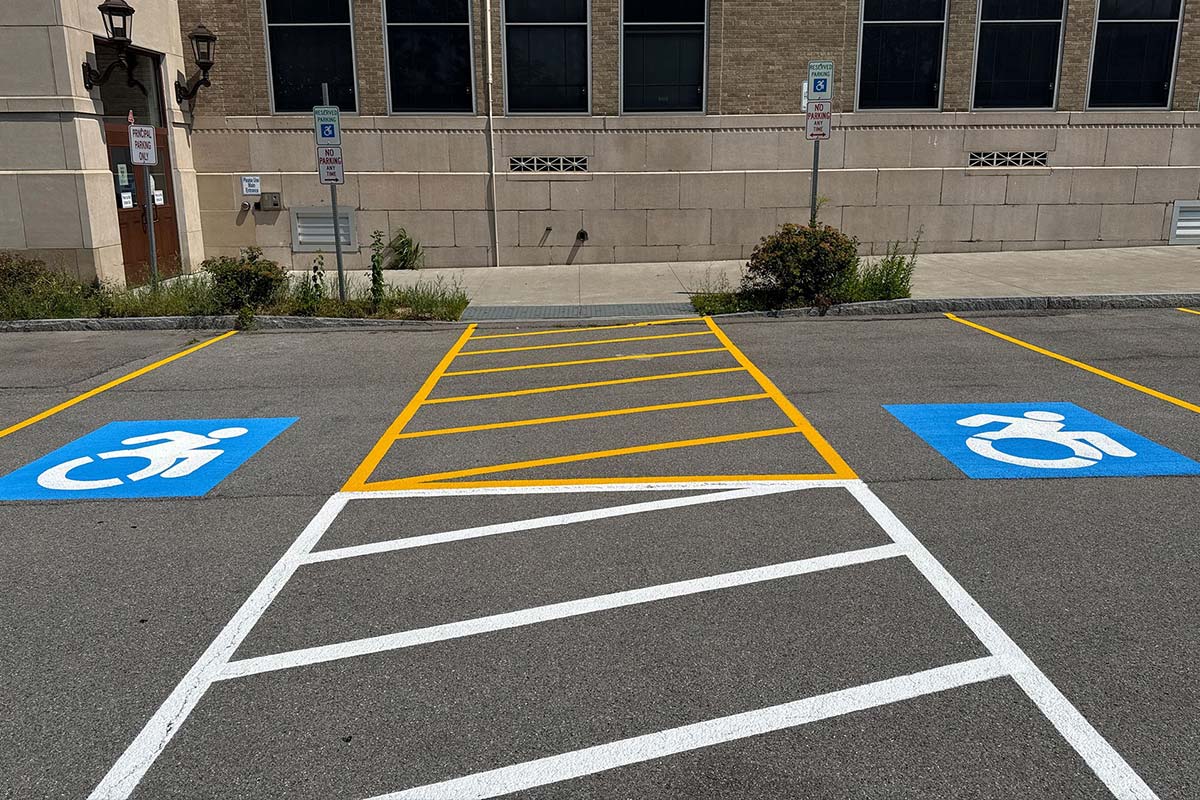
- Accessible stalls, access aisles, and the ISA symbol — the highest-liability markings on the lot, and the ones that must stay legible continuously rather than merely be correct on the day they were painted.
- Fire lanes — red curb, lane lines, and legends, to the specification your local fire authority sets.
- Directional arrows, stop bars, and crosswalks — the traffic-control layer.
- Loading zones, no-parking hatching, and reserved stalls — the site-specific layer.
- Numbers, letters, and custom stencils — unit numbers, visitor and staff designations, EV charging.
Layout Changes at Restripe Time
A restripe is the cheapest moment in a lot’s life to change something, because the surface is already being worked and the old lines are about to be buried anyway. The changes worth considering while the crew is on site are the ones that are painful to retrofit later: bringing the accessible space count up to the band the lot actually falls in, relocating accessible stalls onto the shortest route to the entrance rather than wherever they historically landed, widening an aisle that plows have been clipping for years, and adding the crosswalk between the lot and the door that everyone has been walking anyway. If the lot is going to be reconfigured rather than refreshed, that is layout design and we scope it as such.
Surface Preparation
Paint fails on preparation more often than on product. The lot gets cleaned and blown clear along every line path, because traffic paint bonds to pavement and not to the dust and grit sitting on it. Oil-stained areas need washing first. A stall under a persistent drip will reject paint on the same footprint every cycle until the contamination is removed. Where the previous film is delaminating rather than merely faded, the loose material comes off before anything new goes down. Where sealcoating is planned, it goes first and the restripe follows, never the reverse.
Our Restriping Process
- Site assessment — we inspect the existing layout, measure line visibility, and identify ADA compliance gaps on the asphalt surface
- Surface preparation — we clean the asphalt, remove debris, and power-blow loose material from line paths
- Layout verification — we confirm stall dimensions, aisle widths, and ADA parking space placement match current code
- Line painting — we apply waterborne traffic paint with walk-behind line striping equipment for crisp, durable markings
- Drying and marking — fresh lines dry to touch in 15–30 minutes; we cone off freshly painted areas until fully cured
- Final walkthrough — we verify every stall, arrow, ADA marking, and fire lane against the approved layout
Scheduling Around Your Business
The best time to restripe in Salt Lake City is the May through September window, when asphalt surface temperatures consistently stay above 50°F — the minimum for proper paint adhesion. Avoid scheduling within 24 hours of rain. Spring restriping is ideal: you repair winter damage before summer traffic peaks, and the paint cures fully in warm, dry conditions.
Most lots never close. We section the lot, cone one area at a time, and move as each section releases, which for a retail property usually means an early-morning start and the whole job done before the lot fills. Properties that genuinely cannot give up any daytime capacity get an overnight or weekend crew.
What MUTCD Does and Does Not Govern
Our trade cites the Manual on Uniform Traffic Control Devices constantly, and on a private parking lot the citation is usually wrong. The federal regulation that adopts the MUTCD, 23 CFR 655.603(a), defines the roads it applies to, and it is worth reading both halves of that definition rather than the convenient one.
The inclusive half is broader than people expect: a road open to public travel includes toll roads and roads within shopping centers, airports, and sports arenas that are privately owned but where the public may travel without access restrictions. So the drive through a shopping center is in scope.
The exclusive half is the one nobody quotes: “Parking areas, driving aisles within parking areas, and private highway-rail grade crossings are also not included in this definition.” Your stalls and the aisles between them are outside the MUTCD’s reach.
Which means a company telling you your parking lot must be restriped “to MUTCD standards” is either citing the wrong instrument or quoting only the half of the definition that helps them. What actually binds a commercial lot is the ADA Standards for accessible parking and your local fire authority for fire lanes. We match MUTCD conventions for arrows and legends because drivers already read them, but as a design convention we have chosen, not as a code we are claiming governs you.
For a full list of our pavement marking services, visit our parking lot striping in Salt Lake City page.
Businesses We Serve




How it Works

GET A FREE ESTIMATE
Contact us today and we’ll have a quote to you in 24 hours

SCHEDULE AN INSTALLATION
We’ll have your installation scheduled in less than 7 days, without affecting your business hours

GET A PARKING LOT THAT POPS
For a budget-friendly price, you’ll get a parking lot that looks like new
We proudly work with:


We proudly work with:

Frequently Asked Questions About Parking Lot Restriping in Salt Lake City
How often should you restripe a parking lot?
Most commercial parking lots in Salt Lake City need restriping every one to two years, though high-traffic properties like shopping centers or grocery stores may need it annually. The primary drivers are traffic volume, UV exposure, and Utah’s freeze-thaw cycles, which accelerate paint breakdown faster than in milder climates. A good rule of thumb: if lines are fading to the point where drivers hesitate or park out of bounds, it is time.
What are the signs that a parking lot needs restriping?
Look for faded or barely visible stall lines, worn ADA access aisle markings, illegible directional arrows, and faded fire lane borders. In Utah, post-winter inspections are especially important — snowplow blade contact and repeated freeze-thaw cycles can strip paint from the surface. If any accessible markings are faded, that is a compliance issue to address immediately regardless of the state of the rest of the lot.
Why do lines fail faster here than they did at my last property?
Three mechanisms stack on a Wasatch Front lot that do not stack everywhere. Plow blades abrade the film mechanically. Meltwater gets under the film and freezes, which lifts it in sheets rather than wearing it thin. And elevation raises UV load on the pigment, so color goes before the line does. A lot at sea level in a mild climate is fighting one of those. Yours is fighting all three, and they show up as three different-looking failures.
What paint do you use, and does it matter?
Waterborne traffic paint for nearly everything on a commercial lot. It cures fast enough to reopen a section the same shift, it holds color, and it recoats cleanly next cycle. Where a marking takes constant mechanical punishment a tougher material can pay, but expect a longer closure and a harder removal when the layout changes.
Can you change the layout while you are restriping?
Yes, and it is the right moment to do it. Adjusting an accessible space count, moving accessible stalls closer to the entrance, widening an aisle, or adding a crosswalk all cost far less while the crew is already on site and the old lines are being covered. What we would not do is quietly reconfigure your lot during what you booked as a refresh — layout changes get drawn and agreed first.
What about the ADA markings specifically?
They get treated as the priority, not as part of the general refresh. Faded accessible stalls, access aisles, and symbols are a live compliance exposure in a way that a faded standard stall is not. While we are there we also check the count against the total spaces in the lot and confirm the accessible spaces still sit on the shortest route to the entrance, because lots get re-striped for years without anyone re-checking either.
Do we need to sealcoat first?
Only if the surface needs it. And if it does, the order matters: seal first, stripe after. Striping a lot that is about to be sealed means paying twice for the same lines.
What does restriping cost?
There is no rate sheet, because there is no standard lot. Stall count sets the floor, and past that the number moves on how many stencils and accessible spaces are involved, how much curb and fire lane marking there is, and what condition the surface is in — pavement that needs prep turns a one-stage job into two. Tell us the address and roughly how many spaces you have, and you will have a free itemized estimate within 24 hours. Call (385) 472-3389.