Parking Lot Sign Installation
In Salt Lake City, UT
ADA, Fire Lane, and Directional Signage
1-800-STRIPER provides professional parking lot sign installation in Salt Lake City, UT — mounting accessible-space signs, van-accessible plaques, and fire lane and tow-away notices at the 60-inch minimum height Section 502.6 of the 2010 ADA Standards sets for commercial properties.
1-800-STRIPER® of Salt Lake City PROVIDes Parking Lot Sign Installation Services NEAR YOU
Are you communicating clearly?
We install new signs in adherence with local regulatory standards and can repair or replace damaged signs so you can clearly communicate your parking requirements.
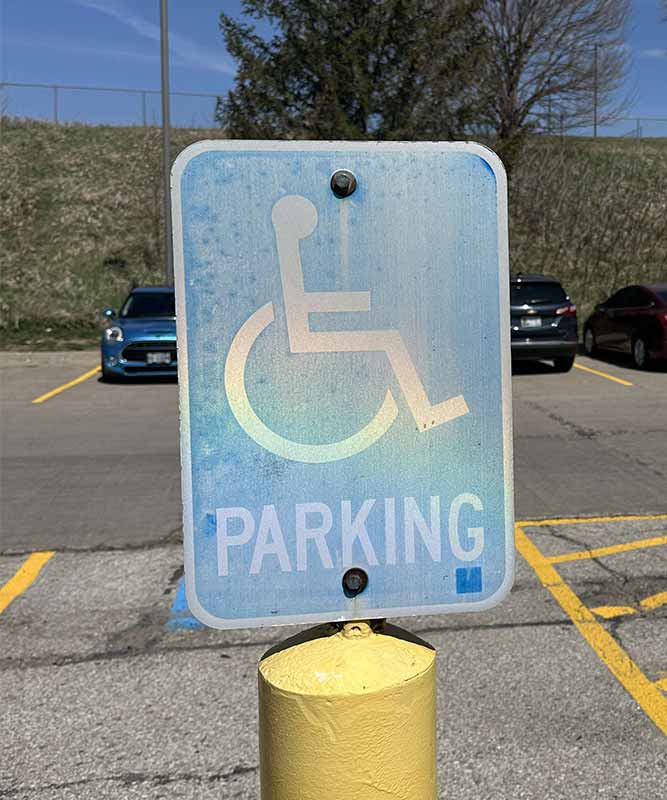
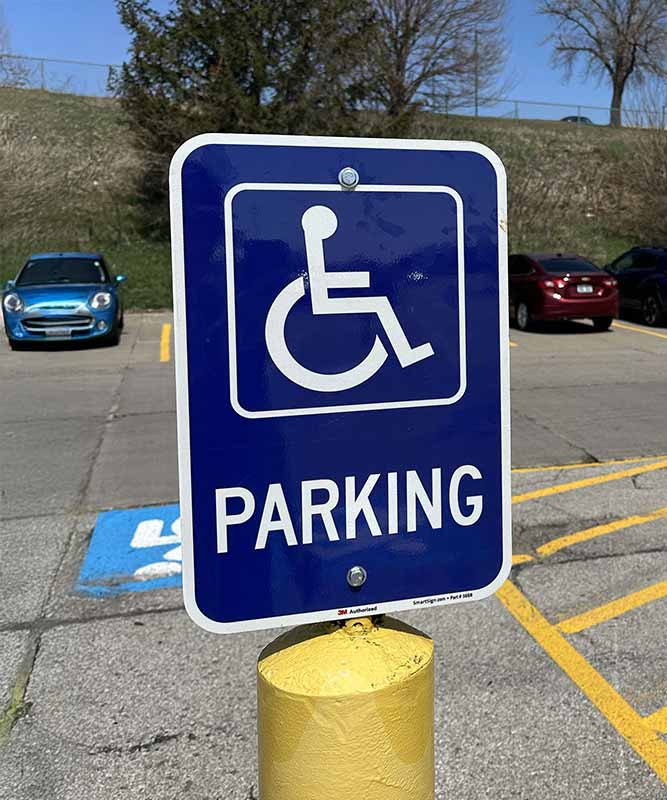
Parking Lot Sign Installation in Salt Lake City, UT
Pavement markings tell drivers where to put the vehicle. Signs tell them the rules, and in a market that spends four months under snow, signs are the half of the system that still works when the pavement is buried. That is the practical case for treating signage as part of the striping scope rather than an afterthought: a perfectly marked accessible stall under six inches of snow is an unmarked stall, and the sign is all that is left.
Accessible Space Signs and the 60-Inch Rule
Two different sections do two different jobs here, and most pages collapse them. Section 216.5 of the 2010 ADA Standards for Accessible Design is the one that requires the sign at all: “Parking spaces complying with 502 shall be identified by signs complying with 502.6.” It carries two exceptions — where a site provides four or fewer parking spaces in total, and, in residential facilities, where spaces are assigned to specific dwelling units, identification is not required. Both exempt the sign, not the space, the aisle, or the count. State or local rules may still require signage where the federal exception applies, so we check before leaving a stall unsigned.
Section 502.6 is the one that says what the sign must be and how high it goes: “Signs shall be 60 inches (1525 mm) minimum above the finish floor or ground surface measured to the bottom of the sign.”
The words that get missed are measured to the bottom of the sign. Not the center, not the top. A sign hung so its middle sits at 60 inches is mounted too low, and it is the single most common signage error we correct. In a snow market the error compounds: 60 inches is a minimum precisely so the sign clears obstructions, and a low sign is the first thing a plow berm hides. Van-accessible spaces carry an additional designation identifying them as such.
| Sign type | Mounting | Note |
|---|---|---|
| Accessible space | 60 in minimum to the bottom of the sign | Required at every accessible space |
| Van-accessible designation | Paired with the accessible sign | Identifies van spaces separately |
| Fire lane / no parking | Per your authority having jurisdiction | Wording and interval are local |
| Tow-away notice | Per local requirement | Often paired with fire lane signage |
| Directional and traffic | At driver eye height, ahead of the decision point | Convention, not code, on a private lot |
| Reserved and visitor | At the stall | Property-specific |
Fire Lane and Tow-Away Signage
Fire lane signs are the element most likely to be wrong, because the specification is genuinely local. Utah Administrative Code R710-9 at R710-9-3(1) defines the authority having jurisdiction as the State Fire Marshal, authorized deputies, or the local fire enforcement authority, and R710-9-12 records that the state fire board has adopted no amendments for application statewide, with R710-9-6(8) having the division maintain a list of amendments granted to individual jurisdictions.
So wording, letter height, and posting interval come from the office that holds your address, not from a state sheet you can look up once and reuse. We confirm the current expectation before fabricating anything, which is a phone call and saves posting a run of signs twice.
Directional and Traffic Signs
Stop, yield, one-way, do-not-enter, speed, and pedestrian-crossing signs on a private lot are a design convention rather than a code obligation. The federal manual that governs traffic control devices applies to roads open to public travel and, at 23 CFR 655.603(a), expressly excludes parking areas and the driving aisles within them. We use the standard shapes and colors anyway, for the obvious reason: drivers already know how to read them, and a non-standard sign is a sign that gets ignored. But we will not tell you a code requires them on your lot. Placement matters more than the sign does. A stop sign after the decision point is decoration.
For a full list of our pavement marking services, visit our parking lot striping in Salt Lake City page.
Businesses We Serve




How it Works

GET A FREE ESTIMATE
Contact us today and we’ll have a quote to you in 24 hours

SCHEDULE AN INSTALLATION
We’ll have your installation scheduled in less than 7 days, without affecting your business hours

GET A PARKING LOT THAT POPS
For a budget-friendly price, you’ll get a parking lot that looks like new
We proudly work with:


We proudly work with:


Frequently Asked Questions About Parking Lot Sign Installation in Salt Lake City
How high do accessible parking signs have to be?
Sixty inches minimum, measured to the bottom of the sign, under Section 502.6 of the 2010 ADA Standards. The reference point is what people get wrong — measuring to the middle puts the sign below the minimum. In Salt Lake City there is a second reason to respect it: snow. A sign mounted low is the first one a plow berm buries, and a buried accessible sign is a stall that gets parked in by whoever cannot see why they should not.
Do van-accessible spaces need a different sign?
They need an additional designation identifying the space as van-accessible, alongside the standard sign. It is a small thing and frequently missed, particularly where a van space was added later, or where a damaged sign got replaced without its plaque.
What has to be on a fire lane sign here?
That is set by your authority having jurisdiction rather than by a statewide rule. Utah Administrative Code R710-9-3(1) defines that authority as the State Fire Marshal, an authorized deputy, or your local fire enforcement authority, and R710-9-12 records that the board has adopted no amendments for statewide application — variation is granted jurisdiction by jurisdiction. Wording, letter height, and how often signs repeat along the lane are exactly the details that differ. We confirm with your office before fabricating.
Post-mounted or wall-mounted?
Wall-mounted where there is a wall in the right place at the right height. It is cheaper, it cannot be knocked over, and it stays out of the plow’s way. Post-mounted everywhere else, which on most lots means most places. The consideration specific to this market is what happens at the base of a post: it sits in the snow-storage zone, takes salt spray all winter, and gets struck by equipment. Setting posts where snow gets pushed is a decision you make once and regret every January.
How often do signs need replacing?
They fail from damage and fading rather than on a schedule. Impact is the common one — posts get clipped by vehicles and plows. Fading matters more than it sounds: a sign whose message has washed out is not doing its job, and on accessible and fire lane signage that is a compliance exposure rather than a cosmetic one. Walk the lot each spring after plowing season, same inspection pass as the pavement markings, and replace what is bent, faded, or missing.
Does the signage need to be reflective?
For anything that has to be read after dark, yes, and it is what we default to. That covers accessible spaces, fire lanes, tow-away notices, and traffic control at entrances and exits. On a private lot the requirement generally comes from your jurisdiction or your insurer rather than from the federal traffic-control manual, which does not reach parking areas at all. The practical test needs no code behind it: if a driver has to read it at night, make it reflective.
How many signs does a lot actually need?
Section 216.5 requires a sign at every accessible space, so that count follows the accessible space count for your lot size. Two federal exceptions exist: a site with four or fewer parking spaces in total, and residential spaces assigned to specific dwelling units. Neither is common on a commercial lot, and state or local rules can still require the sign, so we confirm rather than assume. Fire lanes need signs at the intervals your jurisdiction sets. Beyond that it is driven by the lot’s geometry — entrances, exits, decision points where a driver has to choose, and any restriction you intend to enforce. The honest guidance is that under-signing an accessible space or a fire lane is a compliance problem, while under-signing a directional choice is only an inconvenience. We prioritize accordingly.