Wheel Stop Installation
In Columbia, SC
Concrete and Rubber Parking Stops
1-800-STRIPER provides professional wheel stop installation in Columbia, SC — anchoring concrete, recycled-rubber, and plastic-composite wheel stops at stall heads to protect sidewalks, storefronts, and ADA accessible routes per the 2010 ADA Standards for Accessible Design for commercial properties.
1-800-STRIPER® of Columbia PROVIDes Wheel Stops Services NEAR YOU
Need to protect vehicles or walls from accidental damage?
Wheel stops (also called parking blocks) protect your property, enhance safety, and improve parking lot organization.
Benefits:
Wheel stops prevent vehicles from parking too far into a space or overextending into other spots, pedestrian walkways, and other areas, while also helping with vehicle alignment. They can prevent damage to buildings, curbs, or landscaping. Wheel stops also serve as clear visual cues for proper parking and are sometimes used on slopes to prevent cars from rolling.
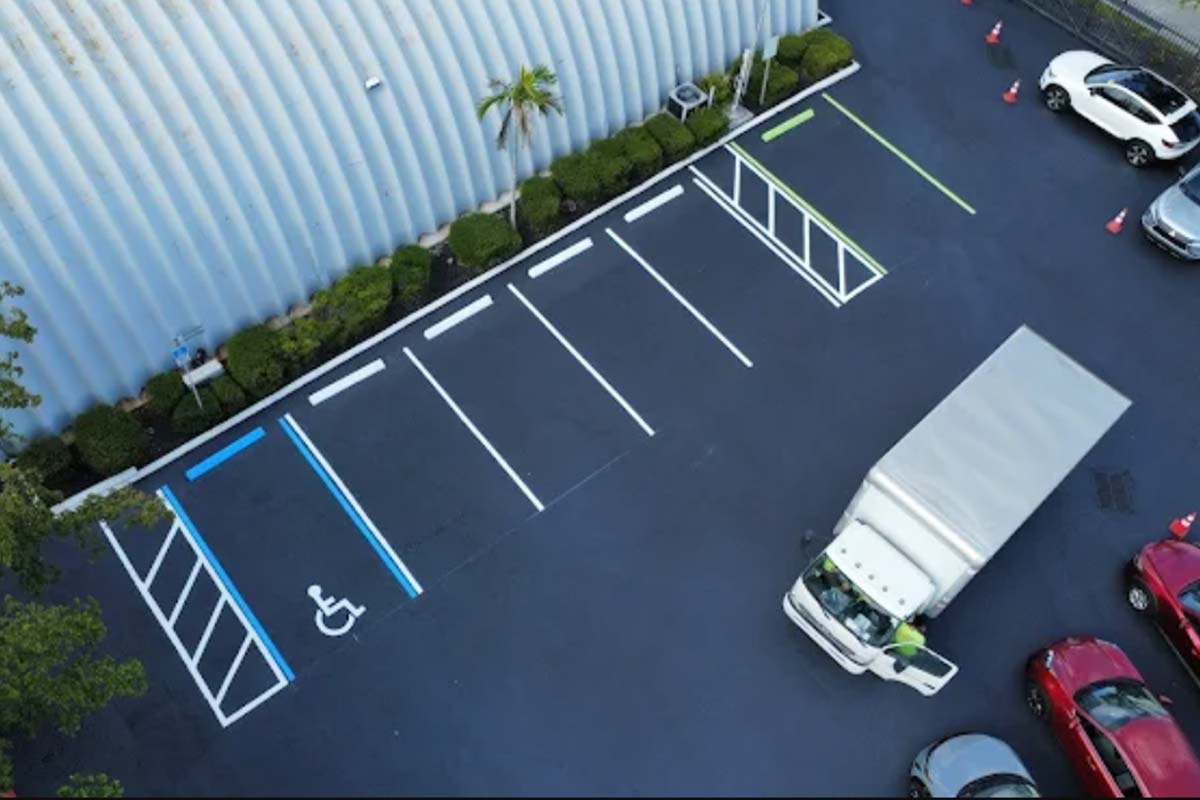
Wheel Stop Installation in Columbia, SC
A wheel stop is a low barrier pinned to the pavement at the head of a parking stall. It does one job: it stops the front tire before the rest of the vehicle reaches whatever is behind the stall. That is usually a sidewalk, a storefront window, a gas meter, a light pole base, or a landscaped island whose curb a bumper would otherwise ride up onto.
Wheel stops matter most where the overhang matters. A car parked nose-in projects a foot or more of bumper past its front tires. On a stall that faces a five-foot sidewalk, that overhang eats the walkway. Put a wheel stop in and the sidewalk stays a sidewalk.
1-800-STRIPER of Columbia installs and replaces wheel stops on commercial properties across Richland, Lexington, Kershaw, and Orangeburg counties — retail centers, medical offices, industrial parks, HOA lots, and schools. We set new stops on a fresh layout, we replace cracked and spalled concrete stops, and we pull and re-pin stops that were installed in the wrong place.
That last category is more common than it should be. A wheel stop dropped into an access aisle, or set where it narrows the walking route between the accessible stalls and the door, converts an accessibility feature into an obstruction. It is a five-minute mistake and an expensive one. Call for a free estimate.
Concrete, Rubber, and Plastic Wheel Stops Compared
Three substrates dominate commercial lots. They fail in different ways, which is the useful thing to know about them — no published standard assigns any of them a service life, and we won’t invent one.
| Precast concrete | Recycled rubber | Plastic composite | |
|---|---|---|---|
| Weight | Heaviest; needs equipment or two people to place | Light; one person can carry and set | Lightest |
| How it fails | Cracks through, corners spall, exposed rebar rusts | Deforms and abrades; fasteners can pull through | Deforms under repeated impact; can crack in cold |
| Snowplow and impact | Chips and breaks | Flexes and rebounds | Flexes, may deflect |
| Water and rust | Internal steel can corrode once cracked | No internal steel to corrode | No internal steel to corrode |
| Relocation | Awkward; often cracks when pulled | Straightforward | Straightforward |
| Typical fit | High-traffic lots wanting mass | Lots that need reduced weight and impact tolerance | Light-duty lots, easy replacement |
Mass is the concrete stop’s whole argument: it resists being shoved out of position by a bumper. Its weakness is brittleness — a precast stop that takes a hard hit or a plow blade cracks, and once it cracks, water reaches the internal steel.
Rubber and plastic-composite stops trade that mass for resilience. They flex instead of cracking, and they carry no steel to rust. Because they weigh less, the anchor does more of the work of holding them in place, which puts the emphasis on the fastener and the substrate rather than on the block.
There is no code section that picks one of these for you. The choice is driven by the lot’s traffic, whether it gets plowed, whether the stops will need to move when the layout changes, and how the property manager wants to handle replacement.
Placement, Anchoring, and ADA Route Clearance
Anchoring is a substrate question. Asphalt is a flexible pavement; concrete is rigid. A fastener that grips one does not necessarily grip the other, and the stop’s manufacturer publishes the fastener type and embedment depth for each. We drill through the stop’s cast-in holes, drive or set the specified fastener for the substrate we’re actually on, and seat the stop flush so it doesn’t rock.
Placement is where the accessibility rules bind. The 2010 ADA Standards for Accessible Design require an accessible route with a continuous clear width of 36 inches minimum. That width may narrow to 32 inches at a point, for a maximum length of 24 inches — a doorway, for example. The U.S. Access Board’s guide to the Standards puts the corollary plainly: that minimum clearance cannot be reduced by an element placed in the route. A wheel stop sitting in the accessible route is such an element.
Access aisles are stricter still. No element, including bollards, columns, or poles, may encroach into the defined area of an access aisle. A wheel stop is no different. The aisle is the space a wheelchair user needs to deploy a ramp and transfer, and it has to stay clear.
Setback from the curb is a design decision, not a code number. It is governed by vehicle overhang — how far a bumper projects past the front tires — and that varies by vehicle. Anyone quoting you a single universal setback dimension as though it were code is quoting a convention, not a rule. What we do is measure what is behind the stall: sidewalk width, what the sidewalk carries, and whether an accessible route runs across it. Then we set the stop so the parked overhang lands short of anything that has to stay clear.
For a full list of our pavement marking services, visit our parking lot striping in Columbia page.
Businesses We Serve




How it Works

GET A FREE ESTIMATE
Contact us today and we’ll have a quote to you in 24 hours

SCHEDULE AN INSTALLATION
We’ll have your installation scheduled restriped in less than 7 days, without affecting your business hours

GET A PARKING LOT THAT POPS
For a budget-friendly price, you’ll get a parking lot that looks like new
We proudly work with:


We proudly work with:


Frequently Asked Questions About Wheel Stop Installation in Columbia, SC
How long do concrete, rubber, and plastic wheel stops last?
No standard or code assigns a service life to any of them, and we won’t quote you a number we can’t stand behind. What we can tell you is how each one fails. Precast concrete is brittle: it chips at the corners, cracks through under a hard impact or a plow blade, and once it’s cracked, water gets to the internal steel. Recycled rubber and plastic composite deform rather than fracture, and carry no steel to corrode; their weak point tends to be the fastener rather than the block. A shaded, low-traffic lot that never sees a plow will hold any of the three a long time. A busy lot with heavy trucks will not.
How do you anchor a wheel stop into asphalt versus concrete?
Different substrates take different fasteners. Asphalt is a flexible pavement — a fastener has to reach past the surface course to hold, so anchors into asphalt are longer and rely on depth. Concrete is rigid and takes a shorter anchor set into a drilled hole. In both cases the wheel stop manufacturer specifies the fastener type and embedment for the substrate, and that specification is what we follow. Undersized fasteners are the single most common reason a wheel stop walks out of position: the block was fine, the anchor wasn’t.
Should wheel stops be installed in accessible spaces or access aisles?
Never in the access aisle. The ADA Standards state plainly that no elements — bollards, columns, poles — may encroach into the defined area of an access aisle, and a wheel stop is such an element. Inside the accessible space itself, the Standards don’t name wheel stops one way or the other, but two requirements still apply: the space’s surface slope cannot exceed 1:48 in any direction, and the accessible route leaving the space has to keep its clear width. So a wheel stop can exist near an accessible stall, but it cannot narrow the route, and it cannot sit in the aisle. That’s the line we work to.
How far back from the curb should a wheel stop sit?
There isn’t a code number, and any contractor who gives you one as if there were is repeating a convention. The setback is driven by vehicle overhang — the distance a bumper projects past the front tires — and that changes with the vehicle. What the setback has to achieve is fixed, though: the parked overhang must not intrude on anything required to stay clear, which usually means a sidewalk carrying an accessible route that has to hold 36 inches of clear width. We measure what’s behind the stall and set the stop to protect it, rather than working from a number.
Can wheel stops be relocated or reused?
Rubber and plastic-composite stops usually can. They’re light, the anchors back out, and the block survives being pulled. Precast concrete is a coin flip — a stop that has been in the ground for years frequently cracks as it comes up, especially if it has already spalled at the corners or the internal steel has begun to rust. When a layout change moves the stall heads, we pull what will survive the move and quote replacements for what won’t, rather than re-pinning a cracked block and calling it done.
Are wheel stops a trip hazard, and can they conflict with an accessible route?
They can, and the conflict is a real compliance problem rather than a stylistic one. A wheel stop placed in an accessible route reduces its clear width, and the ADA Standards say the minimum clearance cannot be reduced by any element. The 36-inch continuous width is not negotiable except at a point, and then only down to 32 inches for a maximum of 24 inches. Where pedestrians cross behind or between stalls, a stop lying across the walking line is exactly the sort of element the Standards exclude. Placement is what prevents this: at the stall head, out of the aisle, clear of the route.