Fire Lane Striping
In Columbia, SC
Code-Compliant Fire Lane Markings
1-800-STRIPER provides professional fire lane striping in Columbia, SC — marking compliant fire lanes, curbs, and no-parking zones per International Fire Code Section 503 requirements for commercial properties throughout Richland, Lexington, Kershaw, and Orangeburg counties.
1-800-STRIPER® of Columbia PROVIDes Fire Lane Striping Services NEAR YOU
Is your parking lot ready for first responders?
Our team is well-versed in local fire regulations and will parter with you to design a fire lane striping plan that creates unobstructed emergency access to protect your customers and property.
Core Services:
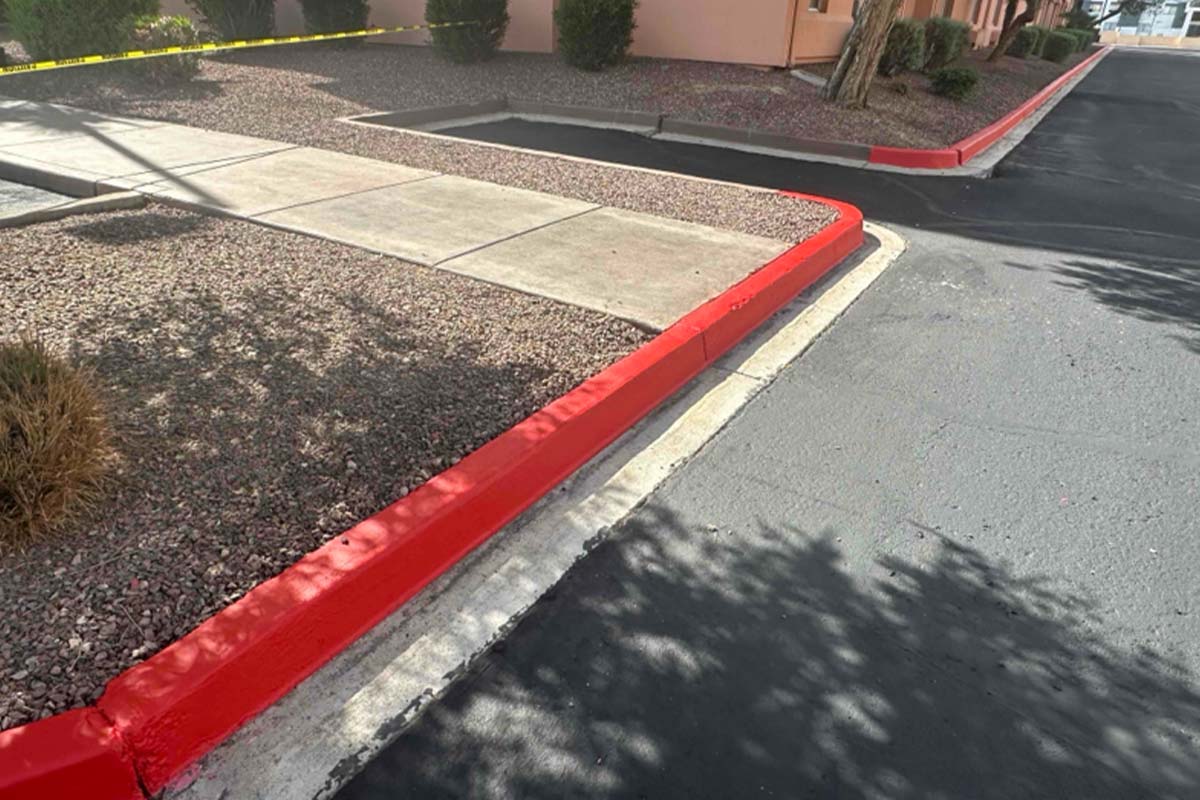
Fire Lane Striping in Columbia, SC
A fire lane is the marked portion of a fire apparatus access road — the route a fire truck has to be able to drive, turn, and set up on when it reaches your building. The code calls the route an access road. The paint and the signs are what keep it usable on an ordinary Tuesday afternoon, when the lot is full and somebody is tempted to leave a car by the door for five minutes. 1-800-STRIPER of Columbia lays out and marks those lanes on commercial property: lane lines, curb faces, keep-clear hatching, the required legends on the pavement, and the sign placements that go with them.
South Carolina handles fire code differently from a home-rule state. Under S.C. Code Title 6, Chapter 9, the South Carolina Building Codes Council adopts the International Fire Code for the entire state, and the 2021 edition is what applies. The practical effect is that the geometry governing a fire lane at a shopping center in Richland County is the same geometry that governs one in Lexington, Kershaw, or Orangeburg. You are not chasing a different set of dimensions in every town. What does stay local is approval and enforcement: inside the city, the Columbia Fire Department is the authority having jurisdiction, and its fire code official is the person who approves the marking scheme.
We mark fire lanes for retail centers, apartment communities, distribution warehouses, medical offices, schools, churches, and self-storage properties across the Midlands. The call usually comes for one of four reasons. An inspection turned up a lane that has faded past reading. A repave or an overlay wiped the markings off. A new tenant changed the traffic pattern and the old lane no longer lines up with the door it is supposed to serve. Or the property changed hands and the new owner wants to know where they stand before somebody else tells them. In all four cases the work starts the same way — we measure the access road as it exists, check it against the access-road requirements in Section 503, and tell you what we find. Estimates are free, and we can usually get you one within 24 hours. Call (803) 679-4314.
Fire Lane Marking Requirements
The requirements below come from Section 503 of the 2021 International Fire Code as adopted in South Carolina. Where a value below is a fixed number, it is fixed in the code text. Where it is not, we say so rather than making one up. The full adopted text is public and readable at International Fire Code Section 503.
| Requirement | What the SC-adopted 2021 IFC states | Section |
|---|---|---|
| Unobstructed width | Not less than 20 feet (6096 mm) | §503.2.1 |
| Unobstructed vertical clearance | Not less than 13 feet 6 inches (4115 mm) | §503.2.1 |
| Reach to the building | Access road extends to within 150 feet of all portions of the facility and of the exterior walls of the first story, measured by an approved route around the building | §503.1.1 |
| Dead ends | Dead-end access roads longer than 150 feet require an approved turnaround area | §503.2.5 |
| Surface | Designed and maintained to support the imposed loads of fire apparatus, surfaced for all-weather driving | §503.2.3 |
| Sign or marking wording | Approved signs, notices, or markings including the words “NO PARKING—FIRE LANE”, where required by the fire code official | §503.3 |
| Condition of markings | Maintained clean and legible at all times; replaced or repaired when necessary to provide adequate visibility | §503.3 |
| Obstruction | Access roads shall not be obstructed in any manner, including the parking of vehicles; minimum widths and clearances maintained at all times | §503.4 |
| Turning radius, grade, approach angles | Determined by the fire code official, based on the department’s apparatus | §503.2.4, §503.2.7, §503.2.8 |
| Width modifications | The fire code official has authority to require or permit modifications to the required access widths | §503.2.2 |
| Hydrant clearance | No parking allowed within 15 feet of a fire hydrant | §507.5.4 |
Two things people expect to find in that table are not in it, and it matters that we say why.
There is no code-mandated fire-lane color. Section 503.3 does not name red, or yellow, or any color. It requires *approved* signs, notices, or markings that carry the words NO PARKING—FIRE LANE, and it leaves the design of those markings to the fire code official. There is likewise no letter height, curb-stripe width, or stencil spacing in the section. The Columbia Fire Department publishes no city-specific fire-lane marking dimensions of its own, which means Section 503 is the whole of the written spec and the rest is approval. So the honest instruction is this: the Columbia fire code official approves the marking scheme, and you should confirm wording, color, and sign placement with that office before anyone opens a paint can. We are happy to make that call with you. What we will not do is paint a scheme to a number nobody published and hand you an invoice for it.
Fire Lane Compliance and Inspections
Fire prevention in the city is run out of the Fire Marshal’s office. The Columbia Fire Department Fire Prevention Division handles fire and life safety inspections, plan reviews, and permit administration, and it states its goal plainly: that businesses, operations, occupancies, and events in the City of Columbia function in accordance with the International Fire Code. Annual fire inspections are how the division checks that. Outside the city limits, the same adopted code applies, but the inspecting authority is whichever fire department or county fire marshal holds jurisdiction over the address.
If you are building or remodeling, the code puts the fire lane in front of the department before anything gets poured. Construction documents for proposed fire apparatus access, the location of fire lanes, and any security gates across an access road must be submitted to the fire department for review and approval prior to construction. Columbia’s Fire Plans Examiner is the person who reviews those site plans. That review is the moment to settle marking layout, sign placement, and lettering — not after the striping crew has left.
On an existing lot, the compliance question is continuous rather than annual. Section 503.4 requires that the minimum widths and clearances be maintained at all times, and Section 503.3 requires the fire-lane designation itself to stay clean and legible at all times. A lane that was compliant the day it was painted stops being compliant the day it stops being readable. That is why a faded legend is not a cosmetic problem. It is a code condition that an inspector can write up, and it is the single most common thing we are called out to fix.
Our part is the measuring and the marking. We walk the access road, take the width and the vertical clearance, note where the 150-foot reach falls short or where a dead end needs a turnaround, and give you a marked-up plan showing what the lane should look like. If the scheme needs the fire code official’s sign-off, we get it approved before we stripe. Call (803) 679-4314 for a free estimate.
For a full list of our pavement marking services, visit our parking lot striping in Columbia page.
Businesses We Serve




How it Works

GET A FREE ESTIMATE
Contact us today and we’ll have a quote to you in 24 hours

SCHEDULE AN INSTALLATION
We’ll have your installation scheduled in less than 7 days, without affecting your business hours

GET A PARKING LOT THAT POPS
For a budget-friendly price, you’ll get a parking lot that looks like new
We proudly work with:


We proudly work with:


Frequently Asked Questions About Fire Lane Striping in Columbia, SC
How wide does a fire lane have to be in Columbia?
Not less than 20 feet of unobstructed width, with not less than 13 feet 6 inches of unobstructed vertical clearance. Those are the dimensions in Section 503.2.1 of the 2021 International Fire Code, which South Carolina adopts statewide, so they apply the same way in Columbia as they do anywhere else in Richland, Lexington, Kershaw, or Orangeburg County. Section 503.2.2 lets the fire code official require or permit modifications to those widths where they are inadequate for fire or rescue operations, so a specific site can end up with more. Overhangs, canopies, low signage, and tree limbs all count against the vertical clearance, which is the measurement owners forget most often.
What color does a fire lane have to be painted?
The code does not specify one. Section 503.3 requires approved signs, notices, or markings that include the words NO PARKING—FIRE LANE, and it leaves the means of designation to the fire code official. It names no color, no letter height, and no curb-stripe width. The Columbia Fire Department does not publish city-specific fire-lane marking dimensions either, so there is no local number to fall back on. In practice this means the fire code official approves your marking scheme. We recommend confirming color and layout with that office before painting, and we will paint to whatever they approve.
What has to be written on fire lane signs and pavement legends?
Section 503.3 requires that approved signs, other approved notices, or markings include the words “NO PARKING—FIRE LANE.” That exact phrase is the one piece of wording the code fixes. Everything else about the sign — whether one is required at your property at all, how many, where they mount, and how the pavement legend is laid out — is determined by the fire code official, because Section 503.3 only requires markings “where required by the fire code official.” The section also requires the designation to be replaced or repaired whenever it stops providing adequate visibility.
Who inspects fire lanes in Columbia?
Inside the city, the Columbia Fire Department’s Fire Prevention Division, under the Fire Marshal’s office. The division runs fire and life safety inspections, plan reviews, and permit administration, and it conducts annual fire inspections toward the goal of having every business, operation, and occupancy in the city function in accordance with the International Fire Code. For new construction and remodels, the department’s Fire Plans Examiner reviews the site plan, and Section 501.3 requires construction documents showing fire apparatus access and fire lane locations to be submitted for review and approval before construction. Outside the city, the fire department or county fire marshal with jurisdiction over the address inspects.
Can a vehicle ever stop in a marked fire lane, even briefly?
No. Section 503.4 states that fire apparatus access roads shall not be obstructed in any manner, including the parking of vehicles, and that the minimum widths and clearances shall be maintained at all times. There is no allowance in that text for a short stop, a running engine, a delivery, or a driver waiting in the car. The same section prohibits traffic calming devices in an access road unless the fire code official approves them, which tells you how narrowly the code reads “unobstructed.” Section 507.5.4 adds that no parking is allowed within 15 feet of a fire hydrant. Enforcement of a blocked lane is a matter for the fire department, not for us.
How often do fire lane markings need to be refreshed?
The code sets no calendar interval, and neither does the Columbia Fire Department. What Section 503.3 requires is that the means by which fire lanes are designated be maintained in a clean and legible condition at all times, and be replaced or repaired when necessary to provide adequate visibility. Legibility is the trigger, not a date. In practice the schedule is set by what the lane goes through — traffic volume across the markings, sweeping and plowing, and how much of the legend sits in a drive path rather than against a curb. If an inspector can read it from a moving vehicle, it is doing its job. If you have to look twice, it is due, and it is worth handling before the next annual inspection rather than after.