Thermoplastic Striping
In Columbia, SC
Long-Lasting Pavement Markings
1-800-STRIPER provides professional thermoplastic striping in Columbia, SC — long-service-life pavement markings for stop bars, crosswalks, directional arrows, and fire lanes applied as preformed or sprayed thermoplastic per AASHTO M249 specifications for high-traffic commercial lots.
1-800-STRIPER® of Columbia PROVIDes Thermoplastics Services NEAR YOU
Want to reduce the maintenance requirements for your parking lot?
Thermoplastic pavement markings are a durable, weather and vehicle-resistant striping option for your parking lot or facility.
You can utilize them for stop bars, ADA stalls, no-parking zones, directional arrows, crosswalks, or your entire parking lot.
Benefits:
Thermoplastic Striping in Columbia, SC
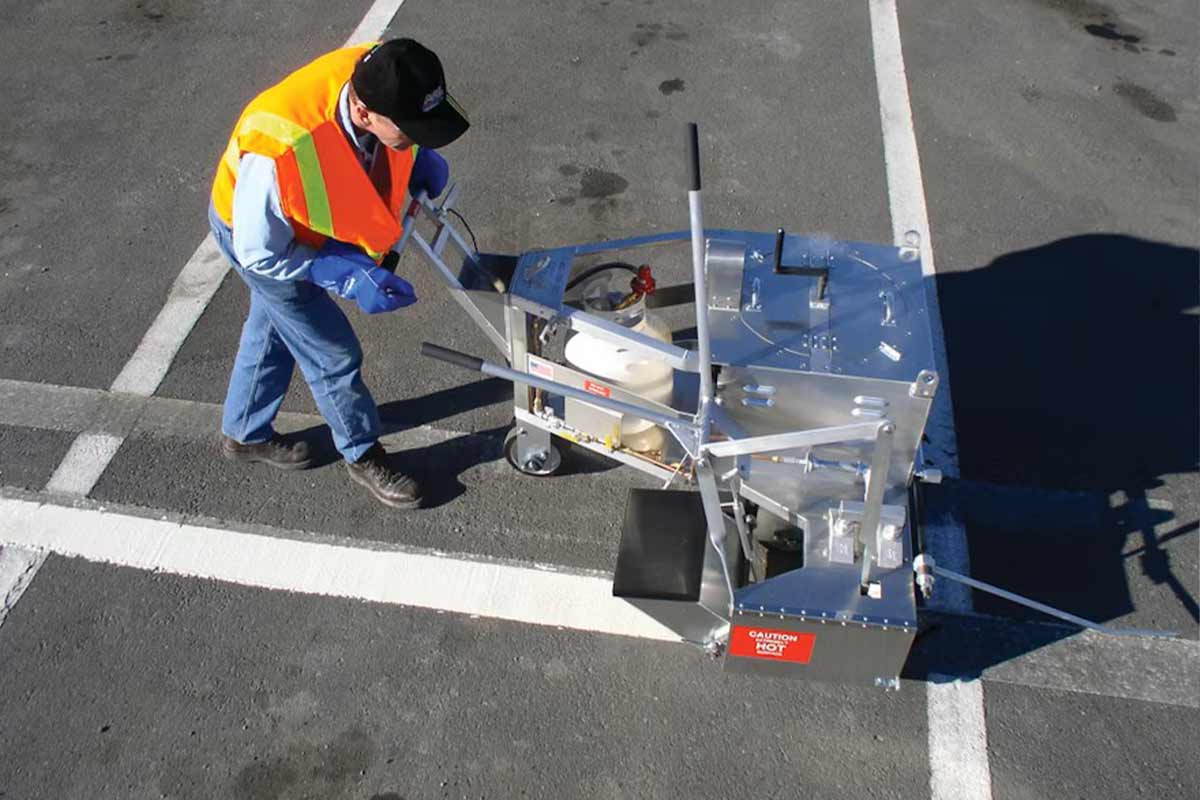
Thermoplastic is not paint. It arrives as a solid, gets heated until it flows, and goes down on the pavement molten. As it cools back to normal pavement temperature it hardens into an adherent stripe of specified thickness and width that is built to resist deformation by traffic. Glass beads are applied to the surface of that stripe while it is still hot, and those beads are what throw your headlights back at you on a wet night. That description is not marketing language — it is the scope of the material specification the industry works to, AASHTO M249, whose title tells you the rest: white and yellow reflective thermoplastic striping material.
The distinction that matters on a commercial lot is thickness. Traffic paint is a thin film laid on top of asphalt or concrete. Thermoplastic is a laid stripe with real body to it, fused to the pavement surface. That is why nobody thermoplastics an entire parking lot and why nearly everybody thermoplastics the parts of it that get driven over hardest: stop bars at the exit, crosswalk bars in front of the doors, directional arrows in a drive aisle, turn legends, and the lettering in a fire lane where a tire crosses the same word four hundred times a day.
We install thermoplastic on high-traffic commercial property across Richland, Lexington, Kershaw, and Orangeburg counties — retail centers, distribution facilities, hospital campuses, apartment communities, and any lot where the same markings keep wearing out ahead of the rest of the layout. Most of our thermoplastic work is not a whole-lot job. It is a targeted specification: paint for the stall lines, thermoplastic for the elements that take the beating. If you are not sure which of your markings belong in which category, that is the conversation to have on a walk-through. Estimates are free and we can usually turn one around within 24 hours. Call (803) 679-4314.
Preformed vs Sprayed Thermoplastic
Both forms are thermoplastic. Both are heat-applied. Both end up as a fused, retroreflective stripe. What separates them is where the material takes its final shape — in a factory, or on your pavement. The material specification that governs the hot-applied form is published by the American Association of State Highway and Transportation Officials, which is where the M249 designation comes from.
| Preformed thermoplastic | Sprayed / extruded thermoplastic | |
|---|---|---|
| How it is supplied | Factory-produced as a finished product, already cut to shape — arrows, legends, symbols, crosswalk bars | Solid material in bulk, melted on site |
| How it is applied | Laid on the pavement and fused to it with applied heat, using a torch of the type the manufacturer recommends | Applied to the road surface in a molten state by mechanical means |
| Where the glass beads are | Beads are part of the factory-produced product, together with resin, aggregate, pigment, and binder | Applied to the surface of the molten stripe, at a rate specified by the purchaser |
| When it hardens | On cooling | On cooling to normal pavement temperature |
| Best suited to | Shapes: arrows, legends, symbols, crosswalks, small quantities, lots where a kettle is impractical | Runs: long lines, continuous stripes, large-volume work |
| Governing material spec | Conforms to AASHTO M249 except for the differences that follow from being supplied preformed | AASHTO M249 |
The choice usually makes itself. Preformed material already *is* the arrow, so it goes where you need a precise, repeatable shape and where you would otherwise be stencilling. Hot-applied material is laid by machine as a continuous ribbon, so it goes where you need length. A single crosswalk at a medical office is a preformed job. Re-marking the truck lanes through a distribution yard is a hot-applied one. Plenty of properties get both on the same visit.
One practical note before you approve a submittal: because preformed shapes are a manufactured product, the governing document for the exact material you are getting is the manufacturer’s own specification, not M249 alone. Ask for it. We do.
Where Thermoplastic Outperforms Traffic Paint
Thermoplastic earns its place where a marking has to survive tires rather than just weather. The specification describes the cured result as an adherent stripe capable of resisting deformation by traffic — deformation, not fading, is the word that matters. A thin paint film wears away under a wheel path. A thermoplastic stripe has enough body that traffic pushes at it instead of erasing it. That is why the highway world specifies it for stop bars and crosswalks, and why the same logic transfers to a commercial lot’s stop bars and crosswalks.
Retroreflectivity is the second reason. Beads are applied to the surface at a rate the purchaser specifies, which means the reflective performance of the line is something you can actually write into a scope of work rather than hope for. On a lot with poor overhead lighting, a beaded stop bar at the exit is doing safety work that a faded painted line is not.
On South Carolina roadway projects, the state layer sits on top of the material spec: the SCDOT Standard Specifications govern pavement marking work on highway construction. Your parking lot is not highway construction, so those specifications do not bind a private property — the owner, or the owner’s engineer, specifies the material. We reference AASHTO M249 as the material standard for what we install and let you decide the scope from there.
Thermoplastic is not the right answer everywhere. It is a permanent marking. When a layout changes, thermoplastic has to be taken off mechanically, where paint can often be covered. So a lot that re-stripes to a new plan every couple of years is usually better served with paint on the stall lines and thermoplastic reserved for the elements that are not going to move: the entrance, the stop bar, the crosswalk, the fire lane legend. That is the specification we recommend most often, and it is the one we will price for you at no cost.
For a full list of our pavement marking services, visit our parking lot striping in Columbia page.
Businesses We Serve




How it Works

GET A FREE ESTIMATE
Contact us today and we’ll have a quote to you in 24 hours

SCHEDULE AN INSTALLATION
We’ll have your installation scheduled restriped in less than 7 days, without affecting your business hours

GET A PARKING LOT THAT POPS
For a budget-friendly price, you’ll get a parking lot that looks like new
We proudly work with:


We proudly work with:

Frequently Asked Questions About Thermoplastic Striping in Columbia, SC
How much longer does thermoplastic last than paint?
Longer, and the reason is structural rather than chemical — but no honest number belongs in this answer. AASHTO M249 does not state a service life in years, and neither does SCDOT’s published specification index. What M249 does state is that the applied material is an adherent stripe of specified thickness capable of resisting deformation by traffic, which is exactly what a thin paint film cannot claim. Real service life on your lot depends on traffic volume across the marking, sweeping and plowing, and how well the pavement was prepared underneath. The trigger for replacement is the same for both materials: when the marking stops being legible and stops reflecting. Any contractor quoting you a specific number of years for your specific lot is estimating, not citing.
Should I use preformed or sprayed thermoplastic?
Preformed for shapes, hot-applied for runs. Preformed thermoplastic is factory-produced as a finished product — the arrow, the legend, the crosswalk bar are already cut — and it is fused to the pavement with applied heat using a torch of the type the manufacturer recommends. Hot-applied thermoplastic is melted on site and applied to the road surface in a molten state by mechanical means, which suits continuous striping and large volumes. A crosswalk and two arrows at a retail entrance is a preformed job. Re-marking a long truck lane is a hot-applied one. We use both, and on most properties we use both on the same visit.
Can thermoplastic go down over our existing painted lines?
We do not recommend it, and the material spec is the reason. M249 describes a stripe applied to the road surface that, on cooling, becomes adherent to that surface. Old paint sits between the thermoplastic and the pavement, so the bond you get is a bond to a worn paint film rather than to the asphalt or concrete under it. Before we lay thermoplastic we remove existing markings where they fall in the new stripe and clean the pavement so the material is meeting the surface it is specified to meet. Where the manufacturer of a preformed product publishes its own surface-preparation instructions, those govern, and we follow them.
What surface temperature do you need to apply it, and how soon can we drive on it?
Take the second half first, because it is the part most people get wrong: thermoplastic does not cure. It sets. The material goes down molten and hardens as it cools to normal pavement temperature, so the lot reopens on a cooling curve, not a drying one — and cooler pavement means a faster set, which is the opposite of how paint behaves. On the first half, there is no single national minimum we can quote you. M249 is a five-page material specification; it defines the material, not the weather window. The minimum pavement temperature comes from the manufacturer’s application instructions and from whatever agency specification governs the job. So we measure the pavement temperature on site, confirm the surface is dry, and reschedule rather than lay material onto a surface that will not take it.
Is thermoplastic only for roadways, or can we use it on a private lot?
You can use it on a private lot, and plenty of commercial properties in Columbia do. M249 is a material specification — it describes what the material must be, not who is allowed to buy it. What is true is that the state-level document, the SCDOT Standard Specifications, governs highway construction. A private parking lot is not highway construction, so nothing obliges you to meet SCDOT’s requirements. That cuts both ways: no agency is going to tell you which of your markings should be thermoplastic, so the specification is yours to set. We generally recommend it for the elements that see the most tire contact — entrance stop bars, crosswalks, directional arrows, and fire lane legends.
How is thermoplastic removed when a layout changes?
Mechanically. The stripe is fused to the pavement and has real thickness to it, so it cannot be washed off, and painting over it hides the color without removing the raised profile — drivers still read the old line at a low sun angle. Removal means taking the material off the surface: grinding, shot blasting, or high-pressure water blasting, chosen for the pavement underneath, because each of them works the substrate as well as the marking. That permanence is the trade-off that comes with the durability, and it is the reason we recommend thermoplastic for the elements of a layout that are not going to move, and paint for the stall lines that might. If you are planning a re-layout, tell us before we specify the material rather than after.