Sports Court Striping
In Columbia, SC
Multi-Sport Court Line Marking
1-800-STRIPER provides professional sports court striping in Columbia, SC — marking pickleball courts to USA Pickleball specifications, basketball courts, tennis courts, and playground game markings using durable acrylic court paint for schools, parks, and recreation facilities.
1-800-STRIPER® of Columbia PROVIDes Sport Court and Playground Markings Services NEAR YOU
Want to get people to come out to play?
Brighten up your faded sport courts or turn your playground into a safe, colorful, and engaging space that entices people to come out and play.
Sport Court Specialties:
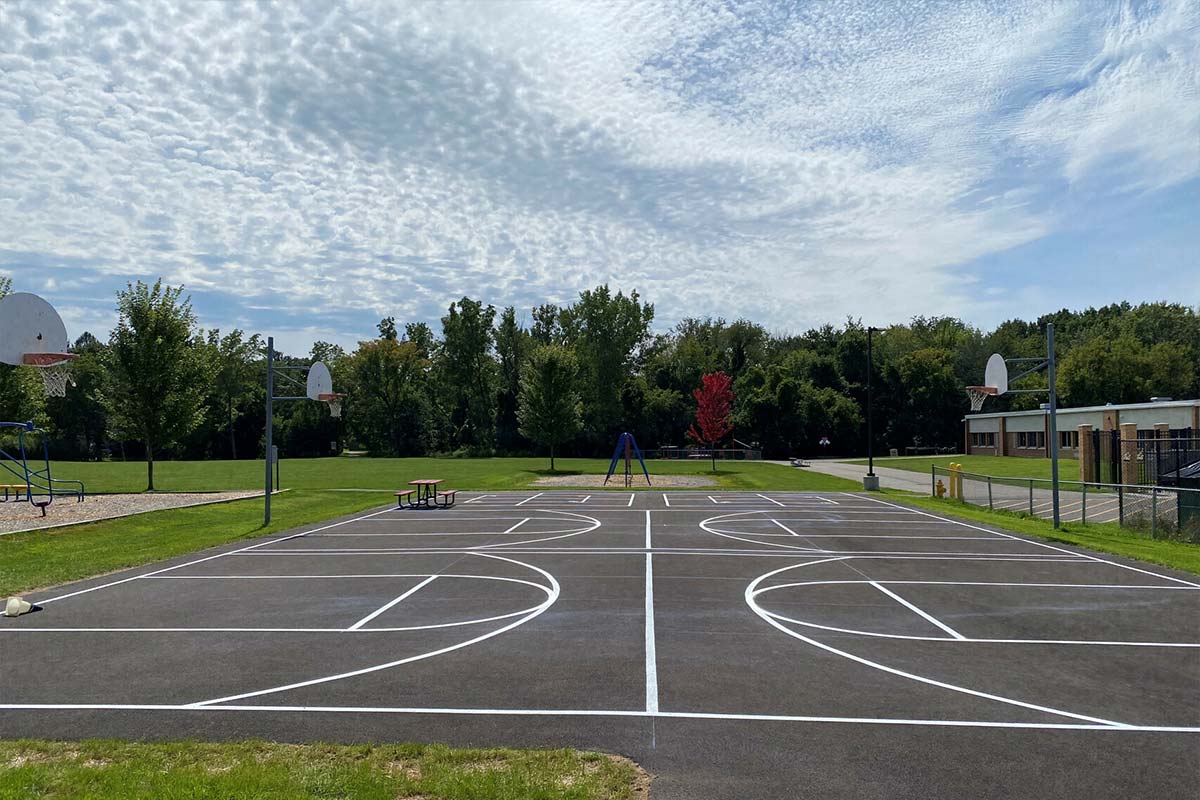
Sports Court Striping in Columbia, SC
Sports court striping is the layout and application of game lines on a hard court surface — pickleball, tennis, basketball, and the game markings that go on school and park pavement. The work is dimensional before it is cosmetic. A pickleball baseline set six inches deep changes how the game plays, and a non-volley line in the wrong place changes the rules of every point that crosses it. So the layout gets measured, chalked, and checked against the governing standard before any paint goes down.
Schools, parks departments, HOAs, apartment communities, and recreation facilities across Richland, Lexington, Kershaw, and Orangeburg counties all run into the same problem eventually: the surface is still sound, but the lines have gone soft. Acrylic court paint sits on top of a court that gets walked on, pivoted on, and hosed down. It wears where the play is heaviest — the service boxes, the key, the kitchen line — and it fades everywhere the sun hits it.
Court striping is not court resurfacing. Resurfacing rebuilds the playing surface itself, filling low spots and laying new acrylic color coats across the full court. Striping is the lines that go on top of that surface. On a court whose asphalt or concrete is in good shape and whose color coat is intact, restriping alone restores a court that reads correctly and plays correctly, without the cost or the closure of a full resurface. When a court does need both, the lines are always the last step — they go down after the color coats have cured, never before.
The most common request we get in Columbia is not a new court at all. It is an existing tennis court that a school or a park wants to play pickleball on, without giving up tennis. That is a layout problem, and it is solved with dimensions and color, not with a bulldozer.
Pickleball, Tennis, and Basketball Court Layouts
Every game line on a court traces to a published standard. Pickleball’s dimensions come from the USA Pickleball Official Rulebook. Tennis court dimensions are published by the United States Tennis Association. Basketball courts are laid out to the rules of the governing body the facility plays under — the FIBA Official Basketball Rules for international play, with high school and collegiate bodies publishing their own court diagrams. Before we chalk anything, we ask which standard the court has to satisfy, because the answer changes the tape measure.
| Court | Playing dimensions (lines included) | Net / rim height | Standard |
|---|---|---|---|
| Pickleball | 20 ft × 44 ft; non-volley zone 7 ft from the net on each side | 36 in at the sidelines, 34 in at center | USA Pickleball Official Rulebook |
| Tennis (singles) | 78 ft × 27 ft | 42 in at the posts, 36 in at center | USTA |
| Tennis (doubles) | 78 ft × 36 ft | 42 in at the posts, 36 in at center | USTA |
| Basketball (FIBA) | 28 m × 15 m (about 92 ft × 49 ft) | Rim at 3.05 m (10 ft) | FIBA |
The playing surface is not the whole court. USA Pickleball recommends a total playing area of 30 ft × 60 ft around the 20 ft × 44 ft court, so players have room to run down a lob without meeting a fence. On a shared or converted surface, that surrounding space is usually what decides how many courts actually fit — not the courts themselves.
Multi-game overlays are the rule rather than the exception here. A doubles tennis court is 36 ft wide and 78 ft long; a pickleball court is 20 ft by 44 ft. The arithmetic works, and it works more than once, which is why a single tennis court so often ends up carrying two or four pickleball courts alongside its own lines. The technique is contrast: each game gets its own line color, the primary sport keeps the most visible color, and the overlay drops to a secondary shade that players can filter out while rallying. Get the color hierarchy wrong and both games become harder to play, even though every line is dimensionally perfect.
Playground Game Markings for Schools and Parks
Playground game markings are painted directly onto school and park pavement — hopscotch grids, four square, number lines, alphabet paths, kickball diamonds, target circles, and the running tracks and shapes that turn a blank asphalt pad into something a class can use. Unlike a pickleball or tennis court, there is no governing body issuing a rulebook and no dimensional standard to satisfy. What the layout has to do is fit the pad, fit the age of the students using it, and leave clear circulation between games.
That freedom is the reason this work goes wrong. A layout drawn to fill space rather than to be played on ends up with a four square court against a wall, a hopscotch grid that runs into a curb, and no room to stand between them. We measure the pad first, place the games that the school has actually asked for, and lay them out so that the busiest games have the most surrounding room.
The paint is the same acrylic system used on the courts, which is what keeps a hopscotch grid legible through a full school year of shoes rather than a single semester. Colors are chosen for contrast against the pavement so the markings read from across the pad, and each game is laid in a color that separates it from whatever it sits next to.
Schools and parks departments across the Midlands typically schedule this work between terms or over a long weekend, when the pad can be closed and the paint can dry without anyone standing on it. Call 1-800-STRIPER of Columbia for a free estimate — we will walk the pad, talk through which games belong on it, and put a layout together before anything is painted.
For a full list of our pavement marking services, visit our parking lot striping in Columbia page.
Businesses We Serve




How it Works

GET A FREE ESTIMATE
Contact us today and we’ll have a quote to you in 24 hours

SCHEDULE AN INSTALLATION
We’ll have your play space restriped in less than 7 days, without affecting your playtime

GET A PARKING LOT THAT POPS
For a budget-friendly price, you’ll get a parking lot that looks like new
We proudly work with:


We proudly work with:


Frequently Asked Questions About Sports Court Striping in Columbia, SC
What are the official dimensions of a pickleball court?
A regulation pickleball court is 20 feet wide by 44 feet long, measured to the outside of the lines, and those dimensions are the same for singles and doubles. The non-volley zone — the kitchen — extends 7 feet from the net on each side. The net is 36 inches high at the sidelines and 34 inches at the center. USA Pickleball also recommends a total playing area of 30 feet by 60 feet, which gives players room to move behind the baseline and outside the sidelines.
Can pickleball lines be added to an existing tennis court?
Yes, and it is the most common sports court striping request we see. A doubles tennis court measures 78 feet by 36 feet, and a pickleball court is 20 feet by 44 feet, so the pickleball layout fits inside the tennis surface — often more than once, depending on how much surrounding run-off space you are willing to give up. The two line sets are laid in different colors, with the primary sport carrying the higher-contrast color, so players can read the game they came to play and visually filter out the other.
Can courts be striped on asphalt as well as concrete?
Both work. USA Pickleball’s rulebook accepts a court surface of asphalt, concrete, or another suitable material, and acrylic court coatings are formulated for both. The difference is in preparation, not in whether the coating will hold. Asphalt is porous and grips a coating readily, but it has to be fully cured before anything is applied to it. Concrete is smoother, so a troweled slab offers the coating less profile to key into and needs more surface preparation before lines go down.
How long before players can get back on a freshly striped court?
Longer than a parking lot needs before cars return, and for a different reason. Acrylic court coatings are water-based and dry by evaporation, so the timeline is driven by air temperature, humidity, and direct sun on the day the lines go down. Foot traffic is also a harsher first contact than a tire is — a pivoting shoe shears and scuffs where a tire would simply roll — so a court surface that feels dry can still mark. The binding cure window comes from the technical data sheet for the specific coating used, and we schedule around it rather than around a general rule. We will give you the window for your court before we start.
What game markings do elementary schools usually ask for?
The requests cluster around a handful of games: hopscotch, four square, number lines and hundred grids, alphabet paths, target circles, kickball diamonds, and painted running tracks or shapes around the edge of the pad. There is no rulebook governing any of them, and no required dimensions — which means the layout is driven by the size of the pad, the age of the students, and how much clear space each game needs around it. Tell us which games you want and we will fit them to the pad.
How often do court lines need to be repainted?
It depends on how much the court is played, how much direct sun it takes, and which coating is on it — a shaded neighborhood court holds its lines far longer than a school court running classes across it all day. Wear shows up first where the feet are: service boxes, the key, and the non-volley line. When the lines have faded enough that players hesitate over a call, it is time. Rather than quote you an interval we cannot stand behind, we would rather look at the court. Call for a free estimate.