Parking Lot Restriping
In Columbia, SC
Restripe Existing Lines and Markings
1-800-STRIPER provides professional parking lot restriping in Columbia, SC — refreshing faded lines, ADA stalls, fire lanes, and directional arrows using fast-dry traffic paint and precision line-striping equipment for commercial properties across Richland, Lexington, Kershaw, and Orangeburg counties.
1-800-STRIPER of Columbia PROVIDes Restriping Services NEAR YOU
Need to brighten up your faded parking lot?
Keep your parking lot safe and attractive by restriping annually to freshen up lines and symbols that have faded from the sun, weather, and traffic. Nothing beats a fresh coat of paint!
Benefits:
Parking Lot Restriping in Columbia, SC
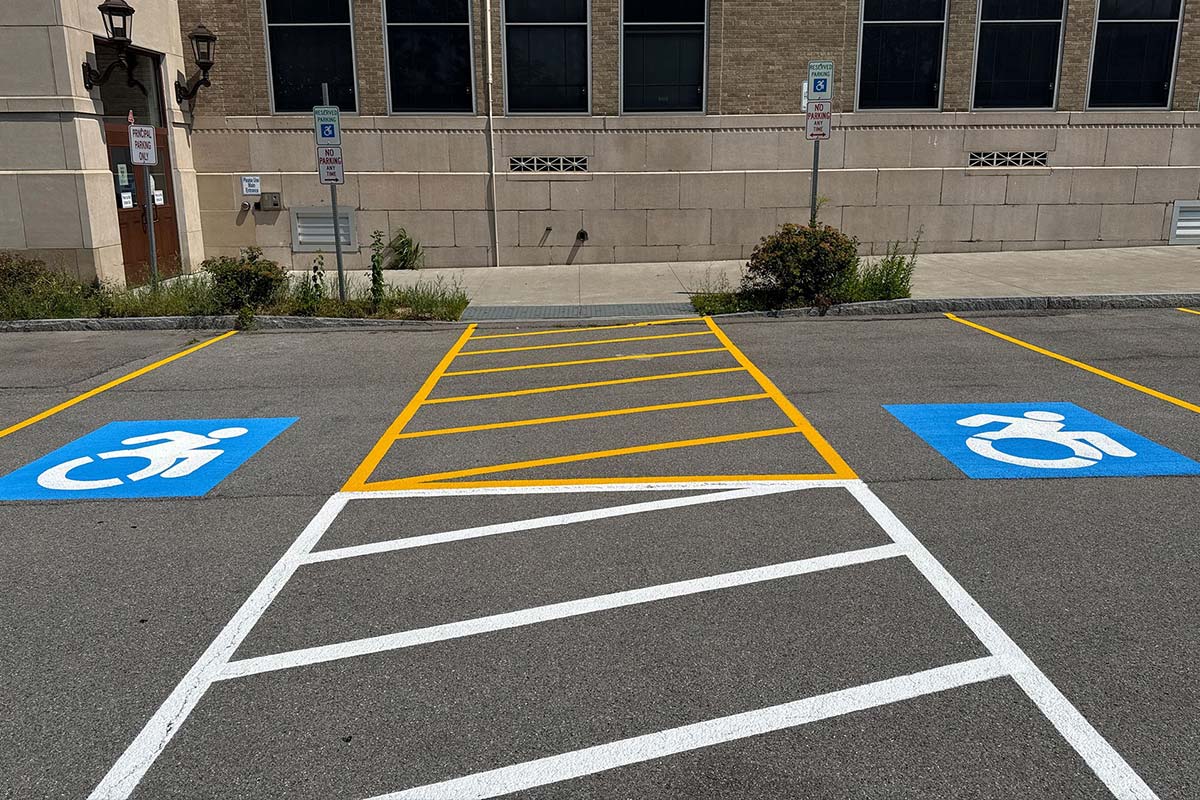
Restriping is repainting the markings on a lot that already has them — stall lines, accessible spaces and their access aisles, fire lanes, crosswalks, stop bars, and directional arrows. The pavement stays where it is. What changes is whether a driver can read the lot at a glance.
That distinction decides what your property actually needs. Repaving replaces the asphalt. Seal coating protects the surface and, in doing so, covers every marking on it. Restriping is the layer that goes back on top, and on a lot with sound pavement and tired paint it is the fastest, least disruptive way to make the property read as maintained again.
Faded markings fail quietly. Drivers stop trusting the stalls and park to the car beside them instead of to the line, so the rows drift and you lose usable spaces. Delivery trucks creep into a fire lane nobody can see. An accessible space whose access aisle has worn to a suggestion stops working as an accessible space, whatever the sign at its head still says. None of that announces itself the way a pothole does.
We restripe retail centers, medical offices, churches, schools, HOA and multifamily lots, restaurants, and industrial properties across Richland, Lexington, Kershaw, and Orangeburg counties. Some jobs are a straight refresh. Some are a refresh plus a correction — an access aisle that was never wide enough, a fire lane that drifted during the last overlay, arrows fighting the drive-through queue. We measure before we paint, so you know which one you have. Call (803) 679-4314 for a free estimate.
How Our Restriping Process Works
Every restripe follows the same five steps, whether we are matching your existing plan or correcting it.
- Walk and measure the lot. We record stall count and spacing, drive-aisle geometry, accessible space and access-aisle dimensions, fire-lane runs, and every legend and arrow on the surface. This is where we photograph anything already out of compliance — so you find out before we paint, not after.
- Clean the surface. Traffic paint adheres to clean, dry pavement and to nothing else. We sweep and blow off grit and debris, and pressure wash where oil, rubber, or heavy soil would sit between the paint and the asphalt. Paint laid over residue lifts within a season, whatever the coating cost.
- Chalk the layout before any paint goes down. On a straight refresh this confirms we are landing on the existing lines. On a corrected layout it lets you see the change while it is still chalk.
- Apply fast-dry traffic paint with precision line-striping equipment. Lines, legends, symbols, and arrows go down at a consistent film thickness, so the markings wear evenly instead of thinning first at the drive lanes and stall heads — which is where the tires actually land.
- Reopen in phases. We stripe in sections and hand each one back as it takes traffic. Most commercial lots never fully close for a restripe.
We schedule around your hours. For a property that cannot lose capacity during business hours, that means an evening or weekend phase plan worked out before the crew arrives.
Restriping Standards and Layout Compliance
Two different bodies of rules land on a commercial restripe, and they govern different things.
The first is the Manual on Uniform Traffic Control Devices, the federal standard for pavement markings. Read its scope carefully: the MUTCD governs markings on highways and on private roads open to public travel, so a private commercial lot is not automatically inside it. What the manual gives a striping contractor is the convention set drivers already know — what a solid line means, what an arrow means — plus one rule that bears directly on restriping. Markings that are no longer applicable and might confuse a road user are to be removed or obliterated so they cannot be identified as a marking. That is the whole argument against painting a new plan over an old one and hoping the ghost lines fade.
The second is the 2010 ADA Standards for Accessible Design, which is not a convention set. It fixes how many accessible spaces a lot must have, how wide they are, how their access aisles are dimensioned and marked, and where they sit relative to the entrance. A restripe does not reduce any of it. If your lot had four accessible spaces and one van space before we arrived, it has four and one when we leave — at the dimensions the standard requires, not the ones the faded paint happened to describe.
Both rules bear on the question owners ask most: how often. There is no code-mandated repaint interval for a private lot. The trigger is condition, not calendar. Restripe when contrast has dropped far enough that drivers hesitate, when a compliance marking has faded past what an inspector will accept, when the lot has just been seal coated or overlaid, when a new tenant makes the current plan wrong, or when you are fielding complaints about traffic flow. A shaded medical office and a full-sun retail lot on the same street will not reach that point in the same year, and no interval printed on a website can tell you which is which.
For a full list of our pavement marking services, visit our parking lot striping in Columbia page.
Businesses We Serve




How it Works

GET A FREE ESTIMATE
Contact us today and we’ll have a quote to you in 24 hours

SCHEDULE AN INSTALLATION
We’ll have your installation scheduled in less than 7 days, without affecting your business hours

GET A PARKING LOT THAT POPS
For a budget-friendly price, you’ll get a parking lot that looks like new
We proudly work with:


We proudly work with:

Frequently Asked Questions About Parking Lot Restriping in Columbia, SC
How long before vehicles can drive on fresh striping?
The question is when tires stop lifting paint, and the industry measures that as no-pick-up time. ASTM D711 is the standard test method: a weighted wheel rolls over a fresh film until no paint transfers. The standard is candid about its limits — it is a laboratory control test, and it names film thickness, humidity, wind speed, direct sunlight, and the pavement’s own temperature, porosity, and moisture content as reasons a lab figure will not transfer cleanly to your lot. So we do not publish a universal number. We stripe in phases, check the film in front of us, and reopen each section when it will carry vehicle traffic.
Do you paint over the faded lines, or remove them first?
It depends on whether the layout changes. If the plan stays the same and the existing paint is sound, we clean the surface and repaint over the old lines; the fresh coat restores contrast on the same geometry. If the plan changes, or many prior coats have built a ridge of paint, we remove the old markings first by grinding or another mechanical method. The reason is the MUTCD rule: markings that no longer apply and could confuse a driver are to be removed or obliterated so they cannot be identified as a marking. A ghost line under a new stall is exactly that. Where markings must go out of service before removal can be scheduled, the manual also permits masking them temporarily with tape close to the pavement color.
Will a restripe change how many ADA spaces my lot has?
Not if we are refreshing the existing plan. The accessible-space count is set by the total spaces in the parking facility under Table 208.2 of the 2010 ADA Standards, and a repaint does not change that total. The distinction that matters underneath is maintenance versus alteration. The Department of Justice’s Title III regulation defines an alteration as a change to a facility that affects or could affect its usability, expressly lists changes or rearrangement in the plan configuration as one, and expressly excludes normal maintenance and painting unless they affect usability. A like-for-like repaint is generally maintenance. Re-drawing the plan — moving rows, adding stalls, relocating accessible spaces — is a change in plan configuration, and the altered portion has to meet the current standard. We tell you which of the two you are buying before we chalk anything.
Water-based paint, solvent-based paint, or thermoplastic for a restripe?
Waterborne traffic paint is the default for commercial lots and is what most restripes use. Solvent-based paint is the older chemistry, still specified where a job’s conditions rule waterborne out. Both are paints — ASTM D711’s scope names waterborne, solventborne, and some 100-percent-solids liquid traffic paints as materials it can test. Thermoplastic is not paint. It is a hot-applied, 100-percent-solids material specified under AASHTO M249, laid far thicker than a painted line, and it belongs on high-wear markings such as stop bars and crosswalks rather than across a lot of stall lines. For a routine restripe, paint is almost always right. Call for a free estimate and we will say where thermoplastic earns its place on your property and where it does not.
Can you fix a layout mistake while you restripe?
Yes, and a restripe is the cheapest moment to do it, because surface prep and mobilization are already paid for. Common corrections we find at the measure-up: access aisles narrower than the standard allows, an accessible space sitting on a longer route to the entrance than a standard space does, arrows that contradict the drive-aisle geometry, fire-lane runs that lost a segment during the last overlay. A correction means the old markings come out rather than get painted over, and it means that portion of the lot is being re-drawn rather than refreshed — so current standards apply to what goes back. We chalk the corrected plan and walk it with you before the first line is painted.
What weather do you need to stripe a lot?
Dry pavement, warm enough for the paint being applied. It is the pavement temperature that governs, not the air temperature — a shaded lot in March can sit well below the reading on your phone. The manufacturer’s product data sheet sets the minimum for the material we are using, so we check the surface rather than the forecast headline. ASTM D711 makes the same point from the laboratory side, identifying pavement temperature, pavement moisture content, humidity, wind speed, and direct sunlight as the field variables that make paint behave differently from lot to lot. We will not stripe damp pavement or paint ahead of rain. If the day turns, we reschedule rather than hand you a lot that has to be redone.