Warehouse Line Painting
In Columbia, SC
OSHA-Compliant Safety Markings
1-800-STRIPER provides professional warehouse line painting in Columbia, SC — OSHA-compliant aisle lines, pedestrian walkways, and safety zone markings per OSHA 1910.176 requirements using durable epoxy and traffic paint for industrial facilities across the Midlands.
1-800-STRIPER® of Columbia PROVIDes Warehouse Floor Markings Services NEAR YOU
Want your indoor space to operate more efficiently?
Warehouse and interior markings ensure clear traffic lanes, organized storage zones, and designated spaces designed to help your business operate safely and efficiently.
Benefits:
Warehouse Line Painting in Columbia, SC
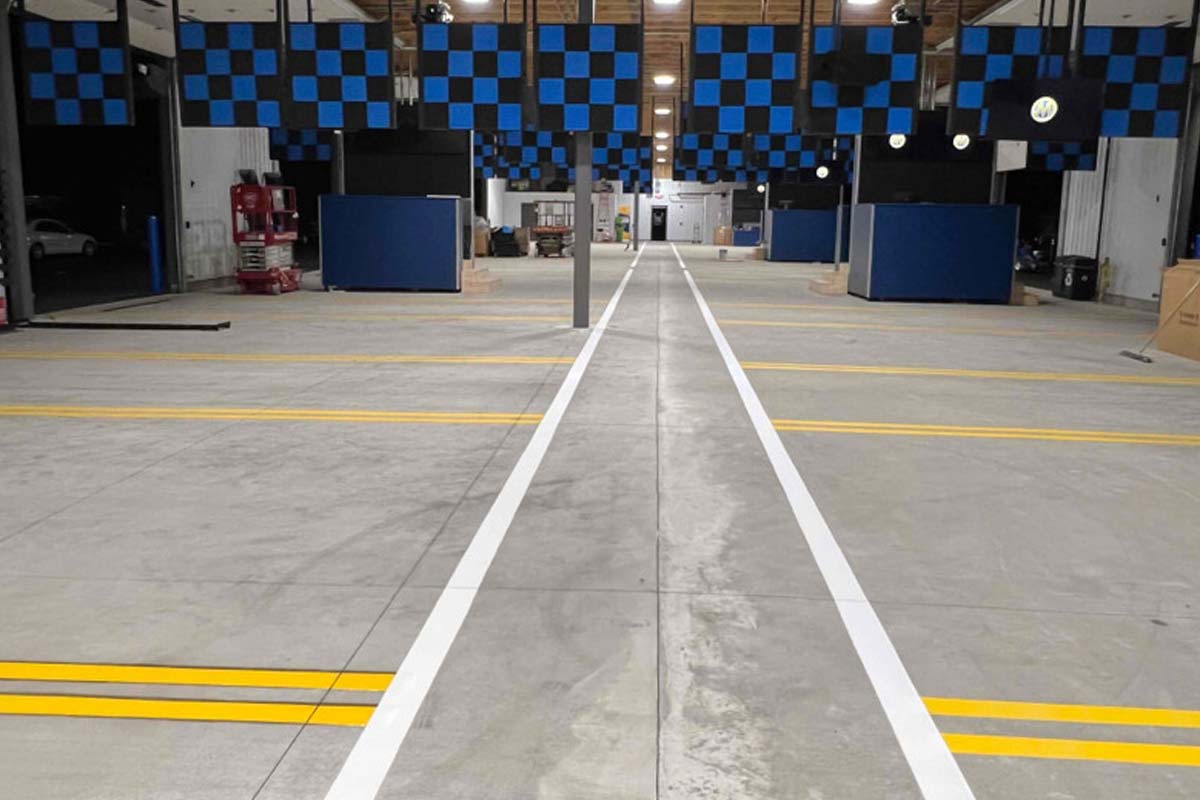
Warehouse line painting is interior floor marking: the aisle lines that separate forklift traffic from people, the pedestrian walkways that carry staff from the door to the pick line, and the color-coded zones that tell everyone in the building what a square of floor is for. It happens inside, on sealed concrete, under equipment that runs across the same lines every shift.
Distribution centers, manufacturing plants, cold-storage facilities, and third-party logistics operations across the Midlands share a floor-marking problem that no parking lot has. A warehouse floor is not walked on and driven on occasionally — it is worked. A counterbalance forklift turns on the same corner a few hundred times a day, and every turn drags a loaded wheel sideways across whatever coating is under it. Pallet jacks scuff. Dropped banding scrapes. Floor scrubbers pass over the same line every night. A marking that would last years in a parking stall gets abraded off a pick-aisle corner in months.
That is the whole design problem in a warehouse: the marking has to survive point-loaded, twisting abrasion in one specific spot, indefinitely, while a safety program depends on it staying legible. Everything downstream — which coating, how wide the line, what color, where the line goes — follows from that.
OSHA Aisle Marking Requirements
The marking duty is easy to cite incorrectly, so it is worth being exact. It lives with the Occupational Safety and Health Administration under 29 CFR 1910.176(a), materials handling and storage. Where mechanical handling equipment is used, that standard requires sufficient safe clearances for aisles, at loading docks, through doorways, and wherever turns or passage must be made; it requires aisles and passageways to be kept clear, in good repair, and free of obstructions that could create a hazard; and it states plainly that permanent aisles and passageways shall be appropriately marked.
OSHA’s separate walking-working-surfaces standard, 29 CFR 1910.22, is the general housekeeping rule — surfaces kept clean, orderly, and in a safe condition, with access and egress maintained. It carries no marking requirement and no dimensions. If a forklift runs on your floor, 1910.176(a) is the provision that puts lines on it.
Here is the part that surprises facility managers: neither standard gives you a number. Not a line width, not a color, not an aisle width. Those come from an OSHA standard interpretation, which recommends aisle markings from 2 to 6 inches wide and treats any width of 2 inches or more as acceptable; permits the lines to be any color, so long as they clearly define the space considered as aisle; allows them to be dots, squares, strips, or continuous; and recommends aisles at least 3 feet wider than the largest equipment using them, or a minimum of 4 feet.
So the specification comes from your operation, not from the regulation. Measure the widest piece of equipment on the floor, add clearance, and mark to that. A 4-inch stripe is the width most facilities settle on because it reads clearly from a seated forklift operator’s eye height without consuming floor. Wider lines are not more compliant. They are just wider.
What OSHA will hold you to is that the marking exists, that it defines the aisle clearly, and that the aisle behind it is clear. A line that has been abraded down to a ghost by forklift traffic is, functionally, an unmarked aisle.
Safety Color Coding and Zone Markings
Color is where a warehouse floor becomes readable at a glance. The safety color meanings below come from ANSI Z535.1, the American National Standard for safety colors, which defines what each color communicates in a workplace.
| Color | ANSI Z535.1 meaning | Typical floor use | Line width |
|---|---|---|---|
| Safety Red | Danger; fire protection equipment | Fire equipment and emergency stop clearance | 2–6 in |
| Safety Orange | Warning; hazardous machine parts, energized equipment | Guarded machine clearance zones | 2–6 in |
| Safety Yellow | Caution; physical hazards — striking, tripping, falling, caught-between | Aisleways, traffic lanes, hazard borders | 2–6 in |
| Safety Green | Safety; first aid and safety equipment | First aid stations, eyewash, safety equipment | 2–6 in |
| Safety Blue | Safety information; notice | Informational floor markings | 2–6 in |
| White / black | Not a Z535.1 safety color — general marking | Racking footprints, staging, housekeeping | 2–6 in |
Two cautions on reading that table. First, ANSI Z535.1 defines what the colors *mean* — it does not assign them to floor markings. The floor uses in the middle column are how facilities apply those meanings, and your facility’s own safety program is what makes them binding on your floor. Second, the widths are OSHA’s interpretive guidance, not a Z535.1 provision.
Zone markings extend the same logic past aisles: staging areas, racking footprints, battery-charging zones, dock approaches, and the clearance around fire equipment and electrical panels. Each one is a border that tells a forklift operator where not to set a pallet down. Consistency across the building matters more than which color you pick — a yellow line that means “aisle” in one bay and “staging” in another means nothing anywhere.
Call 1-800-STRIPER of Columbia for a free estimate and we will walk your floor with your safety plan in hand.
For a full list of our pavement marking services, visit our parking lot striping in Columbia page.
Businesses We Serve




How it Works

GET A FREE ESTIMATE
Contact us today and we’ll have a quote to you in 24 hours

SCHEDULE A STRIPING
We’ll have your space restriped in less than 7 days, without affecting your business hours

GET A PARKING LOT THAT POPS
For a budget-friendly price, you’ll get a parking lot that looks like new
We proudly work with:


We proudly work with:


Frequently Asked Questions About Warehouse Line Painting in Columbia, SC
How wide do warehouse aisle lines have to be?
OSHA requires the marking but does not dimension it. 29 CFR 1910.176(a) states that permanent aisles and passageways shall be appropriately marked where mechanical handling equipment is used — and says nothing about width or color. Those come from an OSHA standard interpretation, which recommends aisle markings of 2 to 6 inches and accepts any width of 2 inches or more. It also leaves color open: the lines may be any color so long as they clearly define the space considered as aisle. Most facilities land on 4 inches, which reads clearly from a seated forklift operator’s eye height without eating floor space. The aisle itself is the dimension worth measuring — OSHA recommends at least 3 feet wider than the largest equipment using it, or a minimum of 4 feet.
What does each floor marking color mean?
ANSI Z535.1 assigns the meanings. Red signals danger and marks fire protection equipment. Orange signals warning and marks hazardous machine parts and energized equipment. Yellow signals caution and covers physical hazards — striking, tripping, falling, caught-between — which is why it is the near-universal choice for aisleways and traffic lanes. Green marks safety equipment and first aid. Blue carries safety information and notices. White, black, and gray are not Z535.1 safety colors and are used for general marking such as racking footprints and staging areas. Z535.1 defines the meanings; your facility’s safety program decides which floor gets which.
Should we use epoxy or traffic paint on a warehouse floor?
It depends on where the forklifts turn. Traffic paint is a single-component coating that dries by evaporation; epoxy is a two-component coating that cures by chemical reaction into a harder, more abrasion-resistant film. That difference matters most where a loaded forklift wheel twists across a line rather than rolling over it — a pick-aisle corner, a dock approach, a turning radius at the end of a rack run. Epoxy holds those lines longer. Traffic paint goes down faster, dries faster, and is easier to change when a layout moves. Many floors get both, applied where each earns its place.
How much downtime does line painting require?
The area being marked has to be clear of traffic while the coating is applied and until it has cured enough to take the equipment that runs on it. Epoxy’s reaction cure takes longer to reach forklift-ready hardness than traffic paint’s evaporative dry, and both slow down as floor temperature drops or humidity climbs — a cold-storage floor behaves differently from a dry-goods floor in July. The binding numbers are on the technical data sheet for the coating we apply. We work zone by zone, and we schedule around your shifts rather than closing a building.
Is line painting the same thing as floor coating?
No, and the distinction matters when you are comparing quotes. Line painting is what we do: aisle lines, pedestrian walkways, safety zone borders, racking footprints, and the color-coded markings your safety program calls for. Floor coating is a different scope — resurfacing the entire slab with an epoxy or urethane system, wall to wall. 1-800-STRIPER of Columbia does not offer full-floor coating systems. If your slab needs to be coated, that is a different trade, and we will say so rather than sell you something adjacent to it.
Do forklift aisles need different markings from pedestrian walkways?
They need to be distinguishable, and that is the point of marking them at all. OSHA’s 1910.176(a) requires permanent aisles and passageways to be marked and kept clear wherever mechanical handling equipment runs; it does not assign a color to either, and its interpretation explicitly permits any color that clearly defines the aisle. What makes a walkway work is that a pedestrian can see where they are protected and a forklift operator can see where they must not go. Facilities achieve that with a consistent color scheme — most commonly yellow for equipment traffic lanes, per ANSI Z535.1’s caution meaning, with walkways given their own distinct treatment — applied identically across the whole building.