
Parking Lot Pressure Washing
In Columbia, SC
Surface Prep Before Restriping
1-800-STRIPER provides professional parking lot pressure washing in Columbia, SC — removing oil stains, tire marks, and surface grime from asphalt and concrete lots with wash-water managed per EPA stormwater discharge regulations for commercial properties across the Midlands.
1-800-STRIPER® of Columbia PROVIDes Parking Lot Power Washing Services NEAR YOU
Need to blast away years of grime?
If your parking lot or parking garage looks dull and dirty, our professional crew can wash away grime, oil, stains, and slippery buildup to restore the appearance of your property.
Benefits:
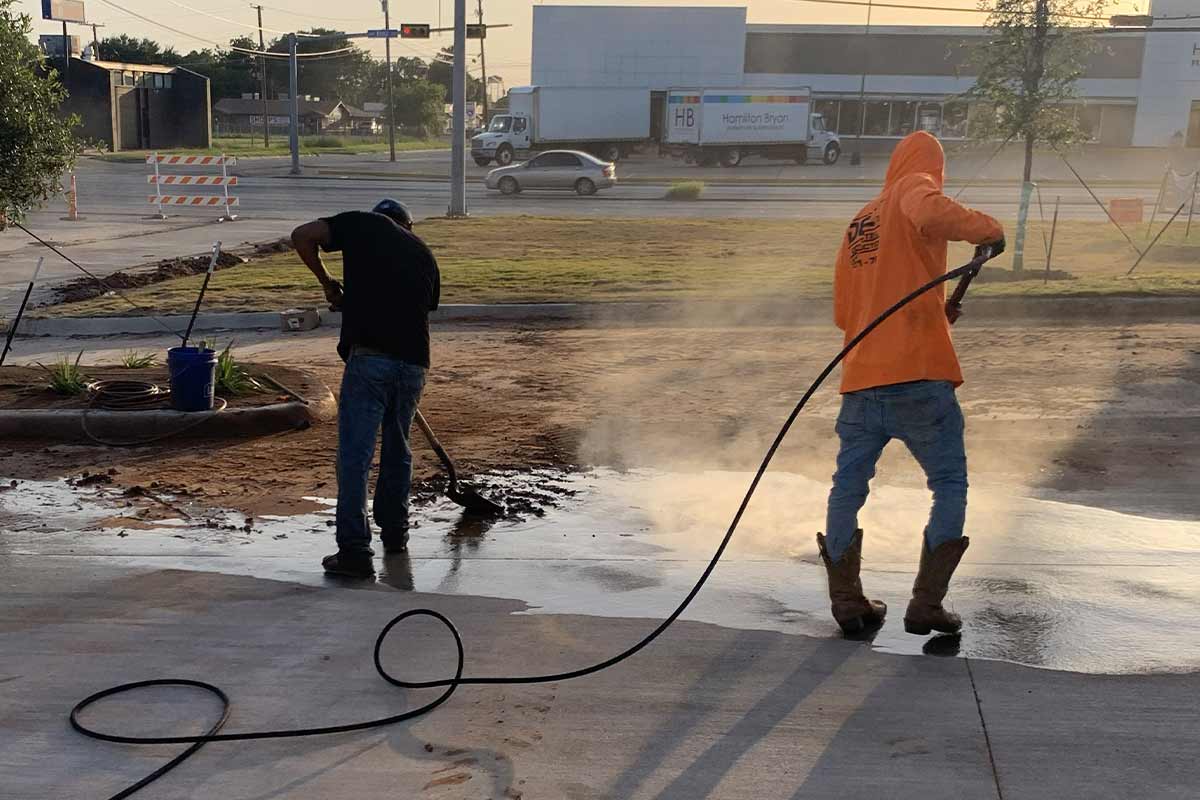
Parking Lot Pressure Washing in Columbia, SC
Pressure washing a commercial lot is surface prep. Sometimes the point is appearance — a retail center whose entrance apron has gone black with tire rubber and drive-through spill. More often, on our jobs, the point is adhesion: paint does not bond to oil, dust, or gum, and a stripe laid over contamination lifts within a season no matter how good the coating is.
That is the axis this service sits on. We are not a striping crew that owns a washer as an afterthought, and we are not a general exterior cleaning company. We wash lots because a clean, sound surface is what a durable marking needs underneath it, and because a commercial property with a filthy entrance reads as a neglected property to everybody who pulls in.
1-800-STRIPER of Columbia washes commercial lots, drive lanes, entrance aprons, loading areas, and dumpster pads across Richland, Lexington, Kershaw, and Orangeburg counties. Asphalt and concrete take different handling, and both take a plan for the water afterward — which, on a commercial property, is the part that actually carries regulatory weight. Call for a free estimate.
What Pressure Washing Removes
Not everything on a parking lot surface is the same problem, and they don’t come off the same way.
Oil and hydraulic fluid soak into asphalt rather than sitting on it. A surface rinse pulls the film and leaves the stain, because the contamination has migrated into the binder. Hot water and a degreasing agent emulsify what’s near the surface so it can be lifted and recovered — but a deep, old drip under a delivery bay may never come back to uniform color. We say so before we start rather than after.
Tire marks and rubber build up at turning points, drive-through lanes, and loading dock aprons. They are mechanical deposits, and they respond to heat and dwell time more than to raw pressure.
Chewing gum is a heat problem. It softens and releases, and it comes up as a solid that should be swept, not flushed.
Dirt, pollen, algae, and organic film are the easy category — they lift with pressure and rinse. In Columbia’s humidity, shaded concrete and north-facing curbs pick up biological growth that turns a light green-black; it is cosmetic, but it is also slick when wet.
Then there is the category that matters most for our work: dust and fines. A lot that looks clean carries a layer of fine grit that paint will happily bond to instead of bonding to the pavement. That grit is why the wash comes before the stripe.
Wash-Water Runoff and Stormwater Compliance
Here is the part most property owners have never been told. A storm drain is not a sink. Municipal separate storm sewer systems collect stormwater and discharge it, untreated, into local water bodies. Under the EPA stormwater discharge regulations that govern them, an illicit discharge is defined as “any discharge to an MS4 that is not composed entirely of stormwater,” subject to narrow exceptions such as NPDES-permitted industrial sources and fire-fighting activities. Wash water carrying oil, degreaser, and lot grime is not stormwater. It does not belong in the drain.
That is a federal frame. The state layer is administered by the South Carolina Department of Environmental Services, which took over South Carolina’s environmental programs, and the operator of the storm sewer your lot drains into holds a permit obligation to detect and eliminate illicit discharges into it.
So containment is part of the job, not an add-on to it:
- Identify every drain, inlet, and grate the wash area drains toward, before any water runs.
- Dry-sweep and scrape first. Remove litter, gum, and solids as solids. Anything picked up dry is something that never enters the water.
- Block or plug the inlets in the work area, and berm the perimeter so the wash area is hydraulically isolated.
- Wash toward a controlled low point, working with the lot’s existing fall rather than against it.
- Recover the wash water at that low point by vacuum, so it is captured rather than allowed to migrate.
- Separate solids and free oil from the recovered water, retaining the sediment for disposal as a solid.
- Discharge the recovered water only by an authorized path — the sanitary sewer where the local utility permits that connection, or hauled off-site for disposal. The utility decides, and we ask before we start, not after.
- Remove the plugs, sweep the area, and confirm the inlets are clear and undamaged.
Property owners are sometimes surprised that a cleaning job comes with a water plan. But the discharge is the regulated event, not the washing.
For a full list of our pavement marking services, visit our parking lot striping in Columbia page.
Businesses We Serve




How it Works

GET A FREE ESTIMATE
Contact us today and we’ll have a quote to you in 24 hours

SCHEDULE AN INSTALLATION
We’ll have your installation scheduled in less than 7 days, without affecting your business hours

GET A PARKING LOT THAT POPS
For a budget-friendly price, you’ll get a parking lot that looks like new
We proudly work with:


We proudly work with:
Frequently Asked Questions About Parking Lot Pressure Washing in Columbia, SC
Can wash water go down the storm drain?
No. A municipal separate storm sewer system carries stormwater to local waterways without treatment, and EPA defines an illicit discharge as any discharge into one that “is not composed entirely of stormwater,” with narrow exceptions for things like NPDES-permitted industrial sources and fire-fighting. Parking-lot wash water carries oil, grit, and often a degreasing agent — it is not stormwater. We plug the inlets, berm the area, vacuum-recover the water, and send it to an authorized disposal path. This is the single most-skipped step in commercial pressure washing, and it is the one with a regulator behind it.
Will pressure washing damage my existing striping?
It can, and that fact is usually a scheduling problem rather than a reason not to wash. Traffic paint is a surface coating. Direct high-pressure spray held on a line — especially hot water on aging paint — will fade it, and on badly weathered markings it will lift them. Where we’re washing a lot whose striping is staying, we drop pressure over the markings, widen the fan, and keep the wand moving. Where the lot is being restriped anyway, that concern disappears: the old paint’s condition stops mattering the moment a new layout is going down over it.
How often should a commercial lot be pressure washed?
There’s no code, no standard, and no honest universal interval — the answer is set by what lands on your pavement. A lot with a drive-through lane, a dumpster pad, and delivery-truck traffic accumulates oil and rubber continuously and shows it within months. A low-traffic office lot may go a great deal longer before appearance or contamination justifies a wash. The trigger we actually watch for is functional rather than calendar-based: visible oil at the stalls, rubber build-up at turning points, biological film on shaded concrete, or an upcoming restripe. Call for a free estimate and we’ll tell you what your lot needs.
Hot water or cold water — does it matter?
For grease, oil, and gum, yes. Heat lowers the viscosity of petroleum residue and softens gum so both release from the pavement and can be recovered. Cold water at the same pressure tends to push the film around rather than lift it. For dirt, pollen, and organic film, cold water and adequate pressure are usually sufficient, and heat buys you nothing. Hot water also asks more of asphalt than concrete does, because asphalt’s binder is a petroleum product and heat softens it too. That is a real trade-off, and it’s why the surface decides the method.
Should the lot be washed before it’s restriped?
Yes, and it is the reason we own this service at all. Paint bonds to what it touches. If what it touches is dust, oil film, or a layer of fine grit, the paint bonds to that instead of to the pavement, and the line delaminates in sheets within a season. Washing is the prep step that makes the striping last. The sequence is: wash, allow the surface to dry fully, then stripe. A wet or damp surface is its own adhesion failure, so we build the dry time into the schedule rather than chasing the crew off the lot.
What pressure is safe on asphalt versus concrete?
There is no published standard that sets a safe pressure for either surface, so we won’t print a number and pretend it’s a specification. What governs is the material. Concrete is a rigid, cementitious surface that tolerates aggressive pressure well. Asphalt is bound by a bituminous binder that softens with heat and can be eroded — pressure that a concrete apron shrugs off will ravel an asphalt drive lane, pulling fines loose and leaving a scoured patch that never quite matches. So on asphalt we run lower pressure, a wider fan, more standoff distance, and let dwell time and heat do the work instead of force. We prove the setting on an inconspicuous test patch before we touch the visible lot.