Wheel Stop Installation
In North Atlanta, GA
Concrete and Rubber Parking Stops
1-800-STRIPER provides professional wheel stop installation in North Atlanta, GA — concrete, recycled-rubber, and bolt-down composite stops anchored at stall heads to protect walkways, storefronts, and ADA accessible routes per the 2010 ADA Standards § 403 throughout the six-county OTP North area.
1-800-STRIPER® of Atlanta OTP North PROVIDes Wheel Stops Services NEAR YOU
Need to protect vehicles or walls from accidental damage?
Wheel stops (also called parking blocks) protect your property, enhance safety, and improve parking lot organization.
Benefits:
Wheel stops prevent vehicles from parking too far into a space or overextending into other spots, pedestrian walkways, and other areas, while also helping with vehicle alignment. They can prevent damage to buildings, curbs, or landscaping. Wheel stops also serve as clear visual cues for proper parking and are sometimes used on slopes to prevent cars from rolling.
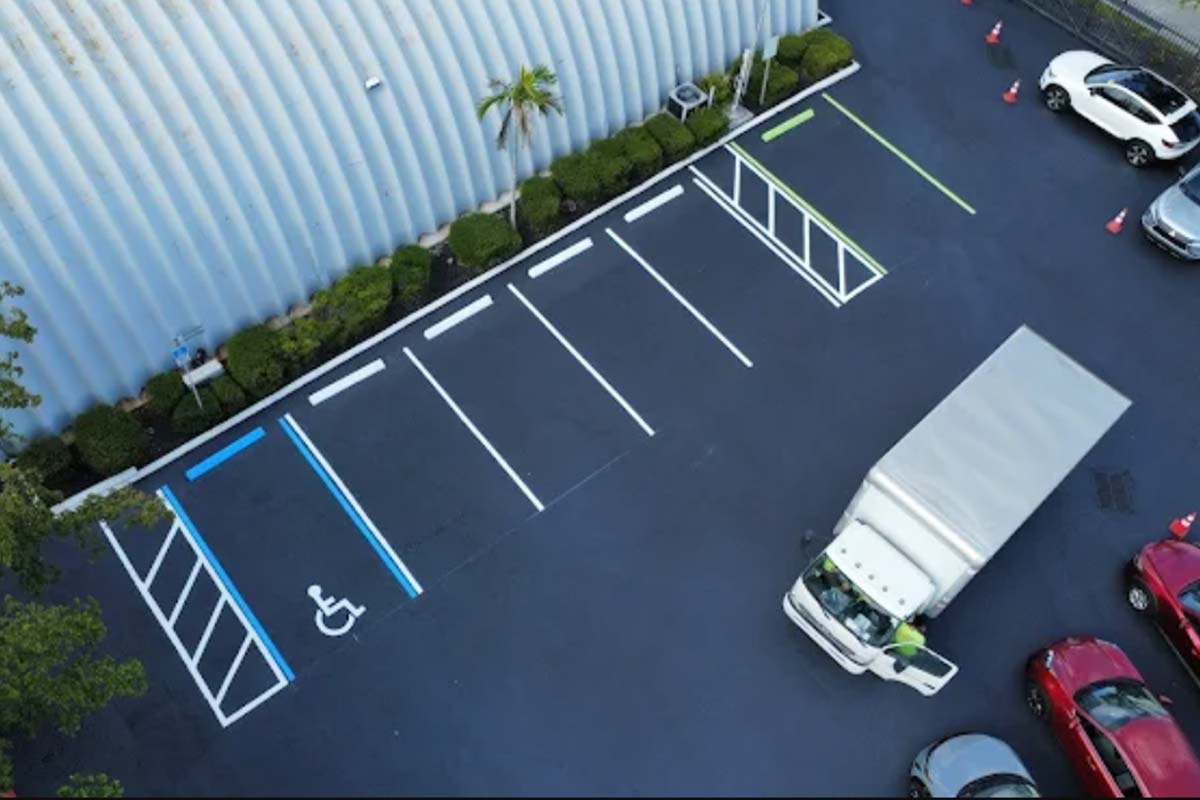
Wheel Stop Materials: Concrete vs Recycled Rubber vs Composite
A wheel stop has one job: stop a parking vehicle from rolling past the stall line and into whatever sits behind it — a sidewalk, a storefront, a pedestrian zone, an ADA-accessible route, a landscape bed, or another parked vehicle. The three material choices each handle that job slightly differently.
Precast concrete is the long-standing standard. A typical 6-foot precast concrete stop weighs 250 to 350 pounds and lasts 15 to 25 years under normal commercial traffic. It anchors with two #4 (½-inch) rebar pins drilled through pre-cast holes and into the pavement, with epoxy bond. The downside is weight — concrete stops chip or crack under sharp impact, and replacement requires the same anchoring labor as a new install.
Recycled-rubber stops weigh 25 to 40 pounds and absorb impact without chipping. They anchor with through-bolt spikes or surface adhesive depending on the pavement. Service life is similar to concrete (15+ years) when properly anchored, and the lighter weight makes single-stop replacement faster. Recycled rubber is the dominant new-install choice on retail, medical, and HOA lots across North Atlanta.
Plastic-composite stops sit between the two — lighter than concrete, harder than rubber, and rated for higher UV exposure than older first-generation plastic. They’re typically used where aesthetic match matters (color-matched composite to building paint) or where load-rating requires the rigidity of plastic over the give of rubber.
ADA § 403 Accessible Route Protection
The most common reason a wheel stop is required (rather than optional) on a commercial lot is the 2010 ADA Standards § 403 accessible-route clearance requirement. An accessible route from an accessible space to the building entrance must be at least 36 inches wide, must be unobstructed, and must not be reduced by parked vehicles overhanging from adjacent stalls.
The standard 9-by-18-foot stall is sized so a typical vehicle (sedan, mid-size SUV) parks with the front bumper at or slightly behind the stall line. But a large truck, a long-bed pickup, or a vehicle parked at the front edge of the stall can overhang by 18 to 30 inches. That overhang crosses into the accessible route, the pedestrian sidewalk, or the building setback — and that’s the ADA non-compliance.
A wheel stop installed at 2.5 to 3 feet from the front of the stall stops the vehicle before the overhang reaches the protected zone. On accessible spaces specifically, the wheel stop is the most common solution when the stall depth doesn’t allow a 24-inch sidewalk setback.
For a full list of our pavement marking services, visit our parking lot striping in North Atlanta page.
Businesses We Serve




How it Works

GET A FREE ESTIMATE
Contact us today and we’ll have a quote to you in 24 hours

SCHEDULE AN INSTALLATION
We’ll have your installation scheduled restriped in less than 7 days, without affecting your business hours

GET A PARKING LOT THAT POPS
For a budget-friendly price, you’ll get a parking lot that looks like new
We proudly work with:


We proudly work with:


Frequently Asked Questions About Wheel Stop Installation in North Atlanta, GA
What is the purpose of wheel stops?
Wheel stops stop a parked vehicle from rolling past the stall line into a protected zone — typically a sidewalk, storefront wall, pedestrian path, ADA-accessible route, landscape bed, or another parking row. The most common compliance trigger is the 2010 ADA Standards § 403 accessible-route clearance requirement on lots where stall depth alone doesn’t protect the route.
What are wheel stops made of?
Three materials cover almost every commercial install: precast concrete (heavy, durable, long-standing standard), recycled rubber (lighter, impact-absorbing, most common new-install choice), and plastic-composite (color-matchable, UV-rated, used where aesthetics or specific load-ratings matter). Each has a 15-plus year service life when properly anchored.
How are wheel stops anchored?
Anchoring depends on the pavement. On asphalt, two #4 (½-inch) rebar pins driven through pre-cast holes in the stop and into the pavement, with epoxy bond. On concrete, the same approach with a core-drilled hole and epoxy. Surface-mount adhesive anchoring works on rubber and composite stops in low-impact applications but isn’t recommended for high-traffic commercial lots — pin anchoring lasts longer.
What size do parking lot wheel stops come in?
The standard single-space wheel stop is 6 feet long. Shorter 4-foot variants exist for compact spaces or specific tight-radius accessible-space configurations. Stop height ranges from 4 to 6 inches; ADA-accessible spaces commonly use the 4-inch height to avoid creating a tripping hazard for users transferring from a vehicle.
Where should wheel stops be placed within a parking stall?
The standard placement is 2.5 to 3 feet from the front of the stall, measured from the stall stripe to the front face of the stop. That distance lets a typical vehicle park fully within the stall (overhanging the stop by the bumper depth) without crossing into the protected zone behind. ADA-accessible spaces sometimes use a 24-inch setback to ensure the access aisle stays clear.
Are wheel stops required by code?
Required is jurisdiction-specific, but the 2010 ADA Standards § 403 accessible-route clearance is the most common compliance trigger — when an accessible-space layout would let a parked vehicle overhang into the accessible route, a wheel stop (or an equivalent stall-depth setback) is the standard solution. Local zoning and stormwater codes sometimes require them at landscape-bed perimeters. Outside those triggers, wheel stops are commonly specified as a property-protection measure rather than a code requirement.