
Warehouse Line Painting
In North Atlanta, GA
OSHA-Compliant Safety Markings
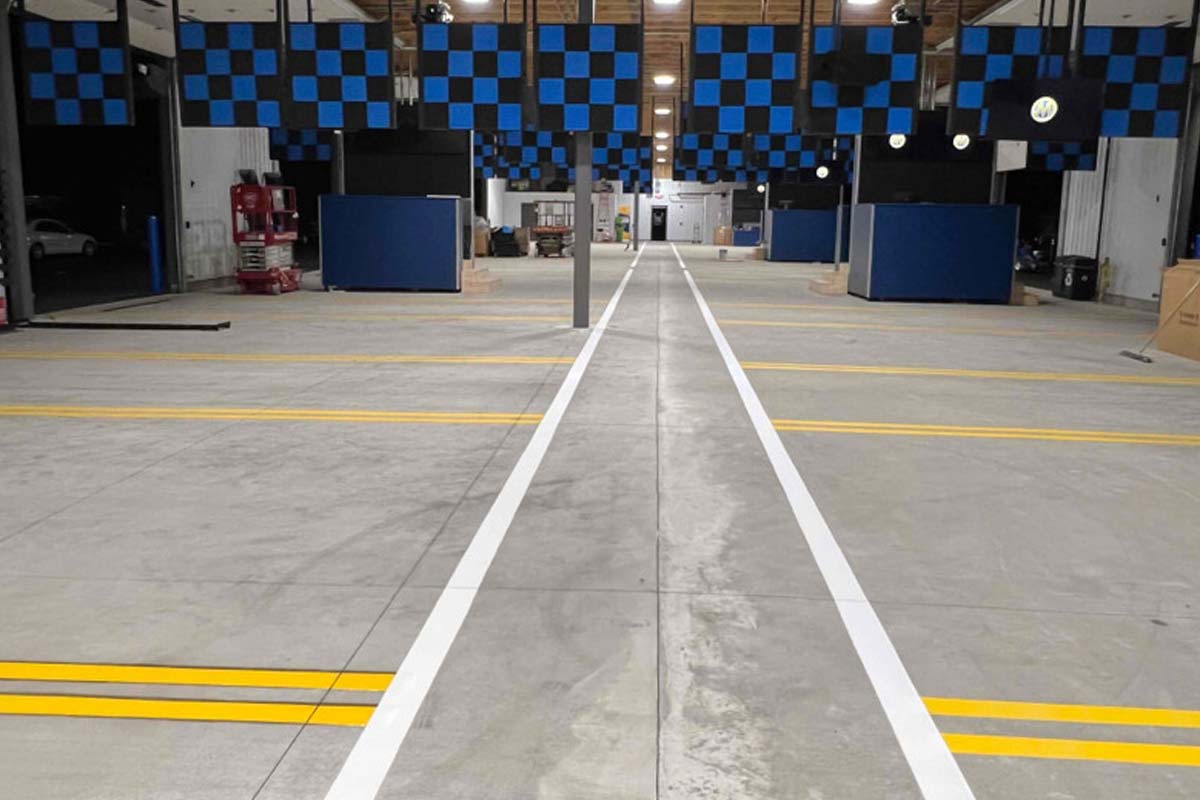
1-800-STRIPER provides professional warehouse line painting in North Atlanta, GA — OSHA-compliant aisle lines, pedestrian walkways, forklift travel paths, and safety-zone markings per OSHA 1910.22 and ANSI Z535.1 color standards using durable epoxy and traffic paint for industrial facilities.
1-800-STRIPER® of Atlanta OTP North PROVIDes Warehouse Floor Markings Services NEAR YOU
Want your indoor space to operate more efficiently?
Warehouse and interior markings ensure clear traffic lanes, organized storage zones, and designated spaces designed to help your business operate safely and efficiently.
Benefits:
OSHA 1910.22 Requirements for Warehouse Floor Markings
The federal floor-marking baseline in industrial facilities sits in OSHA 29 CFR 1910.22 — the general housekeeping standard. Subsection (a) requires that all places of employment, passageways, storerooms, service rooms, and walking-working surfaces be kept clean, orderly, and in a sanitary condition. Subsection (b) specifically requires that aisles and passageways be kept clear and in good repair, with no obstruction across or in aisles, and that permanent aisles and passageways be appropriately marked.
The standard doesn’t prescribe specific colors or line widths — those come from ANSI standards layered on top. What OSHA requires is that the markings exist, that they’re clearly visible, and that they distinguish aisles, walkways, and hazard zones from general production floor areas. OSHA inspections check for unmarked aisles, faded markings, and inconsistent boundaries — three of the most common citations in facility audits.
ANSI Z535.1 Color Code System
ANSI Z535.1 standardizes safety color use in industrial environments. The five primary colors and their meanings:
| Color | Meaning | Common warehouse use |
|---|---|---|
| Red | Fire equipment, danger, emergency stops | Fire-hydrant access zones, emergency-stop button perimeters, danger boundaries |
| Yellow | Caution, physical hazards | Aisle borders, forklift travel paths, low-overhead-clearance zones, trip hazards |
| Green | Safety equipment, first aid | First-aid station perimeters, AED locations, eyewash/safety-shower zones |
| Blue | Information, equipment status | Inspection-required zones, equipment-status indicators |
| White | Boundaries, traffic, housekeeping | Pedestrian walkways, equipment storage outlines, general boundaries |
Orange (warning of dangerous parts of machines) and purple (radiation hazards) round out the secondary set per Z535.1. In typical North Atlanta warehouse work, yellow, white, and red carry roughly 80% of the markings; blue and green handle specific safety-equipment perimeters.
Aisle Width Standards by Forklift Class
Aisle widths aren’t dictated by OSHA directly but are driven by the forklift class operating in the aisle. The Industrial Truck Association classifies lift trucks by power source, rider position, and lift capacity. Aisle width matches the truck’s turning radius plus a safety margin.
| Forklift class | Typical aisle width |
|---|---|
| Counterbalanced (Class 1, 4, 5) | 12 to 13 feet |
| Reach truck (Class 2) | 8 to 10 feet |
| Narrow-aisle / turret (Class 2 specialized) | 5 to 7 feet |
| Order picker / very narrow aisle | 5 to 6 feet |
| Pallet jack / pedestrian walkway | 4 feet minimum |
Standard markings: 4-inch yellow line at each side of the aisle, continuous along the full length. Where the aisle intersects a pedestrian walkway, the walkway boundary continues across the aisle in white paint while the yellow aisle borders break at the crossing.
Pedestrian Walkway Markings
Pedestrian walkways in warehouses get white paint per ANSI Z535.1 convention — 4-inch wide lines defining the walkway boundary, with sufficient width inside the lines to allow two-way pedestrian movement (typically 4 feet minimum). At forklift-aisle crossings, the walkway gets pedestrian-crossing markings (similar to a road crosswalk pattern in white) so both lift-truck operators and pedestrians can see the intersection.
Walkway-to-aisle crossings are the highest-citation zones in warehouse safety audits. The markings need to be both clearly visible and laid out at predictable intersection points; pedestrian-direction arrows along the walkway help reinforce the intended flow.
Forklift Travel Path Markings
Forklift routes get yellow paint per ANSI Z535.1. The width is the operating aisle width set in H2 3, with 4-inch yellow lines at each side. Where forklifts share a multi-use area (loading dock approach, staging zone), the travel path stays yellow but adds yellow diagonal hatching inside the boundaries to indicate caution-zone status.
One-way travel directions get yellow directional arrows along the path. Two-way travel gets center-line dashed yellow striping similar to roadway lane marking.
Safety Zone and Hazard Markings
Specific hazards inside the warehouse get color-coded perimeters:
Yellow-and-black striped hazard borders mark physical hazards — low-overhead-clearance zones, edges of loading docks, pit perimeters, machine operating zones. The diagonal striping pattern at 45° is the universal “caution” visual cue.
Red perimeters mark fire equipment — fire-hydrant access, fire-extinguisher locations, sprinkler-control valves, emergency-stop button zones. Red also marks the line where pedestrians may not cross during equipment operation.
Green perimeters mark first-aid stations, AED locations, eyewash and safety-shower equipment. Sized to the equipment plus a 2-to-3-foot clear-access zone.
Equipment Storage and Staging Zones
Permanent equipment storage gets white outline marking — a “footprint” on the floor showing where each piece of equipment belongs. Common applications: pallet-jack parking, forklift-charging stations, dock-plate storage, equipment-staging carts. The footprint approach makes missing-equipment status visible at a glance and helps maintain housekeeping standards during OSHA audits.
Temporary staging zones get yellow corner markings or full perimeter outlines depending on duration. Outbound-shipping staging, inbound-receiving staging, and quality-hold zones are the most common temporary-staging markings.
Loading Dock and Bay Markings
Loading docks get a specific marking package because of the multiple-traffic-type conflict (forklift, pedestrian, delivery driver, equipment) and the fall-hazard risk at the dock edge.
Dock-edge red striping marks the fall hazard — 4-inch red lines along the open edge of any elevated dock, with diagonal hatching where pedestrians must be excluded during loading.
Approach lane markings for inbound forklift traffic to the dock — yellow lane lines aligning the forklift to the dock-leveler or dock-plate position.
Driver-stand-back zones during loading — yellow-and-black hatched areas where the truck driver must wait clear of the active loading operation.
Numbered bay identifiers — large painted numbers (1 ft tall typical) inside each loading bay so drivers and forklift operators can match dock assignments to dispatch paperwork.
Paint Selection: Epoxy vs Traffic Paint
Two paint chemistries cover the bulk of warehouse line work, and the choice between them comes down to traffic intensity and surface condition.
Epoxy-based industrial floor paint is the heavy-duty answer — two-part epoxy resin applied at 8 to 12 mil thickness, fully cured in 24 to 48 hours, service life 3 to 5 years under continuous forklift traffic. Best on properly prepared concrete (shot-blasted or diamond-ground to expose the porous concrete surface). The downside: longer dry time and surface-prep cost.
Traffic paint (alkyd or acrylic-modified) is the lighter-duty answer — single-component, dries in 60 to 90 minutes, service life 12 to 24 months. Best on sealed concrete or in light-traffic warehouse zones where the heavier epoxy isn’t justified. The advantage: fast return-to-service.
Most modern North Atlanta warehouses run a hybrid: epoxy on the heavy-traffic primary aisles and forklift travel paths; traffic paint on pedestrian walkways and lower-traffic zones; thermoplastic on the very highest-traffic dock approach lanes.
Surface Prep Before Application
Concrete surface prep is the single most important factor in line-paint service life. Three prep methods cover most situations.
Shot-blasting uses steel-shot media propelled at the concrete surface to remove laitance (the smooth, weak top layer of cured concrete) and expose the porous structure underneath. Industry standard for new epoxy installations on green-poured concrete.
Diamond-grinding uses rotating abrasive discs to mechanically abrade the surface. Slightly less aggressive than shot-blasting but cleaner — no media to clean up afterward. Common for retrofit work over older concrete.
Degreasing + pressure-wash is the lighter prep for traffic-paint work on already-sealed or already-painted concrete surfaces. Hot-water pressure washing with industrial degreaser removes oil and tire-rubber film without disturbing intact existing coatings.
Resurfacing Existing Worn Markings
A warehouse re-stripe usually combines several distinct interventions: cleaning oil contamination from heavy-use aisles, removing failing epoxy patches, re-marking the entire facility to current OSHA / ANSI standards, and updating to any changed traffic patterns or equipment-storage layouts since the last marking job.
We typically phase the work zone by zone — one aisle out-of-service at a time, with the warehouse continuing operations in the rest of the facility. Fast-cure epoxy formulations open back to forklift traffic in 4 to 8 hours; traffic-paint zones open in 60 to 90 minutes. Total facility-wide re-marking on a 100,000-square-foot warehouse typically runs 3 to 5 working days when phased across non-operational hours.
For a full list of our pavement marking services, visit our parking lot striping in North Atlanta page.
Businesses We Serve




How it Works

GET A FREE ESTIMATE
Contact us today and we’ll have a quote to you in 24 hours

SCHEDULE A STRIPING
We’ll have your space restriped in less than 7 days, without affecting your business hours

GET A PARKING LOT THAT POPS
For a budget-friendly price, you’ll get a parking lot that looks like new
We proudly work with:


We proudly work with:


Frequently Asked Questions About Warehouse Line Painting in North Atlanta, GA
What kind of paint is used on warehouse floors?
Two paint families cover most warehouse line work: epoxy-based industrial floor paint for high-traffic aisles and forklift travel paths (3-to-5-year service life), and alkyd or acrylic-modified traffic paint for pedestrian walkways and lighter-traffic zones (12-to-24-month service life). Color follows ANSI Z535.1 — yellow for aisles and caution, white for walkways, red for fire equipment, green for first aid.
What is the OSHA marking color code for warehouse aisles?
Color use in warehouses follows ANSI Z535.1, which OSHA recognizes through 1910.22 (general housekeeping). Yellow marks aisles, caution zones, and physical-hazard borders. White marks pedestrian walkways and equipment-storage boundaries. Red marks fire-equipment access, emergency-stop zones, and danger borders. Green marks first-aid stations and safety equipment. Blue marks information and equipment status.
How wide should warehouse forklift aisles be marked?
Aisle width is set by the forklift class operating in the aisle, not by OSHA directly. Counterbalanced lift trucks need 12 to 13 feet; reach trucks need 8 to 10 feet; narrow-aisle and turret trucks operate in 5 to 7 feet. The aisle marking is a 4-inch yellow line at each side, continuous along the full aisle length, with breaks at pedestrian-walkway crossings.
Can you re-stripe a warehouse floor without closing operations?
Yes — phased section work is the standard approach. One aisle out-of-service at a time while the rest of the facility continues running. Fast-cure epoxy opens to forklift traffic in 4 to 8 hours; traffic paint opens in 60 to 90 minutes. We schedule the work around shift patterns and dispatch operations to minimize disruption.
How long does warehouse floor striping last?
Epoxy-based industrial floor paint in heavy-traffic aisles holds 3 to 5 years. Traffic paint in pedestrian and light-traffic zones holds 12 to 24 months. The cycle is driven by traffic count and equipment weight — high-volume distribution centers re-stripe heavy aisles every 18 to 36 months; lighter manufacturing or storage facilities stretch toward the 5-year end of the range.
What surface prep is needed before warehouse line painting?
Concrete surface prep determines service life. Shot-blasting opens new concrete for epoxy installation (industry standard for new-build epoxy). Diamond-grinding handles retrofit work over older concrete. Degreasing plus hot-water pressure washing is the lighter prep for traffic-paint work on sealed surfaces. Skipping prep is the most common reason a warehouse line job lifts within months instead of holding for years.