
Bollard Installation
In North Atlanta, GA
Safety and Security Bollards
1-800-STRIPER provides professional bollard installation in North Atlanta, GA — steel, concrete-filled, and bolt-down bollards protecting storefronts, fuel pumps, and pedestrian zones per ASTM F3016 (vehicle-impact resistance) and ASTM F2656 (crash-rated security) across Cobb, Cherokee, Fulton, Forsyth, Gwinnett, and DeKalb counties.
1-800-STRIPER® of Atlanta OTP North PROVIDes Bollard Installation Services NEAR YOU
Want to prevent accidents and protect your property?
Bollards provide physical protection for your customers and your property.
Safety and security:
Bollards create a physical barrier between vehicles and pedestrians, protecting people in walking areas from accidental or intentional vehicle intrusions.
Bollards act as a protective barrier around storefronts, gas stations, and other vulnerable areas, minimizing the risk of costly damage from vehicle impacts.
Strategic Placement Locations:
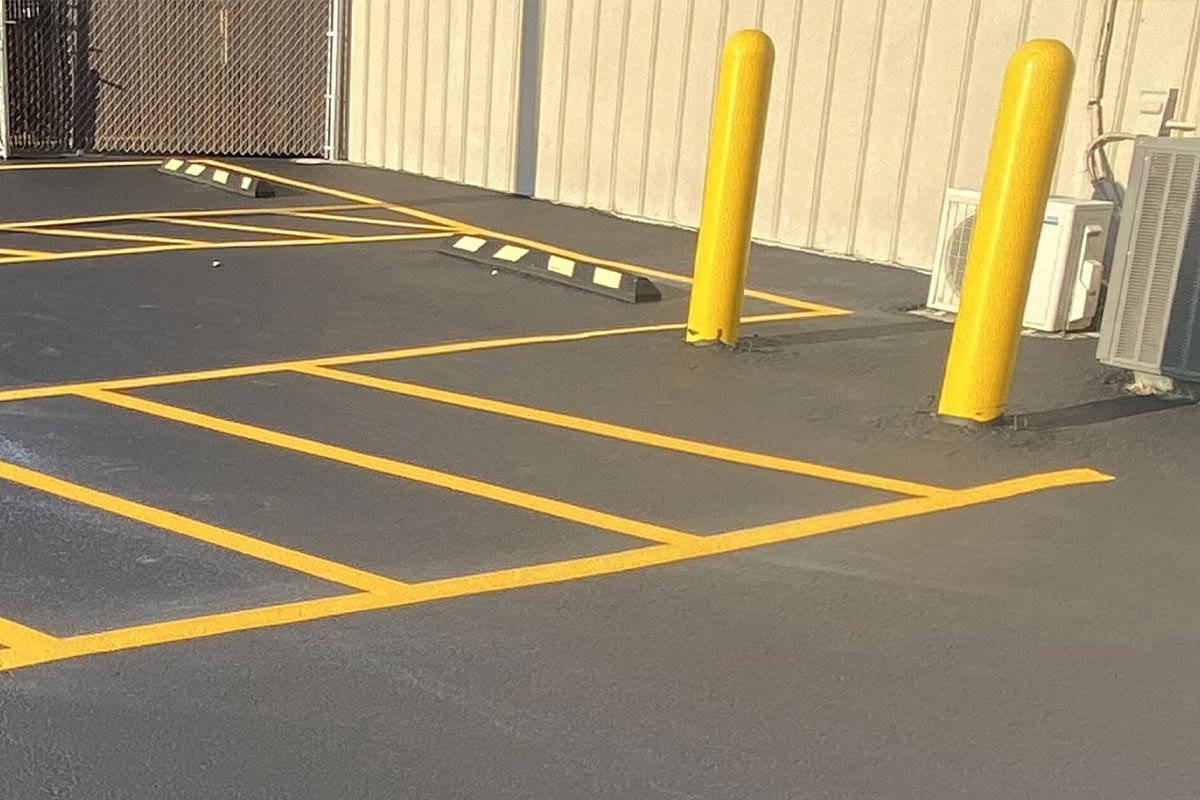
Bollard Types We Install
Bollards fall into three working families based on what they’re protecting against: low-speed accidental impact, deliberate vehicle attack, and pedestrian/traffic guidance. We install all three across North Atlanta commercial properties.
Steel pipe bollards (concrete-filled) are the workhorse. A typical commercial steel bollard is 6-inch diameter Schedule 40 or 80 pipe, 36 to 48 inches above grade, set in a 24- to 36-inch-deep concrete footing and filled with high-strength concrete. They handle accidental impacts up to roughly 15 mph from a passenger vehicle without permanent deformation — the standard protection scope at fuel pumps, drive-through corners, ATM enclosures, and storefront entries.
ASTM F2656 crash-rated bollards are a different family entirely. F2656 is the federal standard for vehicle-impact security barriers — the rating describes the test vehicle weight, speed, and post-impact vehicle penetration. K-ratings (K4, K8, K12) translate to deliberate-attack stopping power. We install F2656-rated bollards on government, financial, and high-security retail properties where the threat model goes beyond accidental impact.
Bolt-down and removable bollards are the third family. Bolt-down units attach to existing concrete via 4 to 6 anchor bolts and serve where a footing isn’t feasible (over a utility line, a tenant-improvement decision, or a fast-deployment scope). Removable units use a sleeve-and-cap system so a single bollard can come out for service access and lock back in afterward.
ASTM F3016 vs F2656 — Which Spec for Which Use
The two ASTM specifications that govern commercial bollards cover different threat models, and choosing between them is the most common pre-install question we hear from facility owners.
ASTM F3016 is the standard for vehicle-impact resistance at parking-and-loading speeds — typically 10 to 30 mph. It assigns S-ratings (S10, S20, S30) for passenger-vehicle impact and M-ratings (M30, M40, M50) for medium-duty truck impact. F3016 bollards are the right choice when the protected target is in a low-speed environment (parking lot perimeter, drive-through aisle, fuel pump island, sidewalk-vehicle conflict zone) and the threat is accidental rather than deliberate.
ASTM F2656 is the standard for security barriers against deliberate vehicle attack. K-ratings describe the test vehicle (passenger car, light truck, heavy truck) at high speed (30, 40, or 50 mph) with measured post-impact penetration. F2656 bollards are the right choice for government buildings, federal facilities, financial institutions, and high-value retail where the design basis threat includes deliberate ramming.
Most commercial properties in North Atlanta need F3016 protection — accidental low-speed impact at storefronts, fuel pumps, and parking-lot perimeter conditions. F2656 enters the conversation only when the threat profile justifies the considerably higher installation cost and engineering scope.
Installation Depth, Setting, and Anchoring
A steel pipe bollard installed for accidental-impact protection follows a consistent specification across commercial work. The pipe itself is typically 6-inch nominal diameter, Schedule 40 (0.280-inch wall) or Schedule 80 (0.432-inch wall) for higher-impact zones, galvanized or shop-primed-and-painted to a safety yellow or color-matched finish. Length depends on above-grade height (36 to 48 inches is standard) plus below-grade depth (24 to 36 inches).
The footing is a core-drilled or excavated hole 12 to 18 inches in diameter, filled with high-strength concrete (4,000 psi minimum) keyed into the surrounding pavement structure. The bollard sits centered in the wet concrete and braces vertical until cure. Concrete-fill inside the pipe goes in after the footing sets, giving the bollard internal mass that absorbs and distributes impact energy.
Bolt-down bollards skip the footing entirely. Four to six structural anchor bolts (typically ⅝-inch diameter, 6 to 8 inches embedment) bolt the base plate to existing concrete. Bolt-down installs are faster but rated for lower impact energy than embedded-footing installs — appropriate for guidance and low-speed protection, not for primary security applications.
Common Use Cases Across North Atlanta
The most common bollard install requests we field across the six-county OTP North area fall into a small number of repeating use cases:
Storefront protection at the front of retail entrances — typically two to four bollards arranged in front of the door to stop a vehicle from accidentally crossing the curb and entering the building. Common at grocery, pharmacy, big-box, and strip-center anchor tenants.
Fuel-pump islands at gas stations and fleet-fueling sites — four to six bollards surrounding each pump island to prevent vehicle drift into the pump or hose reel. Industry standard for new pump-island construction; common retrofit ask on aging stations.
Drive-through and pedestrian-vehicle conflict zones — single or paired bollards at corners where a drive-through lane passes near a pedestrian walkway or queue area. Common at QSR, coffee, banking, and pharmacy drive-through properties.
Loading-dock and equipment protection — bollards around HVAC compressors, electrical transformers, gas meters, and dumpster enclosures. Often required by the utility provider or the property’s insurance underwriter.
Trafficc guidance at parking lot entrances — bollards channeling traffic through a specific approach to a guard shack or access-control point. Common at gated apartment, medical campus, and corporate properties.
Color, Visibility, and Cover Options
Steel pipe bollards leave the shop primed and either powder-coated or wet-painted in a finish color. The default in commercial work is OSHA safety yellow for visibility, but custom colors are routinely matched to building exterior paint, brand standards, or wayfinding schemes. UV-stable two-coat polyurethane finishes hold color for 7 to 10 years under direct Georgia sun before refresh.
Decorative bollard covers add a second layer over the structural pipe — molded plastic, cast aluminum, or composite shells in finishes that range from brushed metal to faux-stone. The cover slips over the installed pipe and conceals the structural bollard while keeping the protective function intact. Common on hospitality, mixed-use, and street-front retail properties where the safety yellow standard doesn’t match the building aesthetic.
For a full list of our pavement marking services, visit our parking lot striping in North Atlanta page.
Businesses We Serve




How it Works

GET A FREE ESTIMATE
Contact us today and we’ll have a quote to you in 24 hours

SCHEDULE AN INSTALLATION
We’ll have your installation scheduled in less than 7 days, without affecting your business hours

GET A PARKING LOT THAT POPS
For a budget-friendly price, you’ll get a parking lot that looks like new
We proudly work with:


We proudly work with:


Frequently Asked Questions About Bollard Installation in North Atlanta, GA
What’s the difference between ASTM F3016 and ASTM F2656?
F3016 covers vehicle-impact resistance at parking and loading-zone speeds (10–30 mph, accidental impact). F2656 covers security barriers against deliberate vehicle attack at high speeds (30–50 mph) — government, federal, financial security applications. Most commercial bollard installs target F3016; F2656 is reserved for design-basis-threat sites.
How deep does a bollard need to be set?
Standard embedded-footing bollards in commercial parking applications sit in a 24- to 36-inch-deep concrete footing, with the pipe itself extending into that footing depth and 36 to 48 inches above grade. Bolt-down bollards skip the footing and anchor with 4 to 6 structural bolts at 6- to 8-inch embedment into existing concrete.
What’s a typical steel bollard size?
6-inch nominal diameter pipe at Schedule 40 wall thickness, 36 to 48 inches above-grade height, concrete-filled, set in a 24-to 36-inch footing. That’s the standard spec across most commercial install requests in North Atlanta. Heavier-duty work goes to Schedule 80 wall thickness; decorative work goes to 4-inch diameter where impact protection is secondary.
Can bollards be removed for service access?
Yes — removable bollards use a sleeve-and-cap system. A concrete-set steel sleeve goes in the pavement; the bollard itself locks into the sleeve via a padlock or key cylinder. Lift out for service vehicle access; lock back in afterward. Common at gated entrances, utility easements, and fire-department-access-required perimeter conditions.
What color are bollards typically painted?
OSHA safety yellow is the default in commercial work for maximum visibility against pavement and vehicle backgrounds. Custom colors matching building paint or brand standards are routinely available — Georgia sun fades UV-unstable paints within 3 to 5 years, so we spec two-coat polyurethane or powder-coat finishes that hold color 7 to 10 years.
Are bollards required by code?
Code requirements vary by jurisdiction and use. The 2010 ADA Standards don’t require bollards directly. The International Building Code requires impact protection in certain conditions (front of pump islands, near gas-meter banks, on emergency-access points). Utility providers and property-insurance underwriters frequently require bollards around equipment they own or insure. Many commercial bollard installs are property-protection or insurance-risk-reduction decisions rather than code-mandated.