Thermoplastic Striping
In North Atlanta, GA
Long-Lasting Pavement Markings
1-800-STRIPER provides professional thermoplastic striping in North Atlanta, GA — long-service-life pavement markings for stop bars, crosswalks, directional arrows, and fire lanes applied at roughly 400°F per AASHTO M249 specifications and MUTCD for high-traffic commercial lots across the OTP North six-county area.
1-800-STRIPER® of Atlanta OTP North PROVIDes Thermoplastics Services NEAR YOU
Want to reduce the maintenance requirements for your parking lot?
Thermoplastic pavement markings are a durable, weather and vehicle-resistant striping option for your parking lot or facility.
You can utilize them for stop bars, ADA stalls, no-parking zones, directional arrows, crosswalks, or your entire parking lot.
Benefits:
Thermoplastic vs Paint — When Each Wins in North Atlanta
Two pavement-marking materials cover essentially all commercial line work: hot-applied thermoplastic and water-based traffic paint. They’re not interchangeable, and the choice between them comes down to traffic volume, expected service life, and return-to-traffic urgency.
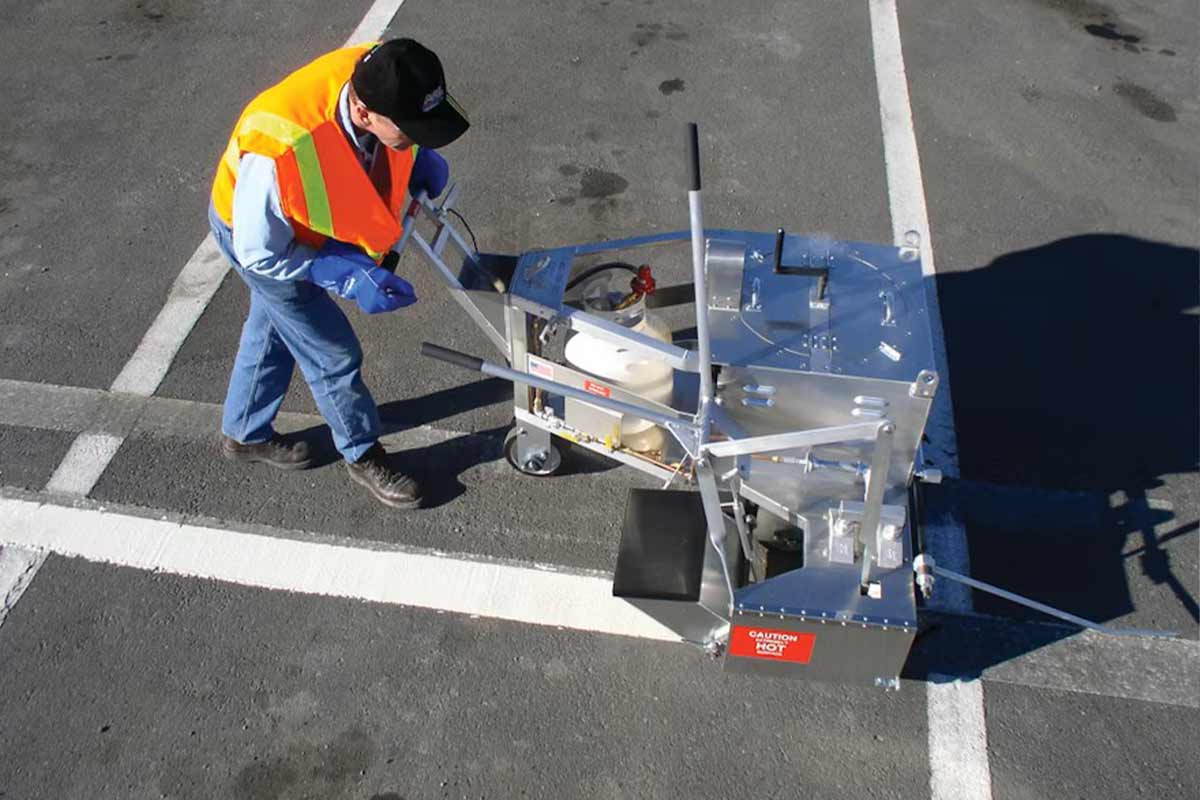
Thermoplastic is a heat-applied resin material extruded at roughly 400°F and bonded directly to the asphalt or primed-concrete surface. Once cooled (about 10 minutes), it’s fully cured and open to traffic. Service life in high-traffic commercial conditions runs 3 to 8 years depending on traffic count, surface temperature exposure, and snow-removal frequency (negligible factor in metro Atlanta). The material itself contains glass beads embedded throughout the resin matrix, giving the marking both initial retroreflectivity and continuing retroreflectivity as the surface wears.
Water-based traffic paint (the Sherwin-Williams Fast-Dry family is industry-standard) is sprayed at ambient temperature, dries in 30 to 60 minutes, and serves for 12 to 24 months under typical commercial-lot traffic. Paint is the right answer for restripes, ADA refresh, fast turnarounds, and lots where return-to-service in under an hour matters.
The decision: thermoplastic for stop bars, crosswalks, directional arrows, and fire-lane elements that need durability and don’t refresh annually. Paint for stall lines, ADA elements, and most full-lot restripes.
AASHTO M249 Specs and Application Process
AASHTO M249 is the federal-spec standard for thermoplastic pavement-marking material. It sets resin composition, glass-bead specification, color, and performance requirements. GDOT Standard Specifications Section 653 references M249 and adds Georgia-specific application requirements for state-funded projects; private commercial work typically follows M249 directly.
Application starts with surface prep — sweep, pressure-wash if oily, and confirm the asphalt or concrete is structurally sound. On concrete surfaces, an epoxy primer goes down first to give the thermoplastic something to bond to (raw concrete is too smooth for direct adhesion). The thermoplastic itself heats to 400°F in a melting kettle on the application truck, then extrudes through a heated nozzle to a 90 to 125 mil (roughly ⅛-inch) thickness on the pavement. Glass beads broadcast onto the still-molten surface boost initial retroreflectivity.
Open-to-traffic time after cooling is about 10 minutes — the fast-return-to-service feature that makes thermoplastic the right answer on busy commercial sites where overnight closures aren’t an option for every line element.
For a full list of our pavement marking services, visit our parking lot striping in North Atlanta page.
Businesses We Serve




How it Works

GET A FREE ESTIMATE
Contact us today and we’ll have a quote to you in 24 hours

SCHEDULE AN INSTALLATION
We’ll have your installation scheduled restriped in less than 7 days, without affecting your business hours

GET A PARKING LOT THAT POPS
For a budget-friendly price, you’ll get a parking lot that looks like new
We proudly work with:


We proudly work with:

Frequently Asked Questions About Thermoplastic Striping in North Atlanta, GA
How long does thermoplastic striping last?
Typical service life in high-traffic commercial conditions is 3 to 8 years depending on traffic count, vehicle weight profile (passenger vs delivery), surface temperature exposure, and direct sun exposure. Stop bars and crosswalks at busy entries see the faster end of that range; less-traveled directional arrows and lane markings see the longer end. Compare against 12 to 24 months for water-based paint.
What are the disadvantages of thermoplastic paint?
Higher upfront cost than water-based paint (typically 2 to 4× per linear foot). Requires asphalt surface temperature above 50°F for proper bond. Doesn’t bond directly to concrete without an epoxy primer first. Equipment investment is heavier (heated kettle truck vs simple airless striper). Not the right choice for full-lot restripes or fast-cycle ADA refresh — better for specific high-durability elements.
How long does thermoplastic take to dry?
Open-to-traffic in about 10 minutes after application — the thermoplastic cools and fully cures as it returns to ambient temperature. That fast-return-to-service is one of the material’s main advantages over water-based paint (30 to 60 minutes minimum) on busy commercial sites.
What’s the difference between thermoplastic and water-based striping?
Application method (heated extrusion at 400°F vs ambient sprayed paint). Service life (3 to 8 years vs 12 to 24 months). Initial cost (higher for thermoplastic, lower for paint). Glass-bead retroreflectivity (embedded throughout thermoplastic, surface-only on paint). Return-to-traffic time (10 minutes vs 30 to 60 minutes). Thermoplastic suits durability-critical elements; paint suits speed and most lot-wide work.
Does thermoplastic work on concrete?
Yes with an epoxy primer applied first. Raw concrete surfaces are too smooth for direct thermoplastic adhesion; the primer creates an interface that the thermoplastic adheres to during the hot application. Without the primer, thermoplastic will lift and delaminate from concrete within months. Most thermoplastic specs in commercial work assume asphalt; concrete adds the primer step.
Can existing painted lines be overstriped with thermoplastic?
Yes if the existing paint is sound and well-adhered; the thermoplastic flows over the paint and adheres to both the paint and the surrounding pavement. If the existing paint is failing, peeling, or chalky, remove it first by waterblasting or grinding before applying thermoplastic. Removing failing paint costs less than re-doing a delaminated thermoplastic install.