
Bollard Installation
In Salt Lake City, UT
Safety and Security Bollards
1-800-STRIPER provides professional bollard installation in Salt Lake City, UT — setting protective posts at storefronts, utility cabinets, and pedestrian corners, including units tested to the low-speed vehicle-impact method published as ASTM F3016 for commercial properties across the Wasatch Front.
1-800-STRIPER® of Salt Lake City PROVIDes Bollard Installation Services NEAR YOU
Want to prevent accidents and protect your property?
Bollards provide physical protection for your customers and your property.
Safety and security:
Bollards create a physical barrier between vehicles and pedestrians, protecting people in walking areas from accidental or intentional vehicle intrusions.
Bollards act as a protective barrier around storefronts, gas stations, and other vulnerable areas, minimizing the risk of costly damage from vehicle impacts.
Strategic Placement Locations:
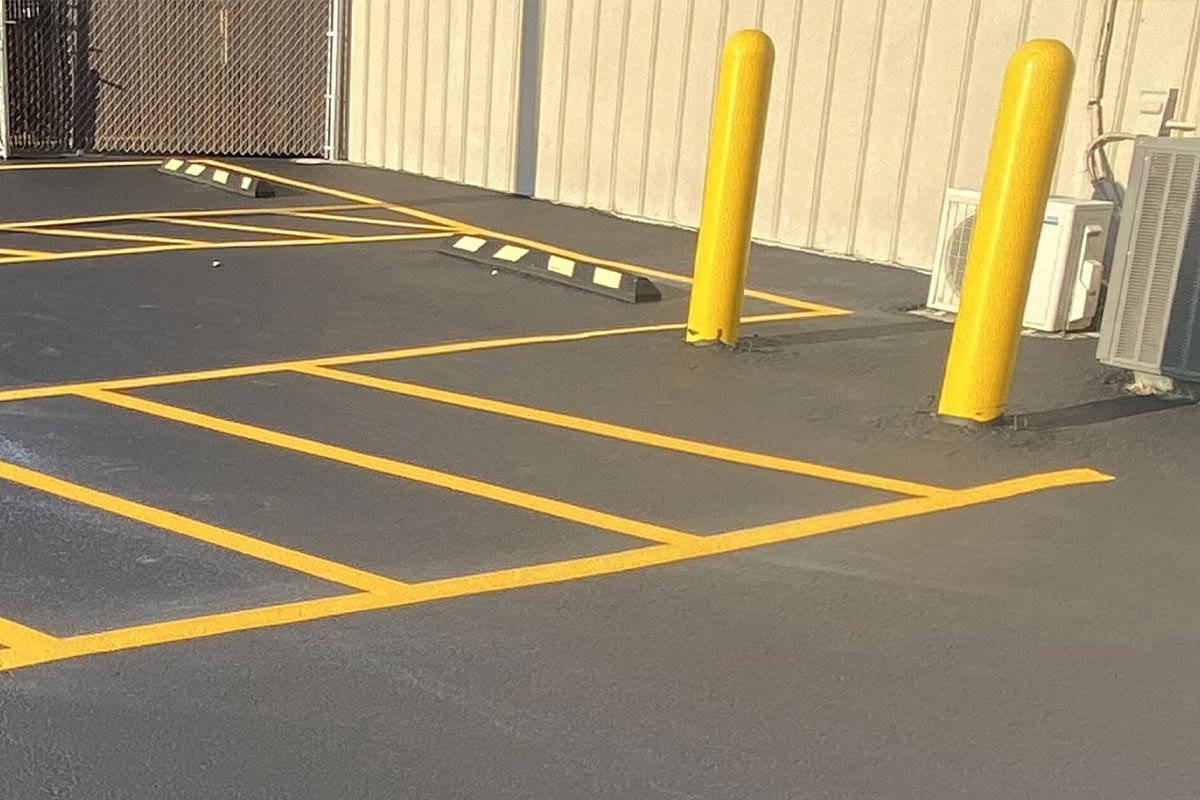
Bollard Installation in Salt Lake City, UT
A bollard is a post that exists to be hit, or more precisely to make being hit survivable for whatever is behind it. On a commercial lot that is usually a storefront, a set of glass doors, a gas or electrical meter, a utility cabinet, a propane cage, an ATM, or the corner where pedestrians step off a walkway into a drive aisle. Low-speed vehicle impacts in parking lots are common and rarely dramatic. A foot slips, a vehicle in reverse finds a pedal, and the cost lands on whatever the vehicle reached.
There is a standard worth naming here, and worth naming precisely, because it is routinely misdescribed. ASTM F3016/F3016M is the Standard Test Method for Surrogate Testing of Vehicle Impact Protective Devices at Low Speeds. Read the title: it is a test method, not a rating. It describes how you test a device at low speed, which is exactly the regime a parking lot operates in.
That makes it a different thing from the high-speed anti-ram ratings people conflate it with — those describe stopping a vehicle at speed, which is a perimeter-security problem, not a storefront-protection one. If your concern is a car at parking-lot speed reaching your entrance, low-speed impact testing is the relevant regime. If your concern is deliberate vehicle attack, that is a different specification and a different conversation.
The standard is paywalled and only its designation and full title were retrieved, so nothing about its internal content, thresholds, or pass criteria is published here. We name what it is. We do not characterize what it says.
Fixed, Removable, and Impact-Rated Options
Fixed bollards are set permanently, either embedded directly in a footing or dropped into a cast sleeve. They are the default for protecting a fixed asset: a storefront, a cabinet, a corner.
Removable bollards sit in a below-grade sleeve with a lock, so they can be lifted out. Use them where you sometimes need the vehicle access you are otherwise blocking: a fire lane a jurisdiction wants closed to routine traffic but open to apparatus, a delivery route used twice a week, an event entrance.
Sleeved versus embedded is the choice people ask about most. A directly-embedded post is stronger and cheaper to install. A sleeved post can be replaced without breaking up the surrounding surface, and since a bollard’s job is to be struck, the one that can be swapped after an impact without a concrete saw pays for itself the first time it is hit.
Covers are the cosmetic and maintenance layer: a plastic sleeve over a steel post that keeps the installation looking maintained without repainting, and takes the scuffs instead of the post.
Installation Sequence
- Layout — mark positions against what is being protected and against the vehicle paths that actually reach it, not just the ones on the drawing.
- Core — cut through the surface at each position.
- Excavate — dig the footing. Depth is governed by local frost depth, which your jurisdiction’s building department publishes; a footing that stops above it will heave.
- Set — place the post or sleeve, plumb it, and confirm alignment across the run before anything cures.
- Backfill and pour — concrete the footing and restore the surface.
- Cap or cover — fit the cap, sleeve, or cover, and mark for visibility.
For a full list of our pavement marking services, visit our parking lot striping in Salt Lake City page.
Businesses We Serve




How it Works

GET A FREE ESTIMATE
Contact us today and we’ll have a quote to you in 24 hours

SCHEDULE AN INSTALLATION
We’ll have your installation scheduled in less than 7 days, without affecting your business hours

GET A PARKING LOT THAT POPS
For a budget-friendly price, you’ll get a parking lot that looks like new
We proudly work with:


We proudly work with:


Frequently Asked Questions About Bollard Installation in Salt Lake City
Fixed or removable?
Fixed, unless you have a specific reason to want the access back. Fixed posts are stronger, simpler, cheaper. Removable ones earn their cost where access is genuinely intermittent: an apparatus route, a scheduled delivery lane, an event entrance.
What does ASTM F3016 actually tell me?
That a device was tested under a published method for low-speed vehicle impact — the regime a parking lot actually operates in. It is a test method rather than a rating, which is the distinction that matters when comparing products: it describes how testing is done, not a grade a product earns. It is also a different thing from the high-speed anti-ram ratings used for perimeter security against deliberate attack. For storefront and equipment protection, low speed is the relevant regime. We will not characterize the standard’s internal thresholds, because it is paywalled and we have not read it.
How deep does the footing need to be?
Deep enough to sit below the local frost line, which is the number that matters in this climate. A footing that stops short of it will heave with the freeze-thaw cycle, and a heaved bollard is loose, out of plumb, and no longer doing its job. The applicable depth is published by your jurisdiction’s building department rather than being a single statewide figure, and we confirm it for your address before excavating rather than applying a default.
Will bollards actually protect my storefront?
Against the thing that usually happens, yes. The common parking-lot incident is a low-speed impact: a vehicle in the wrong gear, a pedal mistake, a slip while parking. A properly footed bollard between the stall and the glass turns a storefront repair into a scuffed post. What bollards do not do is stop a vehicle at road speed, which is a different specification entirely. Placement matters as much as the post does, because a bollard sitting outside the path a vehicle would actually take is decorative.
Sleeve or embed?
Embed if the post is unlikely to be struck and you want maximum strength for the money. Sleeve it if it sits somewhere with real impact exposure. The logic is simple. A bollard exists to be hit, and a struck post often needs replacing. Embedded means breaking up the surface to change it. Sleeved lifts out.
How far apart should they go?
Close enough that a vehicle cannot pass between them, and far enough apart that people, carts, and wheelchairs can. Those two constraints set the range, and where an accessible route passes through a bollard line the pedestrian clearance is the binding one — the gap has to remain a usable route. Spacing is driven by what you are protecting and what has to pass through, so we set it on site rather than by a rule of thumb.
Do the covers need maintaining?
That is largely their point. A plastic sleeve over a steel post takes the scuffs, road salt, and UV that would otherwise put the post on a repainting cycle, and when it looks tired you swap it rather than refinish it.
Can existing bollards be repainted instead of replaced?
Usually, yes, and it is worth doing before they look bad rather than after. Repainting is straightforward on a sound post — the failure that forces replacement is structural, meaning a post that has been struck hard enough to bend or loosen in its footing, not one that has faded. A loose post is the one to act on: if it moves when pushed, its footing has failed and paint will not fix it.