Parking Lot Pressure Washing
In SW Houston, TX
Surface Prep Before Restriping
1-800-STRIPER provides professional parking lot pressure washing in SW Houston, TX — power washing pavement, lifting oil staining and tire marks, and preparing surfaces before restriping, with wash water contained so it does not enter the storm sewer system.
1-800-STRIPER of SW Houston PROVIDes Parking Lot Pressure Washing Services NEAR YOU
Need to blast away years of grime?
If your parking lot or parking garage looks dull and dirty, our professional crew can wash away grime, oil, stains, and slippery buildup to restore the appearance of your property.
Benefits:
Parking Lot Pressure Washing in SW Houston, TX
A commercial lot on the Gulf Coast collects more than dirt. Heat softens asphalt binder and pulls it to the surface, summer storms leave silt in every low spot, and shade from live oaks and pines feeds algae along curb lines and in drainage swales. Add the oil drips that gather under every parking stall and the black scuffing that builds where cars turn hard at aisle ends, and a lot that was clean two seasons ago now reads as neglected from the street.
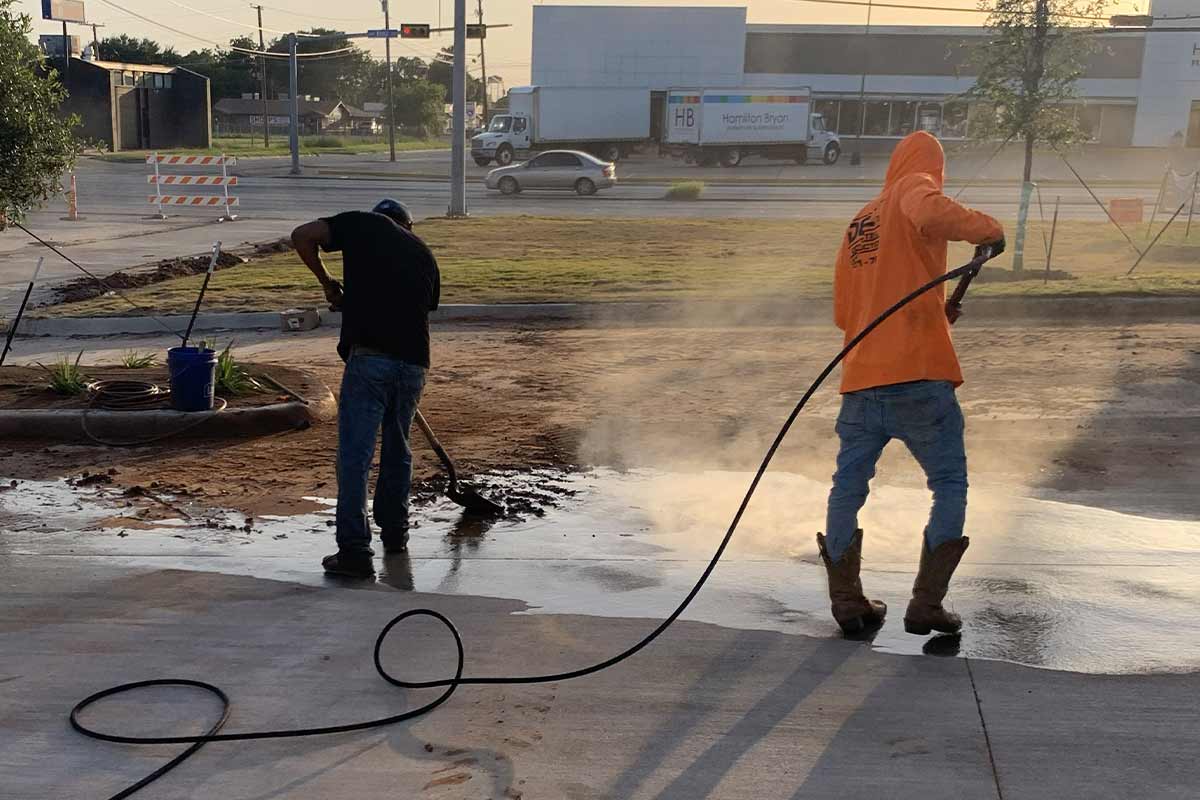
Pressure washing removes that layer. We clean asphalt and concrete parking areas, drive aisles, loading docks, dumpster pads, sidewalks, entry aprons and covered walkways for commercial properties across Fort Bend, Brazoria, Harris and Galveston counties. The work is scheduled around your operating hours, sectioned so tenants and customers keep access throughout, and finished with the wash water managed rather than simply pushed toward the nearest inlet.
Most of our washing is booked for one of two reasons. Either the property is being presented — a lease renewal, a sale, a corporate inspection, a seasonal reset — or the lot is about to be restriped and the paint needs a surface it can actually bond to. Those two jobs look similar from the parking lot and are quite different in how they are specified, which is why the sections below separate them.
Power Washing and Pressure Washing — the Same Work, and What Comes Off
In this trade the two words describe the same service. Some suppliers reserve power washing for equipment that heats the water and pressure washing for equipment that does not, but no standards body enforces that distinction and no customer has ever been served by it. When a property manager in Sugar Land asks for power washing and a facilities director in Pearland asks for pressure washing, they are describing the same visit. We use the terms interchangeably and quote the same way for both.
What actually varies is water temperature, pressure, flow rate, the cleaning agent, and the surface being cleaned — and those are chosen by what has to come off:
- Oil and transmission drips under stalls and along drive lanes. These sit in the asphalt rather than on it, so they need a degreaser with dwell time before pressure does anything useful. An older stain rarely disappears completely, and any contractor promising otherwise is describing a repaved lot.
- Tire marks and scuffing at aisle ends, ramp transitions and drive-through lanes, where rubber is deposited under load.
- Algae, mildew and organic growth on shaded concrete, north-facing walkways, curb faces and dumpster surrounds — the fastest-returning problem in this climate.
- Silt and sediment carried in by storm runoff and left in swales, gutter pans and around inlets.
- Gum, food and beverage staining at entries, in front of retail suites and around outdoor seating.
- Efflorescence and general grime on concrete aprons, sidewalks and dock aprons.
Asphalt and concrete are not cleaned the same way. Concrete tolerates higher pressure and a tighter fan; asphalt does not, and a crew that treats the two alike will scour the binder, raise aggregate and leave a lot looking worse than the stains did. Pressure comes down and chemistry does more of the work on asphalt, which is slower and is the correct trade.
Surface Prep Before Restriping
Paint bonds to the surface it lands on. If that surface is a film of oil, dust, algae or tire rubber, the paint bonds to the film, and the film eventually lets go — taking the line with it. Lines that peel in sheets, ghost within a season, or lift cleanly along one edge are usually a preparation failure rather than a paint failure.
Where a lot is being restriped, washing is scoped differently than a presentation wash. The whole surface does not always need cleaning; the areas that will carry paint do. That means the stall lines themselves, the drive-aisle striping, the accessible spaces and their access aisles, crosswalks, stop bars, directional arrows, fire lane markings and any legends. On a lot where the layout is changing, it also means the areas where old lines are being removed, because residue from a previous marking is exactly the contamination that makes a new line fail.
Timing matters as much as coverage. Pavement has to dry through before paint goes down — not just look dry at the surface. Concrete and shaded asphalt hold moisture considerably longer than open asphalt in full sun, and the dry time that governs is the paint manufacturer’s, published on the product data sheet for the specific material and conditions. We schedule the wash and the stripe with that gap built in rather than compressed, which is why the two are usually separate visits on the same job rather than one long day.
Wash Water, Storm Drains, and Texas Stormwater Rules
This is the part of parking lot pressure washing most contractors leave out of the conversation, and it is the part a property owner is most exposed on.
Storm drains are not sewers. A storm sewer system carries what enters it to a creek, bayou or channel without treatment. In this territory that means the Brazos River and its tributaries, Oyster Creek, Clear Creek, Dickinson Bayou and ultimately Galveston Bay. Anything that goes down a parking lot inlet arrives there in essentially the condition it left the pavement.
Stormwater discharge in Texas is a permitted system. The Texas Commission on Environmental Quality administers the Texas Pollutant Discharge Elimination System, the state-delegated implementation of the federal National Pollutant Discharge Elimination System program, and municipal separate storm sewer systems, industrial sites and construction sites are each authorized under their own general permit. A city’s own permit obligations are the reason municipalities in this area care what goes into their inlets.
What that means in practice on a commercial lot: whether a given wash-water discharge is allowed is decided by the authority with jurisdiction over that property, and it varies municipality by municipality across the ten Fort Bend, five Brazoria, three Harris and two Galveston ZIP codes we cover. We do not treat it as a settled question. Our standing practice is to contain wash water rather than release it — blocking or protecting inlets, berming and directing runoff to a collection point, recovering it, and disposing of it appropriately — and to work with your property’s own requirements where they are stricter. Containment is also simply the better trade: recovered water carries the oil, the sediment and the cleaning agent with it, instead of leaving them a few hundred feet downstream.
For a full list of our pavement marking services, visit our parking lot striping in SW Houston page.
Businesses We Serve




How it Works

GET A FREE ESTIMATE
Contact us today and we’ll have a quote to you in 24 hours

SCHEDULE AN INSTALLATION
We’ll have your installation scheduled in less than 7 days, without affecting your business hours

GET A PARKING LOT THAT POPS
For a budget-friendly price, you’ll get a parking lot that looks like new
We proudly work with:


We proudly work with:
Frequently Asked Questions About Parking Lot Pressure Washing in SW Houston, TX
Do you need a permit to pressure wash in Texas?
There is no statewide permit for the act of washing a parking lot. What is regulated is the discharge. Stormwater in Texas runs through the Texas Pollutant Discharge Elimination System, administered by the Texas Commission on Environmental Quality, and municipalities operate their storm sewer systems under their own permits. Whether wash water may enter an inlet at your address is decided locally and differs across our four counties, so we plan for containment as the default and confirm the requirement for your specific property.
What do I need to pressure wash a parking lot?
Commercially, more than a machine. Parking lot pressure washing needs adequate water supply and pressure for the area, hot water and a degreaser for oil, surface cleaners rather than a bare wand so the pavement cleans evenly, and equipment sized to finish the lot inside the access window you have. It also needs a plan for the water afterward — inlet protection, containment and recovery. The part most people underestimate is the last one, and it is the part that carries the actual exposure.
Is power washing the same as pressure washing?
For a commercial lot, yes. Some equipment suppliers use power washing to mean heated water and pressure washing to mean unheated, but no standard enforces the split and the service you receive is the same. We use both terms for the same work. What genuinely changes the outcome is water temperature, pressure, flow, the cleaning agent and whether the surface is asphalt or concrete, and those are set by what needs to come off rather than by which word appears on the quote.
Where does the wash water go?
Not into the storm drain, on our jobs. A storm sewer discharges untreated to the nearest waterway, which in this area means Oyster Creek, Clear Creek, the Brazos and eventually Galveston Bay. We protect or block inlets, berm the wash area, direct runoff to a collection point, recover the water and dispose of it appropriately. That keeps the oil, sediment and cleaning agent with the water instead of a few hundred feet downstream, and it keeps your property out of a conversation nobody wants to have.
How often should a commercial lot be washed?
It depends on what the lot carries rather than on the calendar. Retail centers, medical offices and restaurants — anywhere with heavy pedestrian traffic, food service or a drive-through — usually justify an annual wash, sometimes twice a year at entries and dumpster pads. Office parks and light-industrial lots often go longer. Shade, tree cover and drainage matter more than age here: a lot under live oaks grows algae in a season, while an open lot in full sun stays presentable for years.
Does a lot need washing before it is restriped?
Where the surface is contaminated, yes, and it is the single most common reason new striping fails early. Paint bonds to whatever it lands on, so oil, algae, dust or tire rubber under a fresh line means the line is bonded to the contamination rather than the pavement. Parking lot pressure washing done as prep is scoped to the areas that will carry paint rather than the whole lot, and it is scheduled far enough ahead that the pavement dries through to the paint manufacturer’s published requirement before striping starts.