
Parking Lot Restriping
In SW Houston, TX
Restripe Existing Lines and Markings
1-800-STRIPER provides professional parking lot restriping in SW Houston, TX — refreshing faded stalls, ADA markings, fire lanes, and directional arrows with fast-dry traffic paint on commercial lots across Fort Bend, Brazoria, Harris, and Galveston counties.
1-800-STRIPER of SW Houston PROVIDes Parking Lot Restriping Services NEAR YOU
Need to brighten up your faded parking lot?
Keep your parking lot safe and attractive by restriping annually to freshen up lines and symbols that have faded from the sun, weather, and traffic. Nothing beats a fresh coat of paint!
Benefits:
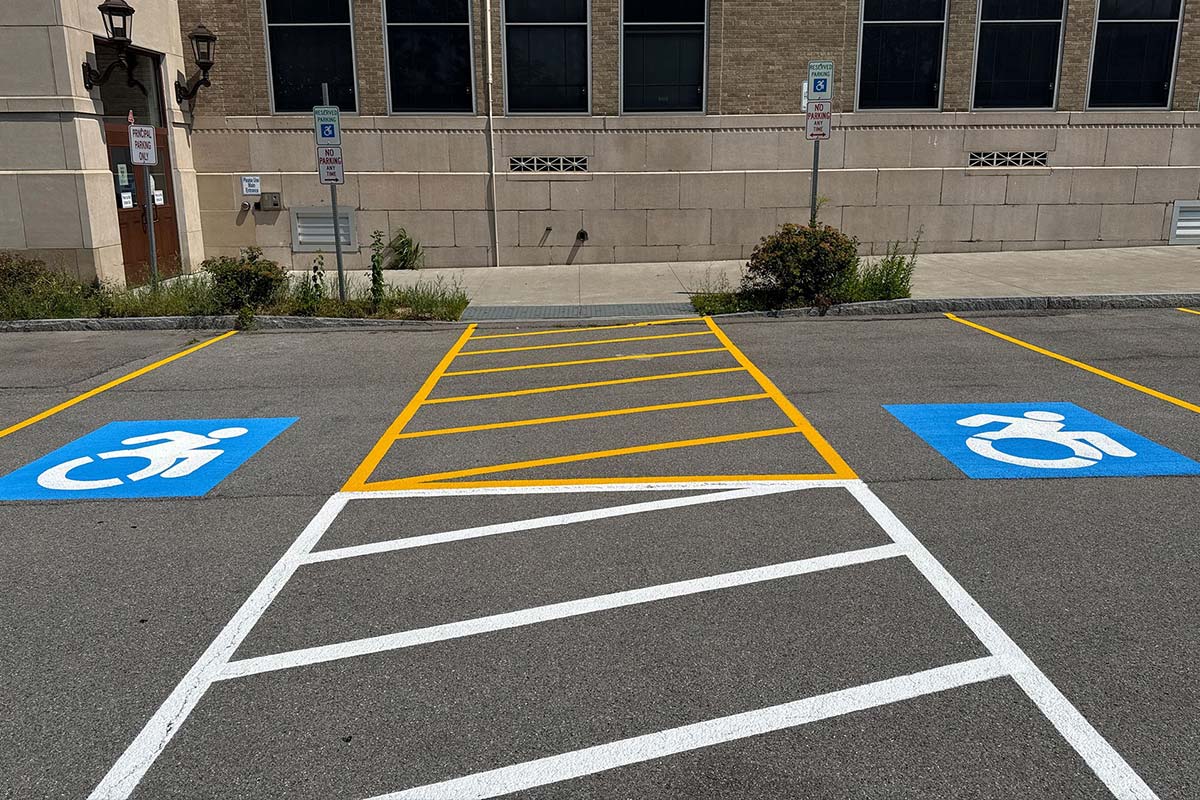
Parking Lot Restriping in SW Houston, TX
Restriping is repainting the markings a lot already has, in the layout it already uses. It is the most common work we do and the fastest visible improvement available to a commercial property: a lot that reads as neglected on Friday reads as maintained on Monday.
We restripe commercial lots across Fort Bend, Brazoria, Harris and Galveston counties — retail centers, medical and professional offices, industrial and warehouse sites, multifamily communities, churches, schools and municipal properties. Work is sectioned and scheduled around your hours so the property keeps trading.
If the layout itself needs to change — more spaces, different circulation, a reconfigured entrance — that is layout design rather than restriping, and it is a different scope.
When a Lot Needs Restriping — and When the Code Says So
Most owners restripe when the lot starts to look tired. That is a reasonable trigger, and there is a second one that carries more weight.
The usual signs are visual: stall lines faded to a suggestion, drivers parking crooked or straddling, accessible markings and the ISA symbol worn thin, arrows and stop bars no longer legible, curb paint chalked or peeling. On the Gulf Coast this happens faster than in drier markets — sustained heat, intense UV and heavy rainfall all attack traffic paint, and the wear concentrates in the tire tracks and turning areas first.
The second trigger is a code condition. Where a lot carries a designated fire lane, the marking is not merely decorative. The International Fire Code requires, in the same provision that requires the lane be marked at all:
The means by which fire lanes are designated shall be maintained in a clean and legible condition at all times and be replaced or repaired when necessary to provide adequate visibility.
That is a continuing duty. A fire lane whose paint has washed out is not a lot that looks tired — it is a designation that no longer satisfies the condition the code places on it. On a property with a fire lane, restriping on a schedule is maintenance of a compliance item.
What Gets Restriped
A full restripe usually covers stall lines throughout the parking field, accessible spaces with their access aisles and ISA symbols, van-accessible designations, fire lane markings and red curbs, directional arrows, stop bars and crosswalks, no-parking hatching and keep-clear zones, loading zones and reserved spaces, wheel stops where they are painted, curb painting, and any legends or numbering the lot carries.
Directional markings follow the conventions drivers already know — arrow shapes, stop bar placement, crosswalk patterns. Those conventions come from the Texas Manual on Uniform Traffic Control Devices, which we use as a marking-convention reference. It is worth being exact: that manual does not govern a private parking lot, and we do not claim it does. We follow its conventions because a driver reads a familiar arrow faster than a novel one.
Surface Preparation Before the First Line Goes Down
Paint bonds to whatever it lands on. If that is dirt, oil, algae or tire rubber, the paint bonds to the film and the film eventually releases — taking the line with it.
Preparation is scoped to the areas that will carry paint: sweeping and blowing the lines clear of dust and debris, addressing oil-contaminated areas, and washing where the surface is genuinely dirty rather than merely dusty. Old markings that are failing get attention rather than a second coat over the top, because a new line over a delaminating one inherits the failure.
Pavement must also be dry through, not just dry at the surface. Shaded areas and concrete hold moisture considerably longer than open asphalt, and the dry time that governs is the paint manufacturer’s for the product and conditions on the day.
How a Restripe Runs, Start to Finish
- Site walk and count. We walk the lot, record the existing layout, count stalls and markings, and note accessible spaces, fire lanes and anything already failing.
- Scope and schedule. We agree what is being repainted and phase the work around your operating hours, so sections close in a sequence you can notify tenants about.
- Clear the section. The area being worked is cordoned and vehicles are moved out ahead of the crew.
- Prepare the surface. Lines are swept and blown clear; contaminated or failing areas are dealt with before paint.
- Lay out and verify. Existing markings are used as the reference and checked before painting, so a faded but correct layout is reproduced accurately.
- Paint. Stalls, symbols, arrows, legends, curbs and fire lane markings are applied in sequence.
- Cure and reopen. The section stays closed until the paint has dried to the manufacturer’s requirement, then reopens and the next section begins.
- Walk it with you. We walk the finished lot with you before we leave.
For a full list of our pavement marking services, visit our parking lot striping in SW Houston page.
Businesses We Serve




How it Works

GET A FREE ESTIMATE
Contact us today and we’ll have a quote to you in 24 hours

SCHEDULE AN INSTALLATION
We’ll have your installation scheduled in less than 7 days, without affecting your business hours

GET A PARKING LOT THAT POPS
For a budget-friendly price, you’ll get a parking lot that looks like new
We proudly work with:


We proudly work with:

Frequently Asked Questions About Parking Lot Restriping in SW Houston, TX
How is a parking lot restriped?
Parking lot restriping runs section by section. We walk the lot and record the existing layout, phase the work around your hours, then close one section at a time. Each section is swept and blown clear, contaminated or failing areas are addressed, the existing markings are used as the layout reference and verified, and then stalls, accessible spaces, arrows, legends, curbs and fire lane markings are painted in sequence. The section stays closed until the paint has dried to the manufacturer’s published requirement, then reopens.
How often should a commercial lot be restriped?
It depends on traffic, sun exposure and drainage more than on a fixed interval. Busy retail and medical lots wear fastest, and on the Gulf Coast heat, UV and heavy rainfall shorten the cycle compared with drier markets. The practical test is legibility: if drivers are parking crooked, if the ISA symbols are thin, or if arrows and stop bars have stopped reading, the lot is past due. Where a fire lane is present, the code’s maintenance duty sets the floor rather than appearance.
Does a restripe have to follow the original layout?
No, but if it does not, it stops being a restripe. Parking lot restriping reproduces the existing layout in fresh paint, which is why it is quick and non-disruptive. Changing stall counts, angles, aisle widths or circulation is layout design — a different scope that may need a site plan review with your city or county, and that we would quote separately. Plenty of properties do both at once: restripe most of the lot and reconfigure one area.
Are faded fire lane markings a code violation?
They can be. The International Fire Code does not simply require a fire lane to be marked once; it requires the means of designation to be maintained in a clean and legible condition at all times, and replaced or repaired when necessary to provide adequate visibility. So a washed-out fire lane is a maintenance obligation that has not been met. The specific marking requirements come from the code edition and local amendments your city or county fire marshal has adopted, which we confirm for your address.
Does restriping change what the ADA requires of the lot?
We will not tell you either way, because the honest answer is that it depends on facts about your property that need a qualified review. Accessibility duties attach on new construction, alteration and change of occupancy, and whether a given repainting counts as an alteration triggering an upgrade is exactly the question a Registered Accessibility Specialist exists to answer. What we can say plainly: we restripe accessible spaces, access aisles and signage to the dimensions in the 2010 ADA Standards.
How soon can the lot reopen after restriping?
Sooner than most people expect, and the number comes from the product rather than from us. Fast-dry traffic paints are formulated to take traffic quickly, but the actual dry and cure times are published on the manufacturer’s data sheet for the specific material, and they shift with temperature, humidity and shade — all of which vary a great deal here. We phase the work so only one section is closed at a time and give you the reopening time for each before the crew starts.