
ADA Parking Lot Striping
In SW Houston, TX
ADA-Compliant Accessible Parking
1-800-STRIPER provides ADA-compliant parking lot striping in SW Houston, TX — laying out accessible spaces, van-accessible stalls, access aisles, ISA symbols, and required signage per the 2010 ADA Standards for Accessible Design and the 2012 Texas Accessibility Standards.
1-800-STRIPER of SW Houston PROVIDes ADA Parking Lot Striping Services NEAR YOU
Need to make your property more accessible?
Upgrade your facility to become fully ADA compliant by partnering with us to create clear, accessible parking for all your visitors.
Our ADA Compliant line striping services include:
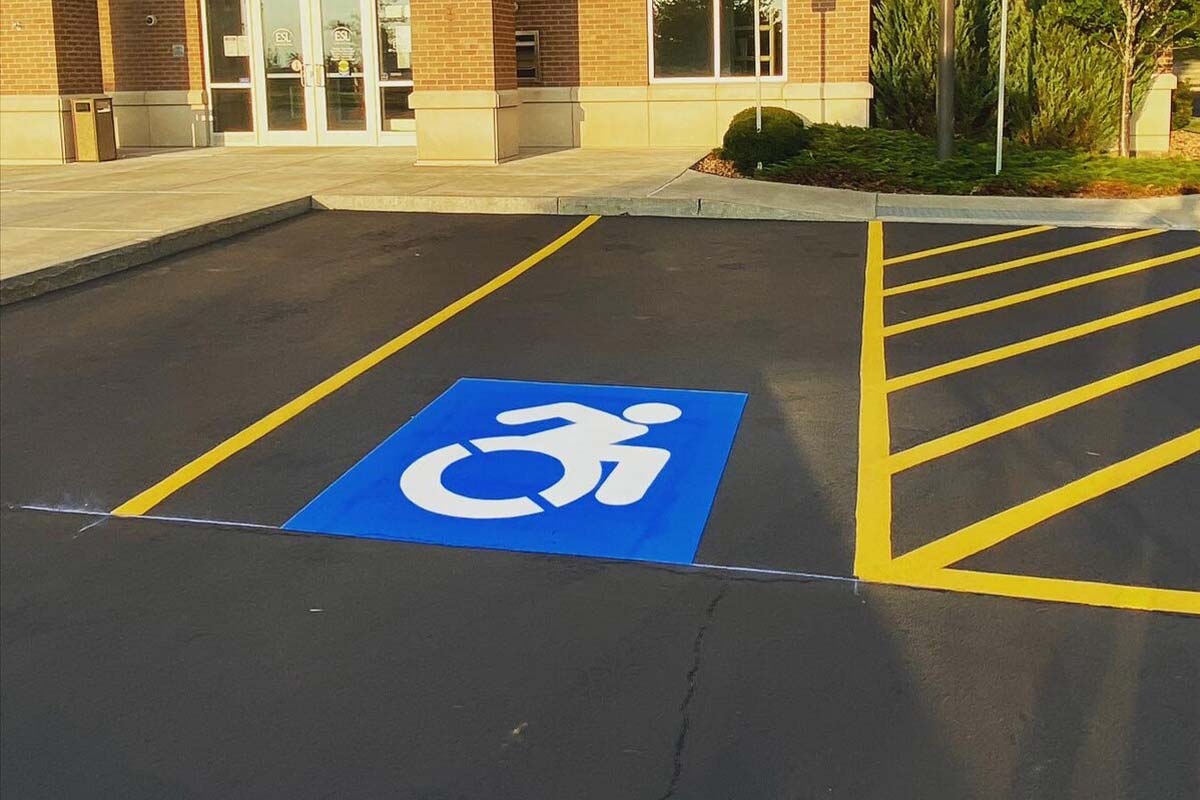
ADA Parking Lot Striping in SW Houston, TX
Accessible parking is the most regulated thing on a commercial lot and the most commonly got wrong. The failures are rarely dramatic: an access aisle a few inches narrow, a sign mounted at a comfortable height instead of the required one, a van space with a car-width aisle, accessible stalls grouped at one entrance when the building has three.
We lay out, mark and re-mark accessible parking on commercial properties across Fort Bend, Brazoria, Harris and Galveston counties: accessible and van-accessible spaces, access aisles, ISA symbols, accessible-route connections, and the signage that identifies each space. New construction, alterations, and refreshing markings on existing lots.
Two Standards Apply in Texas: the Federal ADA and the Texas Accessibility Standards
Most pages in this vertical cite only the federal rule. In Texas that is half the picture, and it is the half that misses the reviewer you will actually meet.
Federal. The 2010 ADA Standards for Accessible Design apply to places of public accommodation and commercial facilities. They set the quantities, the dimensions and the signage requirements, and they apply regardless of what any state or city says.
State. Texas layers the Texas Accessibility Standards on top, administered by the Texas Department of Licensing and Regulation through its Architectural Barriers program. This is not a parallel private-lawsuit regime; it is a review and inspection system. Projects meeting the state’s thresholds are registered, reviewed by a Registered Accessibility Specialist, and inspected. That is a practical difference: the federal standard is enforced after the fact through complaints and litigation, while the state layer is enforced before and after construction by a named reviewer.
Phase 3 identified this as the lever for this page, and it is: no rival ranking in this market cites the state layer at all. The consequence for an owner is concrete — a lot can be built to a drawing, pass nobody’s attention, and still be sitting on an inspection obligation that was never registered.
Accessible Stalls, Access Aisles, and Signage
These are the dimensions that do not vary by city, quoted from the standard itself.
Stall widths. Under §502.2, car parking spaces are 96 inches wide minimum and van parking spaces 132 inches wide minimum, each marked to define the width and each with an adjacent access aisle. There is an exception: a van space may be 96 inches wide minimum where its access aisle is 96 inches wide minimum.
Access aisles. Under §502.3.1 an access aisle serving car and van spaces is 60 inches wide minimum. Under §502.3.2 it extends the full length of the spaces it serves. Under §502.3.4 it may not overlap the vehicular way, and while it may sit on either side of a space generally, angled van spaces must have the aisle on the passenger side. Two spaces may share one aisle.
Marking the aisle. Under §502.3.3, access aisles “shall be marked so as to discourage parking in them” — see FAQ 4, because what that does not say is the most useful fact on this page.
Vertical clearance. Under §502.5, van spaces, their access aisles and the vehicular routes serving them need 98 inches minimum vertical clearance, which is the requirement that catches covered parking and parking structures.
Signage. Under §502.6, identification signs carry the International Symbol of Accessibility, van spaces carry a “van accessible” designation, and signs sit 60 inches minimum above the ground measured to the bottom of the sign.
Quantity. Table 208.2 scales the count with the size of the facility. A lot of 1 to 25 spaces needs 1 accessible space, 2 for 26 to 50, 3 for 51 to 75, 4 for 76 to 100, and upward. Under §208.2.4, at least one in every six required accessible spaces, or fraction of six, must be a van space.
When an Accessibility Duty Is Actually Triggered
This section is where we part company with most of the pages competing for this search, and it is deliberate.
An accessibility obligation attaches at new construction, alteration, or change of occupancy. It is not an ambient duty that descends on every existing lot on a schedule. An older property that was compliant when built is not automatically non-compliant today because the standards were revised.
What we will not tell you is whether repainting your lot counts as an “alteration” that triggers an upgrade to current standards. That is the hinge of the entire question, it turns on the specific scope of your work and the condition of your property, and it is a Registered Accessibility Specialist’s determination — not a striping contractor’s, and not something to take from a web page. A safe-harbor analysis on an existing lot is the same kind of call.
What we do is straightforward: we mark accessible parking to the dimensions in the 2010 ADA Standards, we tell you plainly when something on your lot does not meet them, and we point you to the right professional when the question is whether you are obliged to fix it.
For a full list of our pavement marking services, visit our parking lot striping in SW Houston page.
Businesses We Serve




How it Works

GET A FREE ESTIMATE
Contact us today and we’ll have a quote to you in 24 hours

SCHEDULE AN INSTALLATION
We’ll have your installation scheduled in less than 7 days, without affecting your business hours

GET A PARKING LOT THAT POPS
For a budget-friendly price, you’ll get a parking lot that looks like new!
We proudly work with:


We proudly work with:


Frequently Asked Questions About ADA Parking Lot Striping in SW Houston, TX
What are the requirements for ADA parking in Texas?
ADA parking lot striping in Texas answers to two layers. Federally, the 2010 ADA Standards set quantity by Table 208.2, a 96-inch minimum car space, a 132-inch minimum van space, a 60-inch minimum access aisle running the full length of the stalls, 98-inch vertical clearance for van routes, and signage with the International Symbol of Accessibility mounted 60 inches minimum to the bottom of the sign. On top of that, Texas adds the Texas Accessibility Standards, administered by the Texas Department of Licensing and Regulation as a registration, review and inspection program.
How do you stripe a handicap parking space?
ADA parking lot striping starts with placement. Accessible spaces go on the shortest accessible route to an accessible entrance, dispersed where a lot serves several entrances. The stall is marked to at least 96 inches wide, or 132 for a van space, with a 60-inch minimum access aisle beside it running the full length of the stall and not overlapping the drive aisle. The ISA symbol goes in the stall, the aisle is marked to discourage parking in it, and the identification sign is set at the required height.
How many accessible spaces does a lot need?
Table 208.2 of the 2010 ADA Standards scales it with the size of the parking facility: 1 accessible space for a lot of 1 to 25, 2 for 26 to 50, 3 for 51 to 75, 4 for 76 to 100, 5 for 101 to 150, 6 for 151 to 200, and onward, reaching 2 percent of the total between 501 and 1000 spaces. Separately, at least one in every six required accessible spaces — or fraction of six — must be a van accessible space.
Does the access aisle have to be painted blue?
No, and this surprises nearly everyone. The federal standard requires only that access aisles “shall be marked so as to discourage parking in them,” and its own advisory to that section states that “the method and color of marking are not specified by these requirements but may be addressed by State or local laws or regulations.” Blue is the near-universal convention and a sound choice, but it is a convention plus whatever your local rule says — not a federal mandate. What the standard does stress is that the aisle be clearly marked.
Is an older lot automatically out of compliance?
Not automatically. Accessibility duties attach at new construction, alteration or change of occupancy rather than arriving on a schedule, so a lot built to the standards in force at the time is not rendered non-compliant merely because the standards were later revised. Whether a particular project on an existing lot triggers an upgrade — and whether safe harbor applies — is a determination for a Registered Accessibility Specialist. We will tell you where your markings sit against current dimensions; the obligation question belongs to them.
What is the difference between the ADA Standards and the Texas Accessibility Standards?
The ADA Standards are the federal requirement, enforced largely after the fact through complaints and litigation, and they apply everywhere. The Texas Accessibility Standards are the state layer, administered by the Texas Department of Licensing and Regulation’s Architectural Barriers program, and they work as a registration, plan review and inspection process for projects meeting the state thresholds. In practice the federal rule tells you what to build, and the state program is the one that reviews and inspects it in Texas.