Fire Lane Striping
In SW Houston, TX
Code-Compliant Fire Lane Markings
1-800-STRIPER provides professional fire lane striping in SW Houston, TX — marking fire lanes, red curbs, and no-parking legends to the International Fire Code edition your city or county fire marshal has adopted, for commercial properties across Fort Bend, Brazoria, Harris, and Galveston counties.
1-800-STRIPER of SW Houston PROVIDes Fire Lane Striping Services NEAR YOU
Is your parking lot ready for first responders?
Our team is well-versed in local fire regulations and will parter with you to design a fire lane striping plan that creates unobstructed emergency access to protect your customers and property.
Core Services:
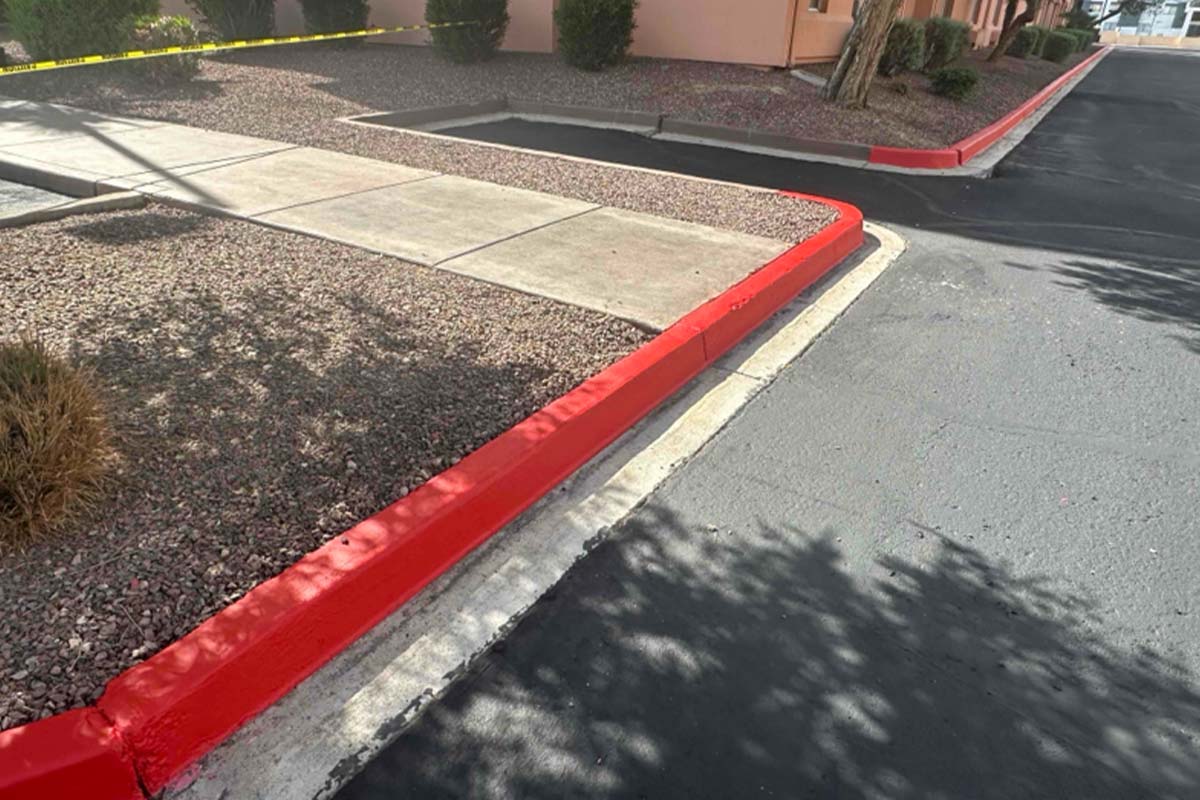
Fire Lane Striping in SW Houston, TX
A fire lane is the route apparatus uses to reach your building, and the markings on it are what keep that route clear on the one day it matters. We mark and re-mark fire lanes, red curbs, no-parking legends and access aisles for commercial properties across Fort Bend, Brazoria, Harris and Galveston counties — retail centers, warehouses and distribution sites, medical offices, multifamily communities, schools and churches.
The part most contractors skip is the part that decides the job: which specification applies to your address. In this territory that is not one answer. Getting it right before paint goes down is the difference between a marking that passes inspection and one that gets rejected and repainted.
Texas Has No Single Statewide Fire Code — Your City or County Does
There is no statewide fire code binding private commercial property in Texas. Fire and building codes are adopted locally: city by city inside municipal limits, and by the county for unincorporated areas. Two properties four miles apart can sit under different editions of the same code with different local amendments.
That is why a fire lane specification quoted off a national blog, or carried over from another Texas metro, is unreliable here. The instrument is usually the same — the International Fire Code, published by the International Code Council — but the edition and, far more importantly, the local amendments are set by the jurisdiction. The base code carries no color, no letter height, no stripe width and no interval. Every one of those numbers in this market comes from a local amendment.
Which Authority Governs Your Property
Our twenty ZIP codes span four counties and roughly fifteen separate authorities:
Fort Bend County — ten of our twenty ZIP codes, and the county our own address sits in. Inside city limits the authority is the city: Sugar Land, Missouri City, Richmond, Rosenberg, Simonton or Fresno. Outside them, it is the county.
Brazoria County — five ZIP codes, covering Pearland, Alvin, Manvel and Rosharon inside their city limits, and the county for unincorporated areas.
Harris County — three ZIP codes. Inside Houston city limits the City of Houston governs, and its marking standard is a City of Houston instrument that does not reach most of this service area. Outside city limits, unincorporated Harris County governs.
Galveston County — two to three ZIP codes, covering Friendswood and Santa Fe.
A property in Sugar Land, one in unincorporated Fort Bend County and one inside Houston city limits can therefore sit under three different marking specifications. We identify the authority for your address first and mark to that specification.
What the International Fire Code Actually Says About Marking
Here is the base requirement, read directly from the 2024 International Fire Code:
Where required by the fire code official, approved signs or other approved notices or markings that include the words “NO PARKING—FIRE LANE” shall be provided for fire apparatus access roads to identify such roads or prohibit the obstruction thereof. The means by which fire lanes are designated shall be maintained in a clean and legible condition at all times and be replaced or repaired when necessary to provide adequate visibility.
Read what it does not say. There is no color in it. No letter height. No stripe width. No spacing interval between legends. What the base code requires is that markings be approved by the fire code official and that they carry the words NO PARKING—FIRE LANE.
That is the honest answer to “what does the fire code require,” and it is why the specification has to come from your jurisdiction rather than from us. What it does mean is that the fire code official’s approval is the operative standard — so the productive first call is to that office, not to a paint supplier.
Sugar Land is the one example we can source completely. The City of Sugar Land has adopted the 2024 International Code Council family, including the 2024 International Fire Code, with local amendments carried in Ordinance 2395. That comes from the city’s own building codes page. We publish it because we read it; we do not publish equivalent claims for the other jurisdictions until we can read those too.
Faded Fire Lane Paint Is a Code Failure, Not a Cosmetic One
This is the sentence in §503.3 that most property managers have never been shown:
The means by which fire lanes are designated shall be maintained in a clean and legible condition at all times and be replaced or repaired when necessary to provide adequate visibility.
Maintenance is not a recommendation in that text. It is a continuing duty, written in the same breath as the requirement to mark at all. A fire lane that was compliant when it was painted and is now washed out, chalked over or worn through by traffic is not a lot that looks tired — it is a lot whose markings no longer satisfy the condition the code imposes on them.
On the Gulf Coast that clock runs faster than owners expect. Sustained heat, intense UV, heavy summer rainfall and standing water all degrade traffic paint, and a lane that carries delivery traffic wears at the tire tracks first. Re-marking on a schedule is cheaper than being told to re-mark on someone else’s.
Red Curbs, Legends, and Lettering
The physical work of fire lane striping typically covers the curb face and top along the designated route, the NO PARKING—FIRE LANE legend repeated along that route, and in many jurisdictions a painted lane line or hatching where the lane is not curbed.
Color, letter height and the interval between legends are the three things owners most want a number for, and they are exactly the three the base code leaves to the local amendment. We will not publish a figure for your jurisdiction that we have not read. What we do is confirm the specification with the authority having jurisdiction before the crew mobilizes, then mark to it — which is also what the fire code official expects.
Fire Lane Signs Alongside the Paint
The code text speaks of “signs or other approved notices or markings,” so signage and pavement marking are alternative or complementary means of designation, and many jurisdictions require both.
Where signs are part of the designation, they are mounted on posts or on a permanent wall along the lane, spaced so the lane is identified along its length, and specified by the same authority that specifies the paint. We install fire lane signage alongside the marking so the two are consistent — a lane whose paint says one thing and whose signs say another is a lane that invites an argument at inspection.
Access Width and Vertical Clearance
Fire apparatus access roads carry dimensional requirements for width, vertical clearance, turning radius and load capacity. Those are design and construction requirements rather than marking requirements, and like the marking specification they are set by the adopted code edition and the local amendments.
They matter to striping for one practical reason: the marking has to designate the lane that actually meets those dimensions. Marking a lane narrower than the required access width does not make it compliant, and re-marking a lane in the wrong place is a cost paid twice. Where the designated route is unclear on an existing property, we resolve it with the fire marshal before painting.
Getting a Fire Lane Marking Approved
- Identify the authority. We determine which city or county has jurisdiction over your address — the single step this territory punishes most for getting wrong.
- Confirm the adopted edition and amendments. The fire code edition and the local amendment that carries the marking specification are confirmed with that office.
- Walk the route. We identify the designated fire apparatus access route on the ground, along with curbs, obstructions and any existing markings.
- Agree the specification. Color, legend wording, letter height, interval and sign placement are set against the jurisdiction’s requirement, not a generic template.
- Prepare the surface. Curb faces and pavement are cleaned so paint bonds; existing failed marking is addressed rather than painted over.
- Mark. Curbs, legends, lane lines and hatching are laid out, chalked, verified and painted; signage is installed where required.
- Walk it with you. We confirm the finished marking against the agreed specification before we leave, so the inspection is a formality.
For a full list of our pavement marking services, visit our parking lot striping in SW Houston page.
Businesses We Serve




How it Works

GET A FREE ESTIMATE
Contact us today and we’ll have a quote to you in 24 hours

SCHEDULE AN INSTALLATION
We’ll have your installation scheduled in less than 7 days, without affecting your business hours

GET A PARKING LOT THAT POPS
For a budget-friendly price, you’ll get a parking lot that looks like new
We proudly work with:


We proudly work with:
Frequently Asked Questions About Fire Lane Striping in SW Houston, TX
Who decides where a fire lane goes on a commercial property?
The fire code official with jurisdiction over your address — a city fire marshal inside municipal limits, or the county for unincorporated areas. Fire lane striping is designated rather than chosen: the route is set by how apparatus must reach the building, and the marking identifies that route. On a new build it is fixed during site plan review. On an existing property with unclear or missing markings, the fire marshal’s office resolves where the lane belongs before anything is painted.
Does the International Fire Code specify red paint and white lettering?
The base code does not. Read directly, §503.3 requires approved signs, notices or markings that include the words NO PARKING—FIRE LANE, and requires them to be maintained legible. It states no color, no letter height, no stripe width and no interval. Red curbs with white lettering are the common convention across this region, but where it is mandatory it is mandatory because a local amendment says so, not because the base code does. That is why we confirm the specification with your jurisdiction first.
My lot is in unincorporated Fort Bend County — who is my fire marshal?
If your property sits outside the limits of Sugar Land, Missouri City, Richmond, Rosenberg, Simonton or Fresno, the county rather than a city is your authority, and Fort Bend County’s fire marshal’s office administers the adopted code and its amendments for that area. Ten of the twenty ZIP codes we serve are in Fort Bend County, so this is the most common situation in our territory. We confirm jurisdiction against your actual address before quoting, because a city limit can run down the middle of a street.
Are faded fire lane markings a violation?
They can be, and that surprises most owners. The code does not merely require a lane to be marked once; §503.3 requires the means of designation to be maintained in a clean and legible condition at all times, and replaced or repaired when necessary to provide adequate visibility. A worn-out lane is therefore a maintenance obligation that has not been met rather than a cosmetic issue, which is why fire lane striping is best treated as a recurring item. Gulf Coast heat, UV and rainfall shorten that cycle noticeably compared with drier markets.
Do fire lanes need signs as well as paint?
Often, and it depends on your jurisdiction. The code text refers to signs or other approved notices or markings, which leaves both routes open, and many local amendments require signage in addition to pavement and curb marking rather than instead of it. We install both where the specification calls for both, and we make sure the two agree with each other. Mismatched paint and signage is one of the more common reasons a marking gets flagged.
My property is in Sugar Land — which fire code applies?
The City of Sugar Land has adopted the 2024 International Code Council family, which includes the 2024 International Fire Code, with the city’s local amendments carried in Ordinance 2395. That is taken from the city’s own published building codes page rather than from a search result — worth stressing, because a web search on this exact question returned a different and incorrect edition. For any address, we verify the adopted edition with the jurisdiction before marking, and Sugar Land is simply the one we can document completely today.