
Warehouse Line Painting
In SW Houston, TX
OSHA-Compliant Safety Markings
1-800-STRIPER provides professional warehouse line painting in SW Houston, TX — aisle lines, pedestrian walkways, floor markings, and safety zones for distribution and manufacturing facilities, per the federal OSHA rule requiring permanent aisles and passageways to be appropriately marked.
1-800-STRIPER of SW Houston PROVIDes Warehouse Line Painting Services NEAR YOU
Want your indoor space to operate more efficiently?
Warehouse and interior markings ensure clear traffic lanes, organized storage zones, and designated spaces designed to help your business operate safely and efficiently.
Benefits:
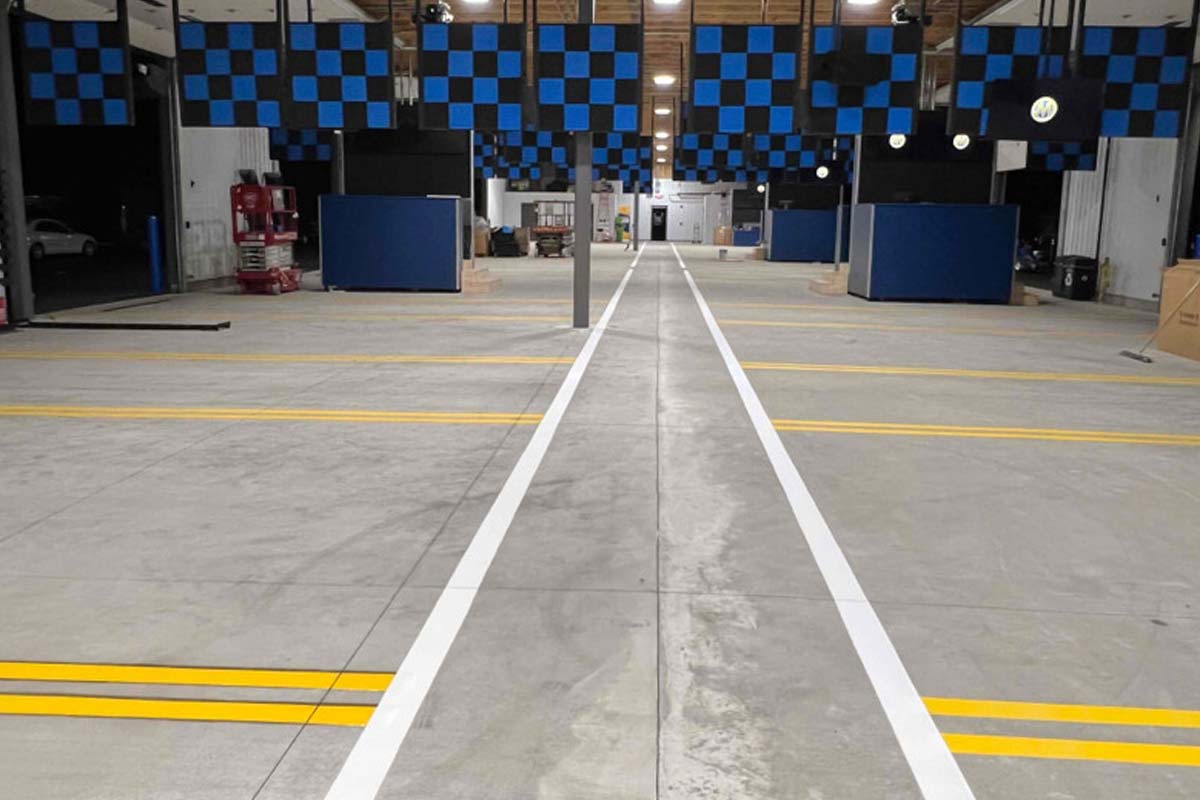
Warehouse Line Painting in SW Houston, TX
Inside a working facility, the lines on the floor are the traffic plan. They separate forklifts from people, keep aisles clear enough to work in, mark what must not be blocked, and tell everyone on the floor where they are allowed to stand.
We mark and re-mark warehouse and industrial floors across Fort Bend, Brazoria, Harris and Galveston counties — distribution and fulfillment centers, manufacturing plants, cold storage, food and beverage facilities, building-products yards and the light-industrial parks along the Highway 59 and Highway 6 corridors. Factory and plant floor marking is the same service under a different name.
The work covers aisle and travel lanes, pedestrian walkways and crossings, staging and hold areas, rack and bay identification, equipment and machine footprints, and keep-clear zones at electrical panels, eyewash stations, exits and fire equipment.
Warehouse Floor Marking and Aisle Striping — What OSHA Actually Requires
Here is the thing almost every page in this vertical gets wrong: no federal regulation gives you a number.
The marking duty is in 29 CFR 1910.176(a), and it reads, in full, on this point:
Permanent aisles and passageways shall be appropriately marked.
That is the requirement. Not two inches. Not yellow. Not a spacing interval. The same section requires that “sufficient safe clearances” be maintained for aisles — and it does not dimension those either. It obliges you to keep aisles in good repair, free from obstruction, and wide enough to be safe for the equipment actually using them, and it leaves the specification to you.
The color rule people are thinking of is a different regulation and does not say what they think. OSHA’s safety color code at 29 CFR 1910.144 assigns red to fire protection equipment and apparatus, danger, and emergency stop devices, and yellow to caution and physical hazards such as striking against, stumbling, falling, tripping and caught-between. There is no aisle color anywhere in it. Yellow aisle lines are an industry convention — a good one, widely understood, and consistent with the caution meaning — but they are a convention, not a federal mandate.
So any page telling you “OSHA requires 2-inch yellow aisle lines” is inventing a citation. What OSHA requires is that permanent aisles be appropriately marked, which puts the judgment on the facility. What we do is help you make that judgment defensible: consistent color meanings across the site, widths that stay legible under traffic, and a marking plan that matches how the floor is actually worked. Where a customer, a corporate standard or an insurer specifies dimensions, we mark to that specification.
Where Warehouse Line Marking Goes in a Distribution Facility
A marking plan follows the way material and people move, not a template:
- Aisle and travel lanes for forklift and pallet-jack routes, laid out to the real turning and stacking geometry rather than to a grid.
- Pedestrian walkways and crossings, kept visually distinct from vehicle lanes and routed so people are not walking blind into an aisle mouth.
- Staging, inbound, outbound and hold areas, so floor space is allocated instead of negotiated.
- Rack, bay and location identification painted at floor level to support picking and cycle counting.
- Equipment and machine footprints, marking where a machine, cage or pallet stand belongs.
- Keep-clear zones at electrical panels, eyewash and safety showers, fire extinguishers, sprinkler risers and exit routes — the markings that most often prevent a citation.
- Dock and staging areas at overhead doors, including trailer positions and dock-level travel routes.
Surface preparation decides whether any of it lasts. Sealed concrete, dusty slabs, and floors with an existing coating each need different handling, and a facility that has been running for years usually has a film of tire rubber and dust exactly where the lines need to bond.
For a full list of our pavement marking services, visit our parking lot striping in SW Houston page.
Businesses We Serve




How it Works

GET A FREE ESTIMATE
Contact us today and we’ll have a quote to you in 24 hours

SCHEDULE A STRIPING
We’ll have your space restriped in less than 7 days, without affecting your business hours

GET A PARKING LOT THAT POPS
For a budget-friendly price, you’ll get a parking lot that looks like new
We proudly work with:


We proudly work with:


Frequently Asked Questions About Warehouse Line Painting in SW Houston, TX
What does OSHA require for warehouse aisle marking?
Less specifically than most people assume. 29 CFR 1910.176(a) says permanent aisles and passageways shall be appropriately marked, and that is the whole of the marking duty. The same section requires sufficient safe clearances and aisles kept in good repair and free from obstruction, again without dimensions. There is no federally required line width, color or spacing. The specification is the facility’s to set, and warehouse line painting done well makes that decision consistent and defensible.
What color should warehouse floor lines be?
Yellow is the convention for aisles and it is a sound one, but it is a convention rather than a federal requirement. OSHA’s safety color code at 29 CFR 1910.144 assigns red to fire protection equipment, danger and emergency stop devices, and yellow to caution and physical hazards — striking against, stumbling, falling, tripping, caught-between. No aisle color appears in it at all. What actually matters is that colors mean the same thing everywhere in your facility, and that the meanings are written down.
How wide does an aisle line have to be?
No federal rule gives a width. Common practice runs from about two to four inches for aisle lines, wider for boundaries that need to read from a distance, but that comes from industry habit rather than regulation. The useful test is legibility under real conditions: a line has to stay readable through tire wear, dust and whatever gets stacked near it. We recommend a width for each marking type based on traffic and sight lines, and we mark to any dimension your corporate or customer standard specifies.
Warehouse striping, warehouse floor striping, warehouse line painting — are these the same thing?
Yes. Warehouse striping, warehouse floor striping, warehouse line marking, warehouse floor marking and warehouse line painting all describe the same service, and which term you use tends to depend on your industry rather than on any difference in the work. Factory floor marking and plant floor striping are the same again. We answer to all of them and quote the same way, so there is no need to guess which phrase gets you the right contractor.
What paint holds up to forklift traffic?
Products formulated for industrial floors rather than parking lots — typically high-solids traffic coatings or epoxies chosen for the substrate, the traffic and the chemical exposure. The paint matters less than the preparation. A coating applied over dust, tire rubber, oil or a failing existing layer bonds to the contamination and lifts in sheets under the first turning forklift, which is the most common reason floor markings fail early. Cure time comes from the manufacturer’s data sheet for the product and conditions.
Does the facility have to shut down for floor marking?
Almost never entirely. Work is sectioned so that part of the floor stays in operation while another part is marked, and it is commonly scheduled around shift changes, weekends or planned downtime. The constraint is not the painting — it is the cure. The floor cannot take traffic until the product has cured to the manufacturer’s published requirement, and that time comes from the data sheet for the specific material and conditions rather than from us. We plan the sequence with your operations team first.