
Sports Court Striping
In SW Houston, TX
Multi-Sport Court Line Marking
1-800-STRIPER provides professional sports court striping in SW Houston, TX — marking pickleball courts to USA Pickleball’s twenty-by-forty-four-foot specification, basketball courts, tennis courts, and playground game markings with durable acrylic court paint.
1-800-STRIPER of SW Houston PROVIDes Sports Court Striping Services NEAR YOU
Want to get people to come out to play?
Brighten up your faded sport courts or turn your playground into a safe, colorful, and engaging space that entices people to come out and play.
Sports Court Specialties:
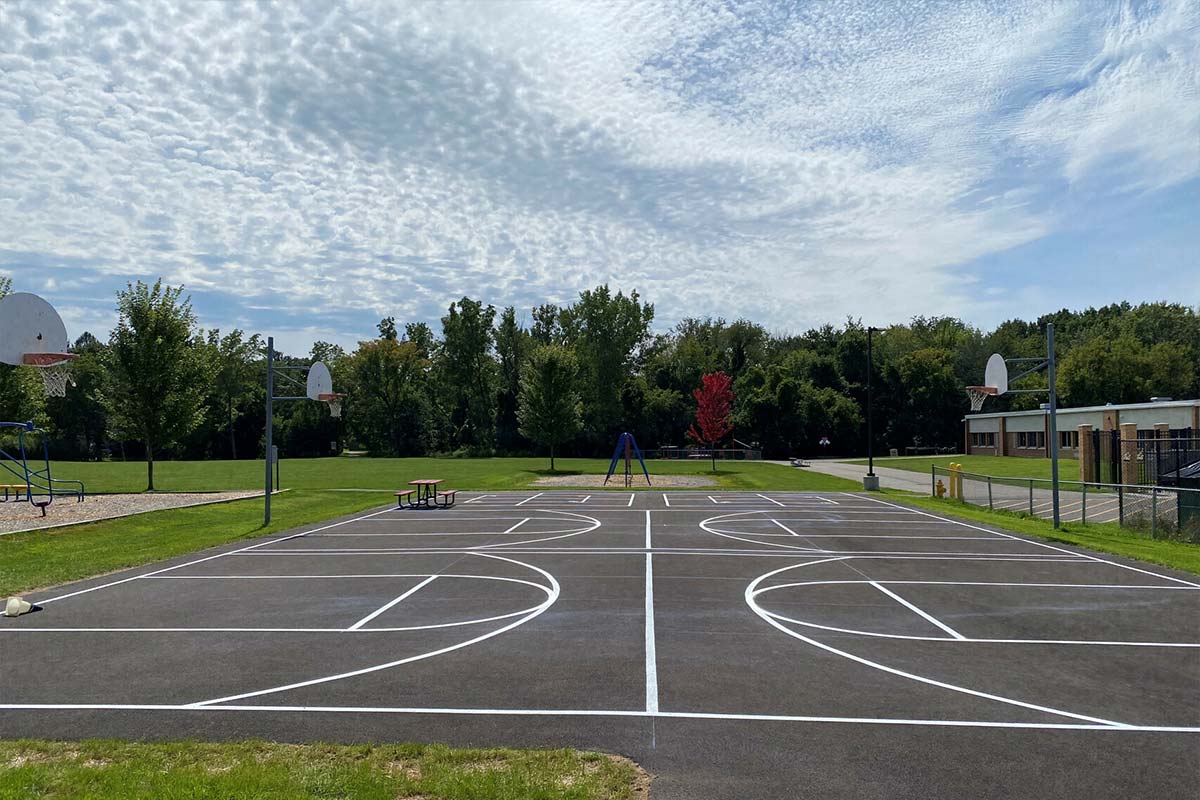
Sports Court Striping in SW Houston, TX
Court markings are what turn a slab into a place people can actually play. We lay out and paint pickleball, basketball, tennis and multi-sport courts, plus playground game markings, for commercial and institutional properties across Fort Bend, Brazoria, Harris and Galveston counties — schools, churches, apartment and HOA amenity areas, parks, community centers, corporate campuses and private clubs.
We stripe. We are a marking contractor, not a court builder or resurfacer, and the difference matters when you are deciding who to call. A court with a sound surface that has faded, or one that needs a new game added to it, is our work. A court with structural cracking, ponding or a failed coating needs resurfacing first, and lines painted over a failing surface fail with it.
Pickleball Court Striping
Pickleball is the reason most of these calls come in now. It is played on a smaller court than tennis, it is straightforward to overlay onto existing surfaces, and demand across this area has run well ahead of purpose-built facilities.
The dimensions are set by USA Pickleball and they are fixed:
A pickleball court measures 20 feet wide by 44 feet long for singles and doubles. The net is 36 inches high at the sidelines and 34 in the center. Each side has a 7-foot non-volley zone.
The non-volley zone — the kitchen — extends 7 feet from the net on each side and is the line that gets played most closely, so it is the one that has to be laid out precisely and repainted before it gets ambiguous. We mark full dedicated courts, and we overlay pickleball onto existing tennis and basketball surfaces, which is by a wide margin the most common request we get.
Basketball Court Striping
We mark full and half courts, key and free-throw areas, three-point arcs, center circles and sidelines, on outdoor slabs, school and church courts, and apartment amenity courts.
Basketball is the game with the widest legitimate variation in dimensions. A high school court, a college court, a professional court and a residential or amenity court are not the same size, and the three-point line in particular differs between them. We lay out to the standard your facility is actually playing to, which we confirm with you before marking rather than assuming — an amenity court painted to a competition dimension usually will not fit the slab it is on.
Tennis Court Striping
Tennis marking covers baselines, sidelines for singles and doubles, service lines, center service lines and marks, and the net line. Because the doubles and singles courts are nested inside one another, the layout is unforgiving: an error in one line propagates through the rest and is visible from the first game.
Most of our tennis work is refreshing lines on an existing court whose surface is still sound, and increasingly it is adding pickleball lines to a tennis court in a second color so both games can share the surface.
Multi-Sport and Shared-Use Courts
A shared court carries more than one game on one surface, and that is normal on school, church and HOA properties where one slab has to do several jobs.
The technique that makes it work is color separation and hierarchy. The primary game gets the dominant line color; the secondary game gets a clearly distinct one; and line weights and colors are chosen so a player can pick out their own court without hunting. Pickleball over tennis, pickleball over basketball, and basketball with volleyball or four square are the combinations we lay out most often here.
There is a practical limit. Past three games on one surface, the court starts to read as noise no matter how carefully the colors are chosen, and we will say so rather than paint it.
Playground Game Markings
Playground markings are painted directly onto asphalt or concrete play areas at schools, churches, daycares and parks: hopscotch, four square, kickball diamonds, running tracks, number and alphabet grids, map outlines, sorting circles and target games.
They wear differently from court markings — playground surfaces take constant foot traffic on a smaller area, and children’s play concentrates wear at exactly the points the game is played from. Refreshing them on a cycle keeps a play area looking maintained, and a faded hopscotch grid is one of the most visible signs of a tired schoolyard.
Surface, Paint, and Recoat Cycle
Court paint, not traffic paint. Court markings are painted with acrylic court coatings rather than the traffic paint used on a parking lot. Court paint is formulated for the surface texture, the color retention and the abrasion that play produces, and traffic paint on a sport surface is a shortcut that shows within a season.
Surface condition governs everything. Paint bonds to a clean, sound, dry surface; it does not bond to dust, algae, standing dirt or a coating that is already delaminating. Courts under tree cover in this climate grow algae quickly and need washing before marking.
Climate shortens the cycle here. Outdoor markings in this region live a shorter life than in dry climates. Sustained heat, high UV, heavy rainfall and humidity all work against a coating, and courts in constant use fade at the play lines first. Planning a refresh on a cycle costs less than waiting until the lines are being argued over.
For a full list of our pavement marking services, visit our parking lot striping in SW Houston page.
Businesses We Serve




How it Works

GET A FREE ESTIMATE
Contact us today and we’ll have a quote to you in 24 hours

SCHEDULE AN INSTALLATION
We’ll have your play space restriped in less than 7 days, without affecting your playtime

GET A PARKING LOT THAT POPS
For a budget-friendly price, you’ll get a parking lot that looks like new
We proudly work with:


We proudly work with:


Frequently Asked Questions About Sports Court Striping in SW Houston, TX
What size is a pickleball court?
A pickleball court is 20 feet wide by 44 feet long, and that is the same for singles and doubles. The net stands 36 inches high at the sidelines and 34 inches at the center, and each side carries a 7-foot non-volley zone — the kitchen — measured from the net. Those figures come from USA Pickleball. It is the one fully dimensioned specification we publish on this page, because it is the one we can source directly to the governing body.
Can one surface carry both pickleball and basketball lines?
Yes, and it is one of the most common shared-use layouts we mark. The technique is color hierarchy: the primary game takes the dominant line color and the secondary game a clearly distinct one, so players can read their own court at a glance. Pickleball over tennis and pickleball over basketball both work well. Beyond about three games on a single slab the surface starts reading as visual noise, and we will tell you that rather than paint it.
What paint is used on an outdoor sports court?
Acrylic court coatings, not the traffic paint used for parking lots. Court products are formulated for the surface texture, color retention and abrasion that play produces, and traffic paint on a sport surface shows its age within a season. The surface has to be clean, sound and dry before anything is applied — sports court striping over dust, algae or a delaminating coating bonds to the contamination rather than the court, and it lifts with it.
Do you stripe playground games?
Yes. We paint hopscotch, four square, kickball diamonds, running tracks, number and alphabet grids, map outlines and target games directly onto asphalt and concrete play areas at schools, churches, daycares and parks. They wear faster than court lines because foot traffic concentrates on a small area at the exact points the game is played from, so most playground markings benefit from a shorter refresh cycle than an adjacent court would need.
How long does court striping last outdoors on the Gulf Coast?
Shorter than in a dry climate, and the variables are sun, use and drainage rather than age alone. Sustained heat, high UV, heavy rainfall and humidity all degrade an outdoor coating, and lines fade first where play concentrates — baselines, service lines and the non-volley zone. A lightly used amenity court holds up well; a school or club court in daily use needs refreshing sooner. Courts under tree cover also grow algae, which shortens the interval further.
Do you resurface or build courts?
No. We are a marking contractor: we lay out and paint lines on sound existing surfaces, and we do not build courts or resurface them. If your court has structural cracking, ponding after rain, or a coating that is peeling or delaminating, it needs resurfacing by a court builder before any marking is worth doing — lines painted over a failing surface fail with it. Once the surface is sound, sports court striping is exactly what we do.