
Bollard Installation
In SW Houston, TX
Safety and Security Bollards
1-800-STRIPER provides professional bollard installation in SW Houston, TX — setting concrete-filled steel safety bollards, security bollards, and protective posts at storefronts, loading docks, and utility equipment on commercial properties across Fort Bend, Brazoria, Harris, and Galveston counties.
1-800-STRIPER of SW Houston PROVIDes Bollard Installation Services NEAR YOU
Want to prevent accidents and protect your property?
Bollards provide physical protection for your customers and your property.
Safety and security:
Bollards create a physical barrier between vehicles and pedestrians, protecting people in walking areas from accidental or intentional vehicle intrusions.
Bollards act as a protective barrier around storefronts, gas stations, and other vulnerable areas, minimizing the risk of costly damage from vehicle impacts.
Strategic Placement Locations:
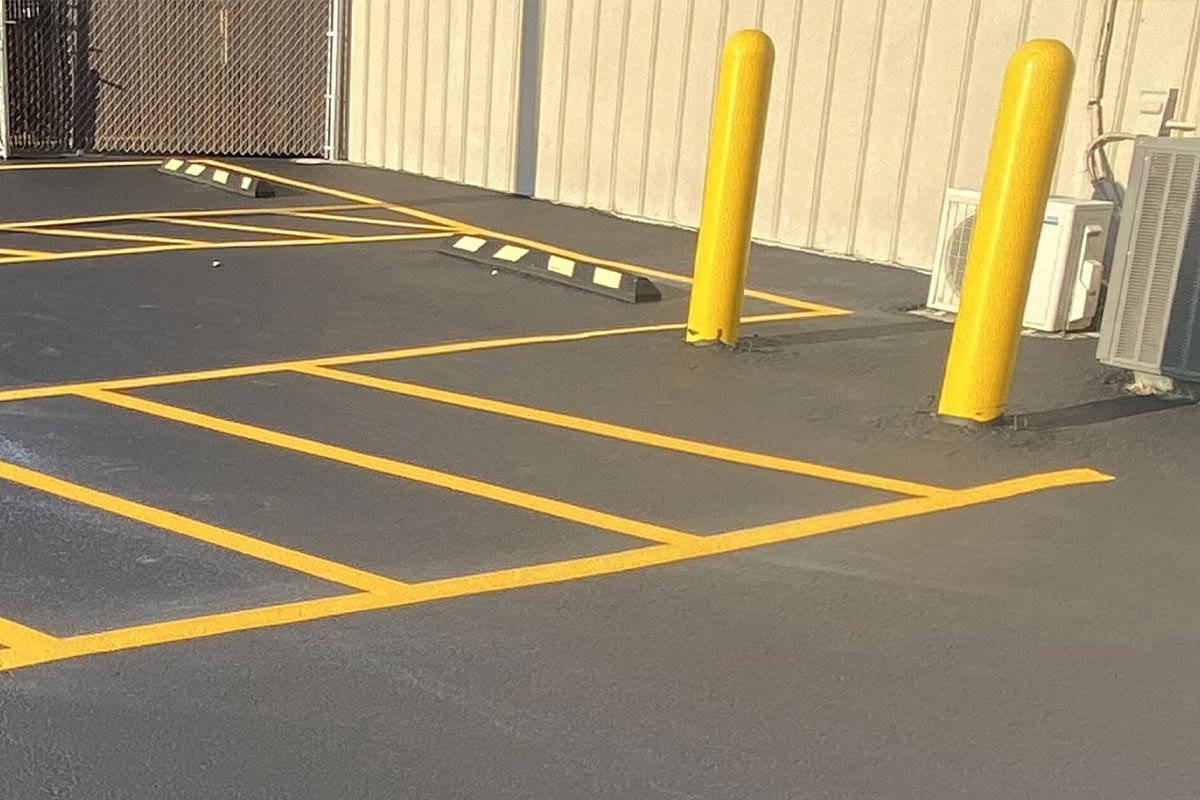
Bollard Installation in SW Houston, TX
A bollard is a short vertical post set into the ground to stop a vehicle reaching something behind it. On commercial property that something is usually a storefront, a person, a gas meter, an electrical cabinet, a dock door or a fuel dispenser.
We install permanent bollards on commercial properties across Fort Bend, Brazoria, Harris and Galveston counties — retail and restaurant frontages, warehouse and distribution docks, medical and office buildings, multifamily communities, and industrial sites protecting utility and process equipment. The work covers layout, core drilling or excavation, setting and concrete, filling and capping, and finishing.
Safety Bollards and Security Bollards — the Difference That Matters
The words get used interchangeably and they describe different design intents.
A safety bollard protects equipment and people from ordinary, low-speed accidents: a delivery van backing into a dock frame, a driver misjudging a parking stall in front of a glass storefront, a forklift clipping a rack upright. Impacts are slow and the goal is to absorb or deflect them.
A security bollard is specified against deliberate or high-energy vehicle impact. It is engineered: foundation depth, post diameter, wall thickness, reinforcement and concrete are designed as a system against a stated threat.
The distinction matters because it decides the foundation, and the foundation is most of the cost and nearly all of the performance. A post that looks identical above grade can be either one. Anyone selling you a bollard without asking what it is protecting against is selling you a post.
Where Bollards Go: Storefronts, Loading Docks, and Utility Equipment
The common positions on commercial property are consistent across our service area:
- Storefronts and glazing, particularly where a parking stall faces the building directly — the classic storefront strike.
- Loading docks and overhead doors, protecting door frames, tracks, levelers and the wall itself from backing damage.
- Utility and mechanical equipment — gas meters, transformers, electrical cabinets, backflow preventers, HVAC units and fire risers. Some of these are protected because a utility or the fire code official requires it.
- Fuel dispensers, air and vacuum stations, and propane cages.
- Drive-through lanes and pickup canopies, protecting posts and structure at the point vehicles turn.
- Pedestrian areas — outdoor seating, walkway ends and entry plazas where vehicles come close to people.
- Interior applications in warehouses: rack ends, column guards and equipment protection along forklift routes.
Concrete-Filled Steel Pipe Bollards
The standard permanent installation is a steel pipe set in a concrete footing and filled with concrete.
The pipe is set into an excavated or core-drilled hole, plumbed, and cast into a footing sized to the application; once cured, the pipe is filled with concrete and capped or domed so water sheds rather than collects. The exposed post is then primed and painted, most often safety yellow where visibility is the point, or fitted with a sleeve.
The variables that decide performance are embedment depth, footing diameter, pipe diameter and pipe wall thickness. Those are chosen for the location and the intent, and shallow embedment is the most common shortcut. A bollard set too shallow does not stand up to the impact it was installed to take; it levers out of the ground and takes a section of pavement with it.
Removable and Retractable Bollards
Some openings need protection most of the time and clear access occasionally: fire lane entries, service drives, loading areas used a few times a week, plaza edges opened for events or deliveries.
A removable bollard sits in a permanent ground sleeve and lifts out, usually locking into place. A retractable bollard drops into a below-grade housing and comes back up without being carried anywhere.
Both need the same thing to work in five years that they needed on day one: drainage. A sleeve or housing that fills with silt and standing water becomes a bollard that will not move, and on the Gulf Coast that happens faster than anywhere dry. We set them so water drains and so the mechanism stays serviceable.
Bollard Covers and Sleeves
A plastic or stainless sleeve slips over an existing pipe bollard. It is a finish and a maintenance decision rather than a structural one. The sleeve adds no impact resistance; it keeps the post looking maintained without repainting and can carry a color that suits a storefront rather than a warehouse.
Covers are worth it on customer-facing frontages, where a chipped, rust-streaked yellow post reads as neglect. They are usually not worth it at a dock, where the post will be hit and repainting is simpler.
Crash Ratings and What They Actually Mean
A crash rating is a performance classification established by testing a barrier against a vehicle of stated mass at stated speed and measuring how far the vehicle penetrates. The two standards you will see named are ASTM F3016, which covers low-speed vehicle security barriers of the kind relevant to storefront protection, and ASTM F2656, which covers high-speed vehicle impact testing for perimeter security.
Two things are worth being straight about. First, a crash rating is normally a design and risk decision, not a code requirement for a typical commercial storefront or dock. Ordinary properties specify bollards for protection, not certification. Where a rating is genuinely required it is because a tenant, an insurer, a utility, a corporate standard or a specific security assessment requires it.
Second, a rating belongs to a tested system — the post, the foundation, the anchoring, installed as tested. We do not represent that any bollard we install carries a crash rating. Where your project genuinely needs rated protection, that is a specified, engineered product and it should be procured and installed as one.
Layout, Spacing, and the Accessible Route
Spacing is set by what is being protected and by what has to pass between the posts. Bollards need to be close enough that a vehicle cannot pass between them, and far enough apart that pedestrians, carts, wheelchairs and hand trucks can.
That second constraint is the one with a fixed number behind it. Where bollards sit along or across an accessible route, the route’s clear width still governs. Under §403.5.1 of the 2010 ADA Standards for Accessible Design:
…the clear width of walking surfaces shall be 36 inches (915 mm) minimum. EXCEPTION: The clear width shall be permitted to be reduced to 32 inches (815 mm) minimum for a length of 24 inches (610 mm) maximum provided that reduced width segments are separated by segments that are 48 inches (1220 mm) long minimum and 36 inches (915 mm) wide minimum.
So a bollard layout that pinches an accessible route below that clear width creates an accessibility problem while solving a protection one. We lay out spacing against both requirements before anything is drilled.
For a full list of our pavement marking services, visit our parking lot striping in SW Houston page.
Businesses We Serve




How it Works

GET A FREE ESTIMATE
Contact us today and we’ll have a quote to you in 24 hours

SCHEDULE AN INSTALLATION
We’ll have your installation scheduled in less than 7 days, without affecting your business hours

GET A PARKING LOT THAT POPS
For a budget-friendly price, you’ll get a parking lot that looks like new
We proudly work with:


We proudly work with:


Frequently Asked Questions About Bollard Installation in SW Houston, TX
What is the difference between a safety bollard and a security bollard?
Design intent, and therefore foundation. A safety bollard protects equipment and people from ordinary low-speed accidents — a van backing into a dock frame, a car nosing into a storefront. A security bollard is engineered against deliberate or high-energy impact, with foundation depth, pipe size and reinforcement designed as a system against a stated threat. The posts can look identical above ground, which is why bollard installation starts with what you are protecting against rather than with the post itself.
Do bollards have to be crash-rated?
For a typical commercial storefront or loading dock, no. A crash rating is a performance classification from testing under standards such as ASTM F3016 for low-speed barriers or ASTM F2656 for high-speed impact, and it is normally a design and risk decision rather than a code requirement. Ratings get required by a tenant, an insurer, a corporate standard or a security assessment. A rating also belongs to a complete tested system — post, foundation and anchoring installed as tested — not to a pipe.
How far apart should bollards be spaced?
Close enough that a vehicle cannot pass between them, and open enough for people. Where posts sit along or across an accessible route, the 2010 ADA Standards fix the lower bound: a clear width of 36 inches minimum, reducible to 32 inches for a maximum length of 24 inches provided the narrow segments are separated by wider ones. Beyond that, spacing follows what you are protecting — a glazed frontage, a dock door, a utility cabinet — and each has a different geometry.
Can bollards be removable?
Yes. Removable bollards sit in a permanent ground sleeve and lift out, usually with a lock; retractable ones drop into a below-grade housing and rise again without being carried off. They suit fire lane entries, service drives and event openings that need protection most of the time and clear access occasionally. The thing that decides whether they still work in five years is drainage: a sleeve that fills with silt and standing water seizes, and Gulf Coast rainfall makes that a fast failure.
Can bollards be installed in existing concrete?
Yes. On an existing slab or paved area we core drill through the surface, excavate the footing below, set and plumb the post, and cast it in — then fill and cap the pipe and finish the surface around it. The work is routine on established properties, and it is how most storefront, dock and utility protection gets added to a lot that is already built. Existing utilities are located before drilling, which is the step that cannot be skipped.
Do you rent bollards or temporary vehicle barriers?
No. We install permanent bollards, set in concrete footings as a lasting part of your property, and we do not offer rental or temporary vehicle barrier hire. If you need short-term barriers for an event or a construction phase, that is a rental specialist’s trade rather than ours. What we can help with instead is temporary striping and layout for event and overflow parking, and permanent bollard installation where the protection needs to stay.